
 KOR
KOR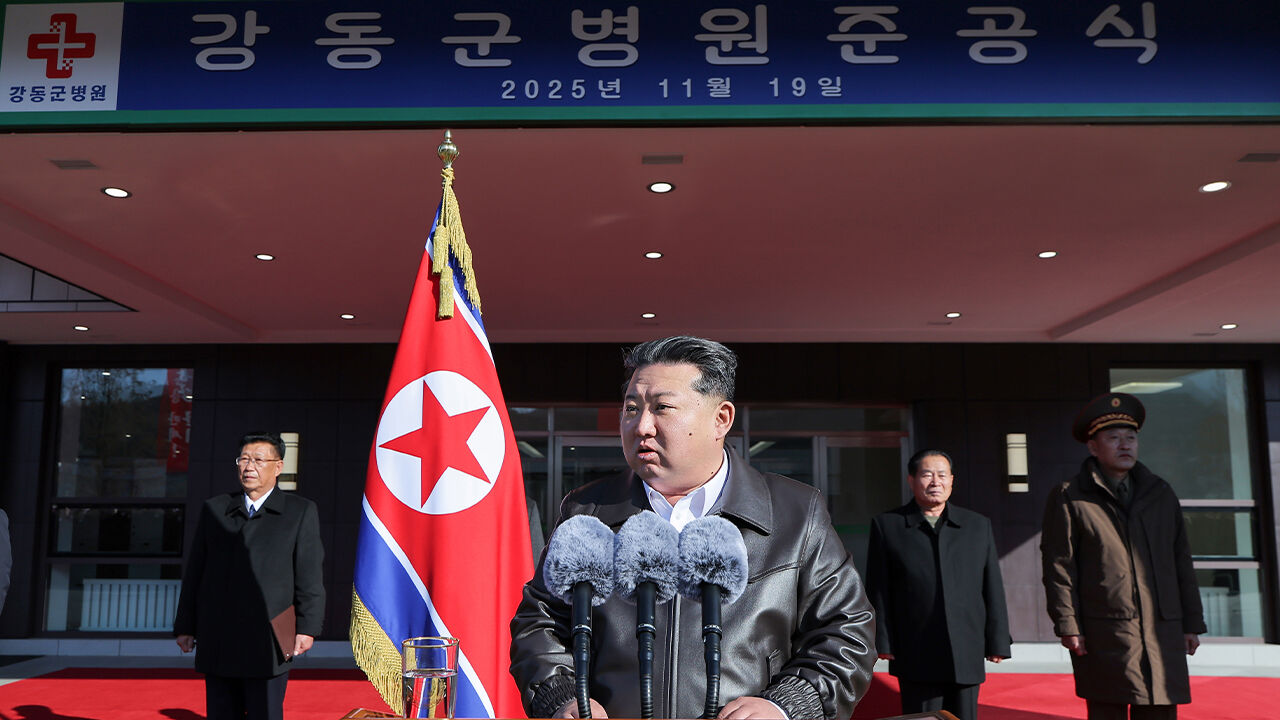
▲ North Korean leader Kim Jong Un delivers a commemorative speech while attending the completion ceremony of Kangdong County Hospital on the outskirts of Pyongyang
As the South Korean government pursues a medical aid project for North Korea, it has been confirmed that the aid items consist not of medical consumables, but of some 1,400 pieces of medical equipment and supplies, including X-ray machines.
According to data submitted today (September 20) by the Ministry of Unification to Representative Kim Dae-sik of the People Power Party, a member of the National Assembly's Foreign Affairs and Unification Committee, the government plans to send 1,431 items across 166 types of medical equipment necessary for diagnosis, surgery, and treatment to Kangdong County Hospital in Pyongyang as part of its "Healthcare Cooperation Package" project to assist in modernizing North Korea's regional hospitals.
These include diagnostic tools such as X-ray machines, stethoscopes, and blood pressure monitors; surgical items such as operating tables and shadowless surgical lights; and treatment devices such as defibrillators (devices that restart the heart through electrical shocks) and ventilators.
The Ministry of Unification explained, "We selected 166 types of essential medical equipment in cooperation with the Korea Foundation for International Healthcare," adding, "We took into account the opinions of healthcare experts regarding essential medical devices and supplies used across various medical departments in domestic hospitals."
The ministry further noted that the list is "a proposed plan that requires consultation with the North Korean side," stating, "Manufacturers and models have not been finalized, and specific items and unit prices may change during consultations with North Korea and the procurement process."
The total estimated cost reported to the National Assembly is 6.75 million U.S. dollars, or approximately 9.3 billion won.
However, amid suspended direct communication between the two Koreas, the South Korean government has yet to confirm North Korea's position.
It only obtained sanctions exemptions for humanitarian medical equipment aid this past May from the UN Security Council Sanctions Committee on North Korea.
Should North Korea signal its willingness to accept the aid in the future, the composition of the items is expected to be subject to change through consultations.
Nonetheless, concerns have been raised in some quarters that the current list of aid items is inappropriate.
Specifically, Representative Park Choong-kwon of the People Power Party, an alumnus of North Korea's Kim Jong Un National Defense University, has raised the possibility that high-tech medical equipment could be diverted for North Korean military purposes.
For example, even if North Korea does not dismantle the X-ray equipment to directly manufacture lethal weapons, the equipment could be repurposed into inspection gear to detect defects in weaponry rather than being utilized for its original purpose in hospitals.
During a plenary session of the Foreign Affairs and Unification Committee on September 17, Rep. Park argued, "Kangdong County in Pyongyang, where the medical equipment is slated to be sent, is home to the Second Economic Committee, the control tower of North Korea's defense industry.
The Ninth General Bureau under the Second Economic Committee oversees the development and production of biochemical weapons," claiming that "some of the 166 types of medical devices being sent could be diverted to the development and production of biochemical weapons."
On the other hand, the South Korean government maintains that medical equipment aid is urgently needed on humanitarian grounds, given North Korea's poor healthcare environment.
Unification Minister Chung Dong-young recently said at a committee meeting, "Criticizing North Korea's nuclear and military policies should not be tied to treating the illnesses of its people."
Shin Young-jeon, a professor at Hanyang University College of Medicine and an expert on North Korean healthcare, also remarked, "Demanding an immediate verification of how medical equipment is actually used in hospitals while inter-Korean relations are strained is tantamount to saying we should not provide aid at all; we need to approach this step by step."
Representative Kim Dae-sik stated, "The National Assembly will thoroughly scrutinize the implementation process and budget execution of the project to ensure that not a single penny of taxpayers' money is spent on inter-Korean aid lacking a clear basis or on a unilateral, subservient North Korea policy."
(Photo: Korean Central News Agency, Yonhap News)
※ Please note: This article was translated by AI and may contain errors.




 Video News

 Video News