
 KOR
KOR
(Part 1) The 38 Billion Won Wildfire Helicopter: Was It a Used U.S. Military Aircraft?
(Part 2) Did They Just Take the Contractor's Word? Was the Contract Modification Justified?
(Part 3) The Core of the Shaky 320 Billion Won Contract Is 'Certification'—Can It Be Obtained?
(Part 4) Unclear Military Accident Records: Is It Safe to Proceed with the Project?
(Part 5) Korea Forest Service Claims 'National Interest,' but Ready to Scuttle Project If It Fails?
Fewer Fires, but 15 Times More Burned Land
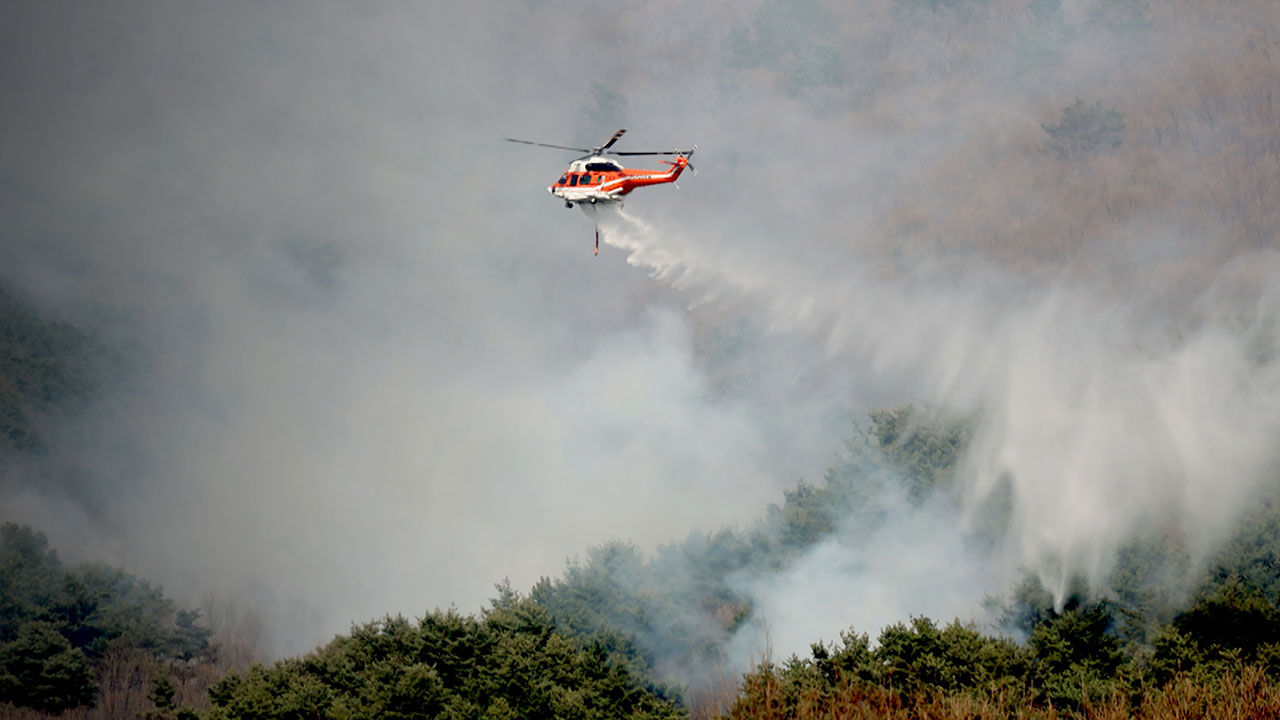
The reporting team conducted an exhaustive analysis of daily wildfire statistics released by the Korea Forest Service and wildfire incident logs from the National Wildfire Information System. We examined 5,291 incidents from 2016 to 2025, alongside 2,211 incidents recorded in the National Wildfire Information System since 2021.
What stands out first is that the number of wildfires themselves has not increased. Over the five-year period from 2016 to 2020, an annual average of 570 wildfires occurred. From 2021 to 2025, the annual average was 488. It actually decreased by 14%.
However, the burned area tells the opposite story. While the annual average damaged area in the first five years was 1,785 hectares, it rose to 27,157 hectares in the latter five years—a 15.2-fold increase.
Large wildfires spreading over 100 hectares also rose from an annual average of 2.2 cases to 5.4 cases. There were 11 cases in 2022, 8 in 2023, and 6 in 2025.
The pattern where just one or two blazes account for most of a year's total damaged area has become even more pronounced. In 2022, of the total 24,797 hectares burned, 16,302 hectares—or 66%—came from a single fire that started in Uljin. In 2025, out of 105,099 hectares damaged, 99,289 hectares—or 94%—stemmed from a single blaze that began in Uiseong.
Wildfires have not become more frequent; rather, once ignited, they become uncontrollably massive. This explains why firefighting resources capable of dumping massive amounts of water in the initial stages are essential.
Wildfires Also Break Out at Night
The reporting team tallied wildfires with recorded ignition times by year using the National Wildfire Information System. Following the Korea Forest Service's official statistical criteria, fires breaking out between 7:00 p.m. and 5:00 a.m. the following day were classified as nighttime fires.
From January 1 to September 17 this year, 422 wildfires broke out, 78 of which started at night. During the same period last year, there were 39 nighttime fires out of 394 total. Nighttime wildfires have exactly doubled. Their share of the total also jumped from 9.9% to 18.5%.
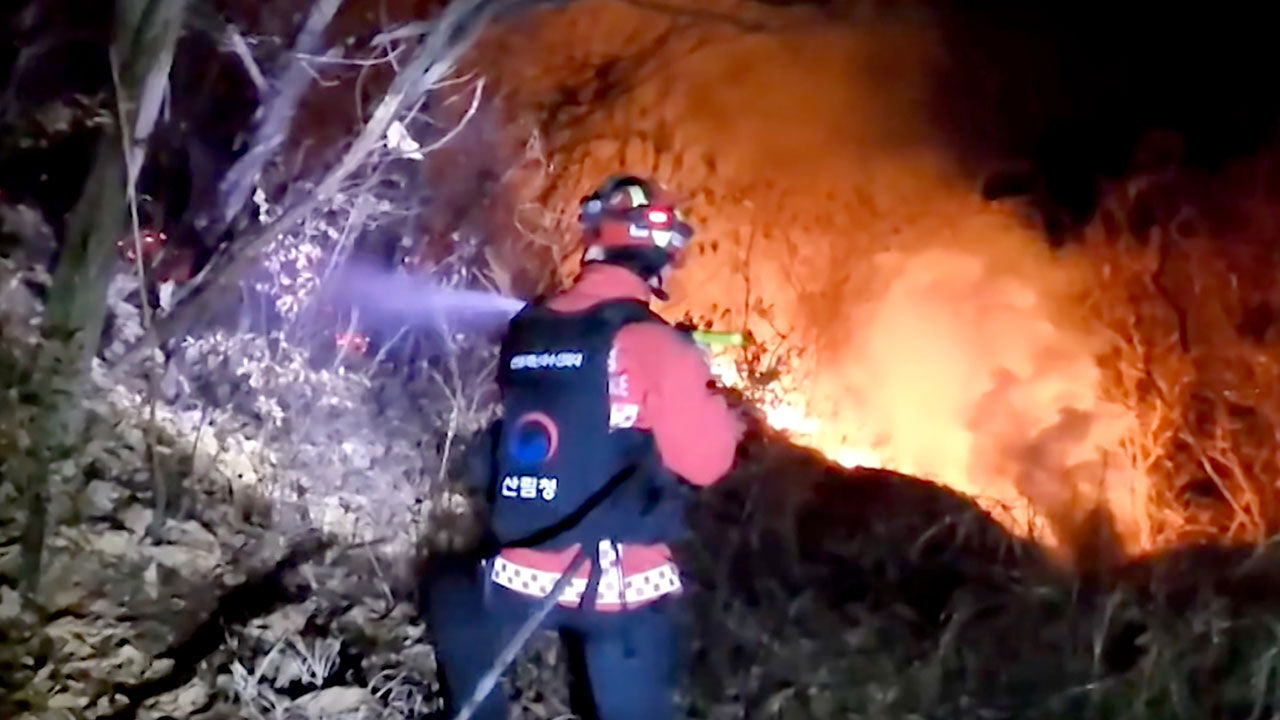
Yet, the Korea Forest Service has never scrambled helicopters at night.
An exhaustive analysis of 12 years of deployment records—totaling 12,763 missions across all 63 helicopters of the Korea Forest Service, obtained through an information disclosure request—revealed that not a single helicopter ever made an initial takeoff after sunset. There were only 10 instances where helicopters deployed during the day continued suppression operations into the night.
The Forest Aviation Headquarters acknowledges this. An official stated, "None of our aircraft have ever engaged in nighttime wildfire suppression. While the Surion has taken off at night a few times for filming purposes, it has never performed firefighting operations."
In response, the Korea Forest Service recently announced plans to deploy three Surion and four S-64 helicopters at night starting this autumn wildfire season.
21,000 Liters of Water Have Vanished?
The reason heavy helicopters are needed lies in their water-carrying capacity. While the domestically produced Surion is rated at the 2,000-liter class in specifications, the Forest Aviation Headquarters explained that after fueling up for flight, the amount of water it can actually carry is around 1,200 to 1,500 liters. In contrast, the super-large helicopters contracted this time can carry up to 10,000 liters, typically transporting 6,000 to 7,000 liters.
The Forest Aviation Headquarters stated, "Everyone acknowledges that for massive wildfires like these in the future, 10,000-liter class Chinooks are necessary. But the issue lies in matters such as certification."
There is no dispute that super-large helicopters are necessary. The question is how to procure them.
The U.S. Forest Service Doesn't Buy a Single Helicopter
According to data from the U.S. Forest Service, the agency operated 304 helicopters in 2023. Not a single one was owned by the agency. Eighty-two were chartered through exclusive-use contracts, and 222 were contracted with private companies on a call-when-needed basis.
In Australia, the states operate the National Aerial Firefighting Centre (NAFC). A 2020 Royal Commission report noted about this entity that "NAFC does not directly own or operate any aircraft." Instead, it contracts about 150 aircraft by aggregating state requirements and procuring them collectively from the market. The same report explained the rationale: "It is neither practical, reasonable, nor cost-effective for any single state to maintain all the specialized aviation assets it requires."
When Canada established its first national wildfire aviation fleet this year, allocating 316.7 million Canadian dollars over five years, it secured 10 aircraft by contracting with three private companies rather than purchasing the aircraft outright.
What Police Helicopters Have and Firefighting Helicopters Lack
When the reporting team reviewed relevant laws and regulations, such mechanisms already existed. However, the Korea Forest Service is excluded from their scope.
Article 2-2 of the Act on Flight Safety Certification of Military Aircraft stipulates, "The provisions concerning airworthiness certification under this Act shall apply mutatis mutandis to aircraft for police and customs use as prescribed by Presidential Decree." Article 2 of the Enforcement Decree of the same Act defines the eligible aircraft as those used by the National Police Agency, the Korea Coast Guard, and the Korea Customs Service.
In other words, police and coast guard helicopters receive airworthiness certification from the Defense Acquisition Program Administration (DAPA) based on the same standards as military aircraft. A legislative precedent already exists for applying the military certification system to aircraft of non-defense agencies. Yet, the Korea Forest Service and the National Fire Agency are not included in that enforcement decree.
Korea Forest Service helicopters are categorized as "aircraft of state agencies, etc." under the Aviation Safety Act and fall under the jurisdiction of the Ministry of Land, Infrastructure and Transport (MOLIT). However, the Aviation Safety Act contains no procedure for MOLIT to conduct prior reviews or consultations at the aircraft introduction stage. Both type certificates and airworthiness certificates operate on an ex-post, application-based principle, initiated only when "the person seeking to obtain" them submits an application.
The same is true on the procurement side. Article 24 of the Government Procurement Act limits the scope under which the Public Procurement Service can act as an agent for demanding agencies' procurement operations to software projects and construction works. There is no legal basis to handle the procurement of aircraft, which are classified as general goods.
What If It Were Entrusted to DAPA?
There is no statutory basis in that law. The "military supplies" defined by law are goods acquired for use and management by the Ministry of National Defense and the armed forces, and the delegation and entrustment under Article 61 only specifies a downward direction—from the Minister of National Defense to the Minister of DAPA, and from the Minister of DAPA to the Agency for Defense Development and the Defense Agency for Technology and Quality.
However, another channel exists. Article 6, Paragraph 3 of the Act on Contracts to Which the State Is a Party provides, "The head of each central government agency may entrust affairs related to contracts under their jurisdiction to another agency as prescribed by Presidential Decree." Under Article 5 of the Enforcement Decree of the same Act, they simply need to obtain the consent of the head of the counterpart agency and notify the Board of Audit and Inspection.
We examined which provisions would have applied if this project had fallen under the framework of the Defense Acquisition Program Act.
Article 46-5 of the Defense Acquisition Program Act establishes that "original defense acquisition contracts cannot, in principle, be modified." The Korea Forest Service changed the aircraft model, delivery deadline, and contract amount all at once in October last year. Article 46-4 mandates that liquidated damages for delay "shall be imposed" on a contracting party that delays performance without justifiable grounds, enumerating limited grounds for reduction or exemption. The Korea Forest Service extended the delivery deadline by one year and six months, effectively exempting the contractor from being subject to damages. Article 21 sets the principle that procurement test evaluations must be conducted as "test evaluations using actual physical items." Article 14-2 mandates a project feasibility study before embarking on large-scale procurement projects and even specifies the executing institutions in the law. In its response to the National Assembly, the Korea Forest Service wrote, "No separate verification procedure was conducted to assess whether all domestic and overseas certification processes could be completed by the end of 2025." Article 12 provides for an integrated program management system, where specialized personnel in charge of model selection, negotiation, quality assurance, and technical management are integrated to oversee the entire project lifecycle.
Moreover, there is not a single corresponding mandatory provision in the State Contract Act system.
This is the basis on which the Korea Forest Service claims there is "no legal issue" with altering the contract and extending the delivery deadline. In fact, the head of the Forest Aviation Headquarters explained to the reporting team that they received legal counsel from a law firm based on Article 65 of the Enforcement Decree of the State Contract Act and Article 57 of the Public Procurement Service's Regulations on Handling Foreign Supplies Operations. However, our reporting confirmed that this was only possible because the oversight mechanisms governing this project were loose to begin with.
What Are the Alternatives?
First is the procurement method. The practice of purchasing aircraft that take three to five years to deliver one by one under single-year annual budgets is no longer sustainable. A multi-year acquisition system—such as the "certain number of aircraft over 10 years" requested by the head of the Forest Aviation Headquarters to the Ministry of Economy and Finance—is the starting point. The defense sector already has mid-term plans and multi-year contracting systems in place.
Second is the procurement entity. Aircraft procurement is an undertaking where model selection, test evaluation, standardization, airworthiness certification, and contract performance oversight must function as a cohesive whole. There is no reason why the Korea Forest Service should handle all of this on its own. Precedents already exist where DAPA handles airworthiness certification for police and coast guard aircraft, and legal pathways to entrust contract affairs to other agencies are already established. It is merely a matter of amending a single line in the enforcement decree.
Third is whether to own. The common conclusion reached by the United States, Australia, Canada, and the European Union was to contract for availability rather than purchasing heavy firefighting aircraft. However, as the Australian Royal Commission pointed out that relying on foreign aircraft poses a "sovereign risk," the contracting model also has drawbacks. In its 2023 report, the U.S. Wildland Fire Mitigation and Management Commission recommended that "a national strategy should consider all ownership models, including contracting and government ownership," noting that a cost comparison between government ownership and private contracting had not yet been conducted. This was not a conclusion that one is cheaper, but a recommendation to compare them first.
We have never conducted such a comparison.
Wildfires have not grown more frequent, but once ignited, they spread massively, and now they break out even at night. No one disputes that equipment is needed to stand against them. What this project leaves behind is not the question of whether equipment is necessary, but whether we have the system in place to properly secure what is needed.
※ Please note: This article was translated by AI and may contain errors.




 Video News
 Video News
 Video News