
 KOR
KOR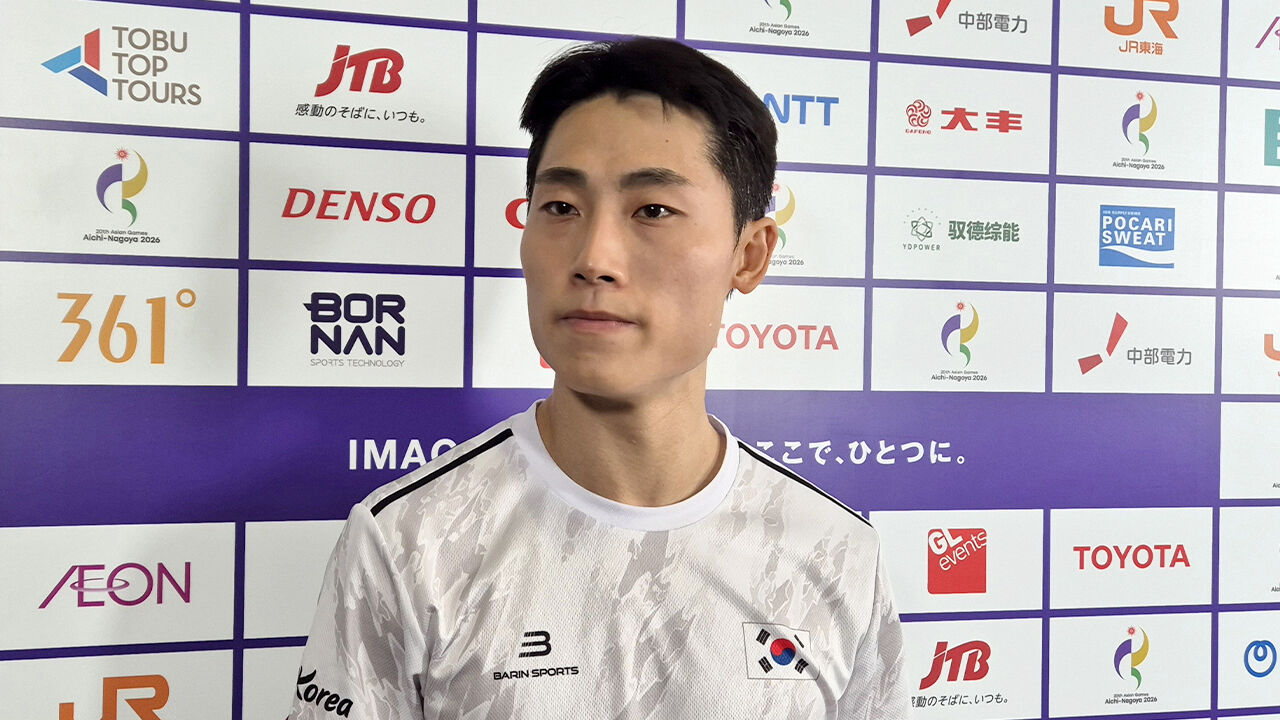
▲ Lee Joon-seok is interviewed after winning the men's singles teqball semifinal at the 2026 Aichi-Nagoya Asian Games at the Higashi Sports Center in Nagoya, Japan, on the 19th.
"The hardest part was worrying about the future."
After securing the first-ever Asian Games medal in South Korean teqball history, Lee Joon-seok shared these words following his victory in the men's singles teqball semifinal at the 2026 Aichi-Nagoya Asian Games held at the Higashi Sports Center in Nagoya, Japan, today (19th), secured when Zaid Eidan of Kuwait retired due to an injury.
Having given up his livelihood in pursuit of the dream of winning an Asian Games medal in South Korea, a barren wasteland for teqball, Lee said, "Through today's match, I have found hope that I can continue my career as an athlete. I want to win the gold medal in tomorrow's final to spread the word about teqball and create a foundation where our athletes can continue their careers without worries."
Teqball is a sport played by hitting a football back and forth across a curved, specially designed table, and was devised in Hungary in 2012.
It drew attention as football players primarily enjoyed it for training purposes, and it began to establish itself as a professional sport with the founding of the International Teqball Federation in 2017.
Domestically, the Korea Teqball Association was established in 2018, and athletes often work as teqball players while balancing a livelihood, mostly coming from football or jokgu backgrounds.
Lee Joon-seok, the ace of South Korean teqball, also played as a football player in the K4 League until he was 21, went through jokgu, and then entered teqball.
Working as a contract production worker at a large corporation, he heard the news in February of this year that teqball had belatedly been adopted as an official Asian Games event, prompting him to give up his livelihood and immerse himself in training.
He said, "Because teqball was included as an official event belatedly, we couldn't enter the Jincheon National Training Center like athletes in other sports and instead trained with national team members outside. We focused on training from morning till evening every day without a day off even in poor conditions, and I am glad to see that bear fruit."
He continued, "The hardest part during training was the fear that if I didn't win a medal, I wouldn't be able to promote teqball and my path forward in life would be bleak. I approached this competition with the mindset of reaching at least the final, and every night I dreamed of playing in the final match. I feel like I've achieved that dream."
On this day, his mother, Yoon Soon-jung, and his older sister visited the venue to cheer Lee on.
He introduced, "When I was playing football, I told my family not to come because their presence would make me nervous. But this competition felt like a stage that would be difficult to experience again in my life, so I asked my family to come."
He added, "Recalling my early twenties when things were economically difficult, I mustered the courage to transition into a teqball player and asked my mother for help, saying, 'I want to play teqball.' Despite our meager household finances, she scraped together money to buy me a teqball table worth 2 million won. I remember those times a lot. I am especially glad because it feels like I've done a filial duty for my mom."
Having secured at least a silver medal, Lee now aims for the gold in the final taking place on the 20th.
His opponent is Iraq's powerhouse Ali Jalil Mezher Al-Eabi.
Lee resolved, "Al-Eabi is a player considered a favorite to win, and while I have never faced him in singles, he is a player I know well. Like today's match, I will immerse myself crazily and secure the victory."
Meanwhile, after finishing the first set 12-10, Lee won the match during the second set when his opponent Eidan retired due to a left thigh muscle injury.
Lee, who had been shouting loudly and celebrating every scoring moment throughout the match, left the court without showing signs of joy when Eidan was unable to get up.
He then approached Eidan, who was exiting in a wheelchair, bowed his waist, shook his hand, and comforted him.
Lee said, "That player must have also participated with big dreams. I advanced to the final of my dreams, but in that situation, I felt a sense of regret."
(Photo: Yonhap News)
※ Please note: This article was translated by AI and may contain errors.


 Video News
 Video News

 Video News
