
 KOR
KOR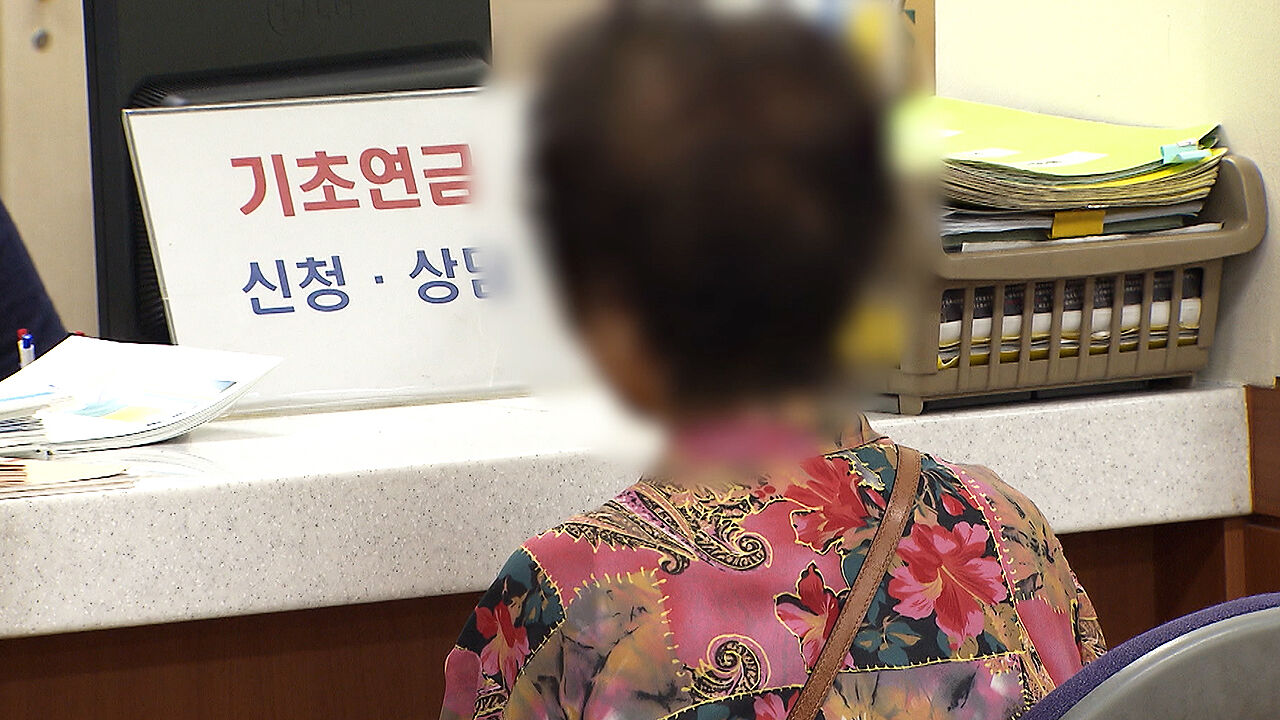
▲ Elderly Basic Pension
With the relative poverty rate among adults aged 65 and older reaching 35.9%, a state-run research institute has suggested that the basic pension—currently paid uniformly to the bottom 70% of earners—should be reformed to provide differential support based on income levels to alleviate elderly poverty.
The recommendation calls for establishing a customized support system tailored to income and health conditions by providing a thicker safety net of basic pensions for low-income seniors while linking them with elderly job programs, earned income tax credits, medical care, and social care services.
Kim Tae-wan, a senior research fellow, and Han Su-jin, a researcher at the Korea Institute for Health and Social Affairs, proposed this policy direction in a report titled "Policy Linkage Measures for Improving Elderly Poverty," published in the September 2026 issue of the Health and Welfare Forum.
According to the report, the relative poverty rate for those aged 65 and older stood at 35.9% in 2024, more than double the average for all households at 15.3%.
This means that roughly one out of every three elderly individuals earns less than half of the median income level.
Breaking it down by specific brackets, those in extreme poverty struggling for their daily meals—defined as having an income at or below 30% of the median—accounted for 14.2%, those between 30% and under 40% accounted for 11.9%, and those standing right on the threshold of escaping poverty between 40% and under 50% of the median stood at 9.8%.
The research team paid special attention to the 9.8% of seniors hovering just below the poverty line.
As of 2024, the median shortage needed for these individuals to cross the monthly poverty line of 1.639 million won was only 177,000 won per month.
Because adding a relatively small amount can immediately lift them out of poverty, this group has been identified as a core bracket that can lower the elderly poverty rate the fastest with limited national financial resources.
However, the current basic pension structure pays a similar level of benefits to seniors in the bottom 70% of income, creating little difference in support based on the degree of poverty.
The research team suggested that limited financial resources need to be reorganized into a progressive approach that concentrates more support on seniors experiencing severe poverty.
The researchers also emphasized the need for a phased approach that systematically combines the basic pension, job programs, and welfare systems according to the economic circumstances of the elderly.
For extremely impoverished seniors who struggle to make ends meet day by day, national livelihood subsidies under the Basic Livelihood Security program alone are not enough to push them over the poverty line. The team noted that pairing these with public-type jobs, such as street cleaning, can increase living expenses while offering health improvement effects through social activities.
However, a current contradiction arises because earnings from jobs result in corresponding reductions in livelihood subsidies, which dampens the motivation to work.
The researchers pointed out that the deduction system, which excludes income earned by seniors through work from livelihood subsidy calculations, needs an urgent overhaul.
They also argued that for seniors in the near-poverty class who can escape poverty with just a little extra help, the compounding effects of these systems must be maximized.
This approach involves reforming the basic pension to give more to those in greater need while packaging earned income tax credits and public-type jobs for low-income workers.
On the other hand, the researchers suggested that it is desirable to encourage middle-class seniors or above—who own homes or have a certain level of financial cushion—to manage their self-prepared assets rather than relying on government financial support.
Since many elderly Koreans have their entire wealth tied up in a single house, the report explained that pathways must be opened for them to sustain their later years independently by actively utilizing the reverse mortgage program—which allows them to receive monthly pensions while continuing to live in their homes—along with the national pension and private sector jobs.
Additionally, the researchers added that for vulnerable seniors unable to participate in work due to illness, emergency medical support and disaster medical expense support should be reinforced, alongside a densely built integrated care network for treatment and care at home.
※ Please note: This article was translated by AI and may contain errors.




 Video News
 Video News
 Video News