KOR
KOR
▲ Ministry of Science and ICT
Amid ongoing criticism from researchers that the Ministry of Science and ICT's recently reformed research allowance system would cut down allowances, the ministry has stepped forward to offer clarifications.
The ministry announced that it held a meeting today at the National Science and Technology Advisory Council in Gwanghwamun, Seoul, with executive professors from the Council of University Industry-Academic Cooperation and Research Directors and officials from the four major science and technology institutes to explain this year's national research and development administrative system improvement plan.
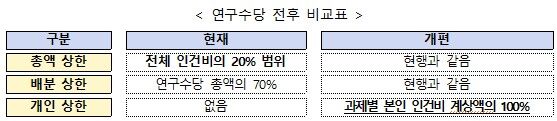
To prevent research allowances from being concentrated on a single individual, the improvement plan introduces a new individual cap—limiting allowances to within 100 percent of the researcher's own allocated labor costs for each project—in addition to the existing total cap (20 percent of labor costs) and allocation cap (70 percent per person).
For instance, if labor costs are set at 120 million won for a 200 million won research and development (R&D) project, the project's research allowance cap would be 26 million won, which is 20 percent of the labor costs, and the maximum amount a principal investigator could receive was 18.2 million won, which is 70 percent of that amount.
However, under the reform, if project participation is set at 20 percent, the actual research allowance receivable drops to 10 million won, and even if set at 30 percent, it decreases to 15 million won.
The issue is that under the 3-project/5-project limit system, which allows principal investigators to undertake up to three projects as a principal investigator and up to five projects in total including joint research, participation rates must be distributed across multiple projects, making it practically difficult to raise participation rates to the level required to receive the maximum possible allowance.
Consequently, there were widespread concerns that this would reduce the only virtually available compensation for principal investigators such as professors participating in projects and increase administrative burdens by making participation rate calculations even more complex.
The Ministry of Science and ICT stated that while some misunderstandings may arise that this research allowance reform would lead to a reduction in researcher compensation, the total amount of research allowances disbursed will not decrease.
Instead, the ministry explained it expects that resolving the concentration of research allowances will increase the disbursement amounts for other researchers participating in the same projects, such as postdoctoral researchers and non-tenure-track faculty.
In relation to this, the ministry pointed out that while research allowances should be distributed based on contribution evaluations, there have been cases of moral hazard where principal investigators used their status to allocate a significant portion of research funds to themselves, or where researchers received allowances regardless of their degree of participation in the project.
(Photo provided by the Ministry of Science and ICT, Yonhap News)
※ Please note: This article was translated by AI and may contain errors.


![72 Billion Won Worth of Seoul Love Gift Certificates Available on First-Come Basis... 5% Discount and 2% Refund [Friendly Economy]](http://img.sbs.co.kr/newimg/news/20260918/202223577_300.jpg) Video News
Video News
 Video News
 Video News
 Video News