
 KOR
KOR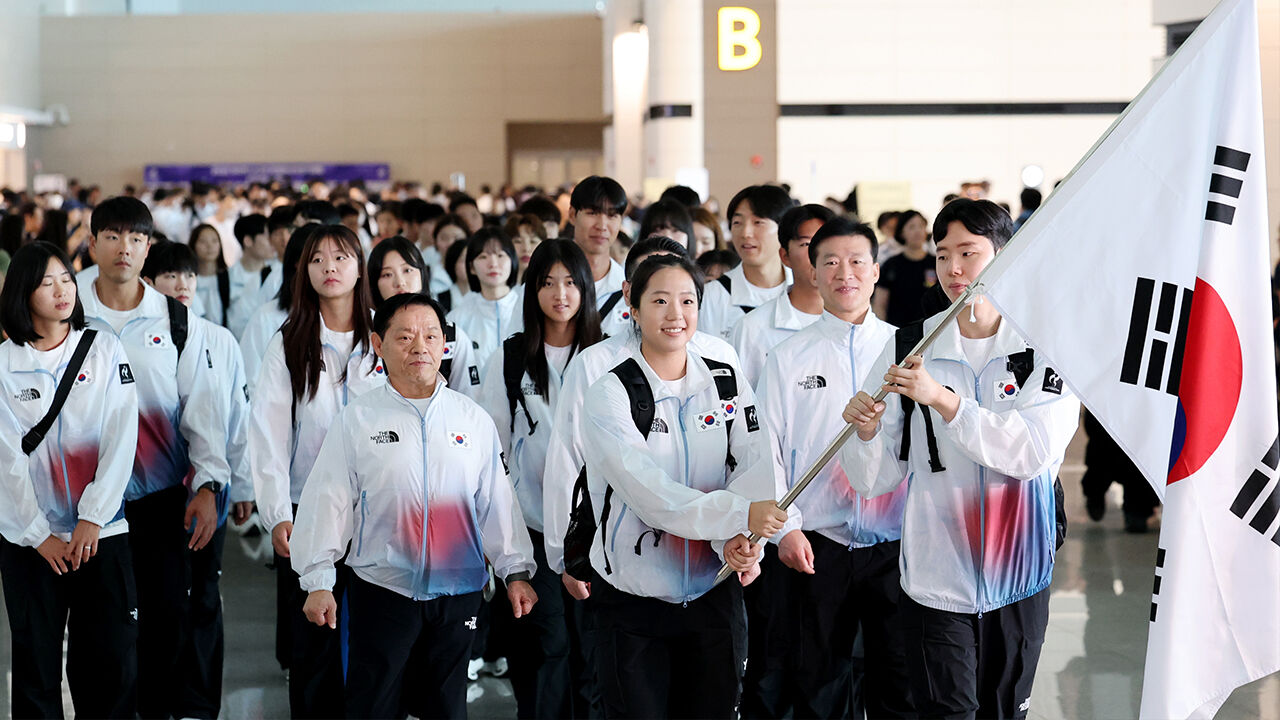
▲ South Korean delegation members, including table tennis player Shin Yu-bin and badminton player Seo Seung-jae competing in the 2026 Aichi-Nagoya Asian Games (AG), move together after finishing their departure event at Terminal 2 of Incheon International Airport in Yeongjongdo, Incheon, on the 17th.
The Summer Asian Games, the premier sports festival of the Asian continent, will kick off in earnest this weekend.
The 2026 Aichi-Nagoya Asian Games will embark on a 16-day run starting with the opening ceremony held at the Mizuho Park Athletics Stadium in Nagoya, Japan, from 6:00 PM tomorrow (the 19th).
Summer Asian Games are typically held once every four years, but because the previous 2022 Hangzhou Games were delayed by a year to 2023 in the wake of the spread of COVID-19, this edition returns after three years.
This marks the third time for the Summer Asian Games to be held in Japan, and the first in 32 years following the 1958 Tokyo and 1994 Hiroshima Games.
This competition features 469 gold medals across 43 sports and 71 disciplines.
This is an increase of 3 sports and 10 disciplines compared to the Hangzhou Games.
Newly introduced events include Virtual Taekwondo, a taekwondo discipline utilizing virtual reality (VR) technology; Padel, which mixes the strengths of tennis and squash; and Teqball, which combines soccer and table tennis.
Around 10,000 athletes and officials from 45 National Olympic Committees (NOCs) affiliated with the Olympic Council of Asia (OCA) and the Asian Refugee Team will compete in this event.
The games will take place across Aichi Prefecture, including the prefectural capital Nagoya, with some sporting events also held in Tokyo, Osaka, and Shizuoka.

Having finished in second place overall at the 2014 Incheon Games and consecutively placing third at the 2018 Jakarta-Palembang Games and the Hangzhou Games, the South Korean delegation has set its goal once again on "maintaining a top-three finish."
The primary goal is to retain third place overall with 40 to 45 gold medals, similar to the Hangzhou Games (42 golds, 59 silvers, 89 bronzes), while also fostering an atmosphere expecting a "surprise standout performance."
Korea has won a total of 2,425 medals in Asian Games history, consisting of 787 gold, 723 silver, and 915 bronze medals, raising the possibility that the 800th gold medalist and 2,500th medalist could be crowned at this event.
Attention is also focused on the performances of stars such as aiming for five consecutive titles in baseball, four consecutive titles in men's soccer, badminton women's singles world number one An Se-young, 2024 Paris Olympics three-gold medalist Kim Woo-jin, Paris Olympics fencing men's sabre two-gold medalist Oh Sang-uk, swimming icons Hwang Sun-woo and Kim Woo-min, high jumper Woo Sang-hyeok, and League of Legends (LoL) eSports emperor Lee Sang-hyeok ("Faker").
The South Korean delegation has already been underway with match schedules starting with men's basketball on the 10th, and the main contingent entered the local area yesterday to focus on adjustment.
Table tennis star Shin Yu-bin and rowing representative Kim Dong-yong have been selected as flag bearers for the delegation at the opening ceremony, standing at the vanguard of the march holding the Taegeukgi.
North Korea is also sending a delegation consisting of 107 athletes across 14 sports to this competition.
Although the delegation size has slightly decreased compared to the Hangzhou Games, they are challenging for medals in strong events such as weightlifting, wrestling, boxing, and shooting.

The English translates to "Imagine One Asia," and the Japanese means "Here, as One," emphasizing Asian solidarity and harmony.
The mascot is "HONOHON," a name derived from "honoko," the etymological root of "flame" in Japanese.
Honohon is shaped in harmony with flames, modeled after the "Shachihoko," a mythical creature with a tiger's head and a fish's body.
The Shachihoko is regarded as the guardian deity of Aichi and Nagoya.
Yukihiko Tsutsumi, a Nagoya-born director who has worked in various fields such as film, theater, and digital art, will serve as general director for the opening ceremony that will signal the start of the festival.
Under the concept of "Heartbeat," which signifies the united hearts of Asian athletes, colorful performances harmonizing local history, culture, and cutting-edge technology are reportedly set to unfold.
The torch was ignited separately in Tokyo and Hiroshima, where the 1958 and 1994 Summer Asian Games were held, and then combined at Nagoya Castle last month, followed by a torch relay passing through 40 municipalities in Aichi Prefecture.
The final torchbearer who will crown the climax of the opening ceremony remains shrouded in veil.
Ahead of the opening ceremony, the Japan Air Self-Defense Force aerobatic team, Blue Impulse, is scheduled to perform an aerobatic flight at key locations within Aichi Prefecture.
(Photo: Yonhap News)
※ Please note: This article was translated by AI and may contain errors.


 Video News
 Video News

 Video News
 Video News