
 KOR
KOR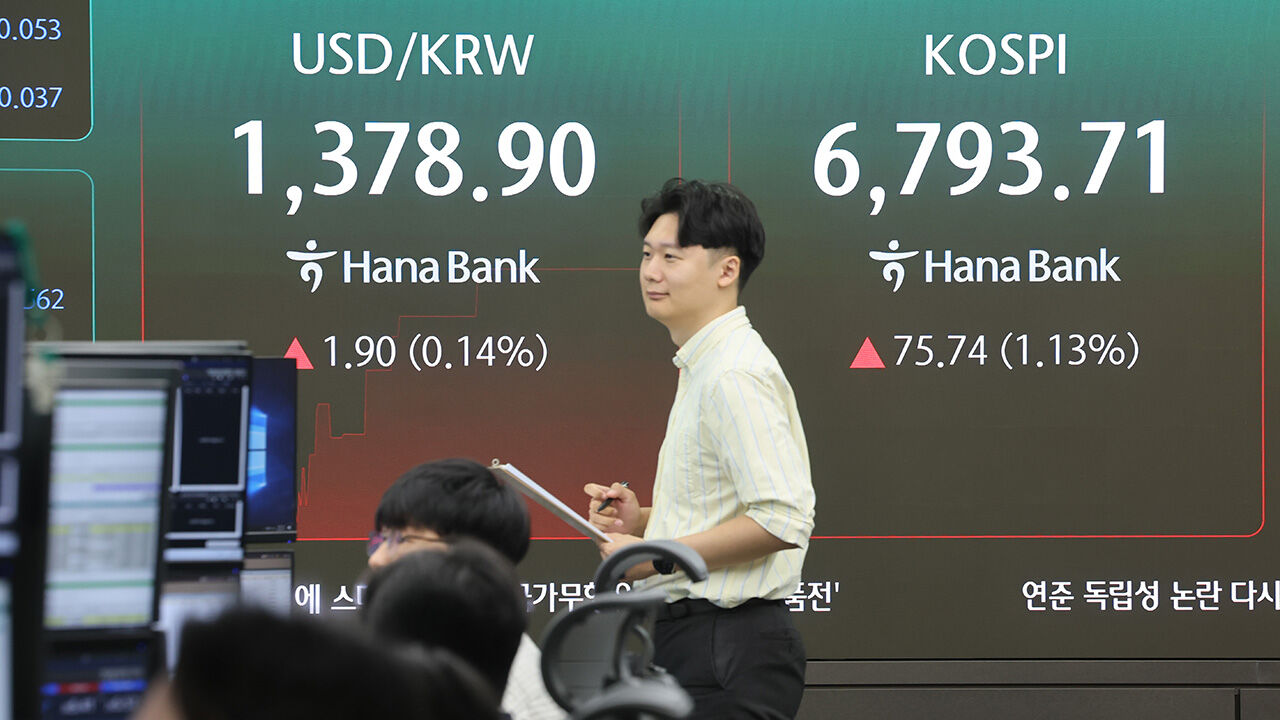
▲ The won/dollar exchange rate and the KOSPI are displayed on an electronic board at the dealing room of Hana Bank in Jung-gu, Seoul, on the 17th. (Photo: Yonhap News)
The KOSPI is trading on an upward trend on the 17th, despite the U.S. Federal Reserve's benchmark interest rate hike overnight and hawkish remarks from Fed Chair Kevin Warsh.
However, the upside for the stock market appears limited as foreign investors continue their selling streak.
As of 9:26 a.m. today, the KOSPI stood at 6,741.39, up 23.42 points, or 0.35%, from the previous session.
The previous day, the KOSPI rebounded for the first time in five sessions driven by the strength of semiconductor shares, and the upward momentum is continuing for a second consecutive day today.
The index opened at 6,779.02, up 61.05 points, or 0.91%, from the previous session, and briefly expanded its gains to as high as 6,795.53 (1.15%).
It has since narrowed its gains.
In the KOSPI market, individual investors are net buyers of 260.9 billion won, while other corporations hold a buying advantage of 127.9 billion won.
Conversely, foreign investors are net sellers of 303.4 billion won, marking a selling streak for the seventh consecutive session, and institutions are also net sellers of 86.5 billion won.
However, foreign investors are net buyers of 23 billion won in the KOSPI 200 futures market.
Wall Street indexes closed lower across the board overnight following the Fed's rate hike and hawkish message.
The Dow Jones Industrial Average dropped 1.21% from the previous session, while the S&P 500 and Nasdaq indices fell 0.45% and 0.01%, respectively.
Overnight, the U.S. Federal Reserve raised its benchmark interest rate by 0.25 percentage points to a range of 3.75% to 4.00% at the Federal Open Market Committee (FOMC) meeting.
This marks the first tightening measure in three years and two months since July 2023.
All 12 FOMC members with voting rights unanimously voted in favor of the rate hike.
Previously, the market had already anticipated a 0.25 percentage point increase and had been closely watching for signals regarding future additional rate hikes.
Amidst this, Fed Chair Kevin Warsh emphasized the Fed's commitment to price stability during a press conference, stating that "inflation is too high and has persisted for too long."
The market interpreted this as a hawkish (favoring monetary tightening) remark, dampening investment sentiment in the stock market.
The yield on the 10-year U.S. Treasury note, a global benchmark for interest rates, rose 2.2 basis points (1 bp = 0.01 percentage point) from the previous session to 5.024%.
Tech stocks, however, showed strength; NVIDIA (0.82%), Intel (4.03%), and Broadcom (0.07%) advanced, pushing the Philadelphia Semiconductor Index up by 0.63%butadiene.
International oil prices, which had surged for two consecutive days, also turned downward, aided by news of Saudi Arabia's indirect oil supply.
West Texas Intermediate (WTI) crude for October delivery finished trading down 3.21% from the previous session at $102.43 per barrel.
The domestic stock market is receiving upward pressure today despite Chair Warsh's hawkish remarks.
This is interpreted as the result of the market having already priced in concerns over the Fed's rate hikes, alongside resilient U.S. tech stocks and falling international oil prices.
Han Ji-young, an analyst at Kiome Securities, noted, "Although short-term yields such as the 2-year note rose following the September FOMC, the limited increase in long-term yields like the 10-year note is something to consider," adding, "It shows that concerns over the Fed's tightening and inflation have already been priced into long-term yields."
She further explained, "For the stock market, this suggests that it is more appropriate to place heavier weight on the trajectory of 10-year yields and international oil prices rather than an additional 25 bp hike itself among future macroeconomic variables."
Among top market cap stocks, Samsung Electronics (0.20%) is rising, whereas SK Hynix (-0.63%) is declining, showing mixed fortunes for major semiconductor shares.
Driven by the monetary tightening stance of major economies, bank stocks such as KB Financial Group (1.87%), Shinhan Financial Group (0.98%), and Hana Financial Group (1.98%) are strong.
Conversely, Samsung Electro-Mechanics (-1.16%), LG Energy Solution (-1.23%), and Hyundai Motor (-0.41%) are trading lower.
By sector, transportation and warehousing (1.46%), insurance (1.51%), and transportation equipment (1.22%) are posting gains, while medical precision (-0.32%) and entertainment and culture (-0.22%) are declining.
At the same time, the Kosdaq index stood at 819.98, up 4.00 points, or 0.49%, from the previous session.
The Kosdaq index opened at 820.16, up 4.18 points, or 0.51%, from the previous session, and briefly widened its gains to 823.58 before paring the increases.
Individual and institutional investors are net buyers of 16.1 billion won and 7.0 billion won, respectively, while foreign investors are net sellers of 23.5 billion won.
By stock, Alteogen (0.39%), EcoPro (0.36%), Jusung Engineering (1.24%), Leeno Industrial (1.06%), and HLB (1.25%) are advancing.
Spurred by news that SpaceX is embarking on a test flight to launch its 'Starship' spacecraft into Earth's orbit for the first time, related stocks such as Sphere (10.57%) and Ajou IB Investment (5.86%) are also on the rise.
Meanwhile, EcoPro BM (-0.38%), Wonik IPS (-1.17%), and EO Technics (-0.85%) are weak.
(Photo: Yonhap News)
※ Please note: This article was translated by AI and may contain errors.



 Video News
 Video News

