
 KOR
KOR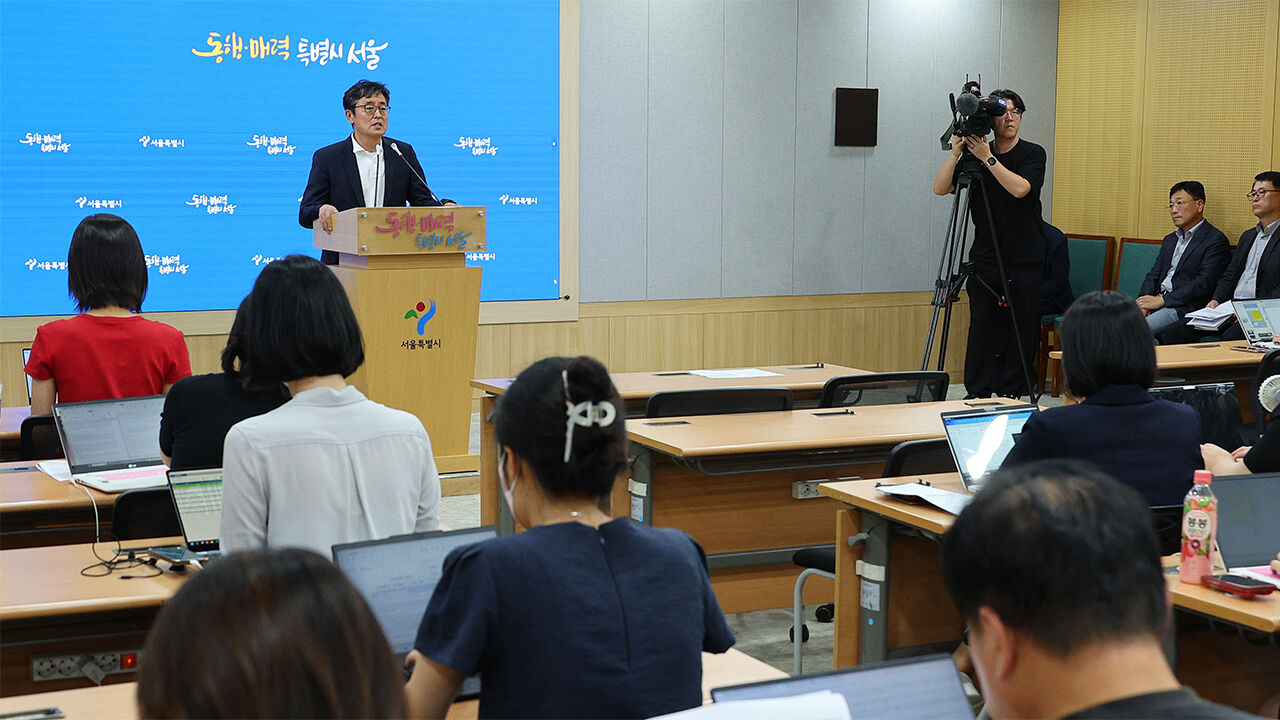
▲ Yeo Jang-kwon, head of the Seoul Metropolitan Government's Transportation Office, holds a briefing.
The Seoul Metropolitan Government has refuted claims by the city bus labor union that a monthly calculation standard of 176 hours for regular wages has been finalized by a court ruling, calling the assertion factually incorrect.
Regarding the union's statement that there is "room for negotiation" on its demand for a 7.85% wage hike, the city emphasized that applying the 176-hour standard for regular wages would automatically result in a wage increase effect of about 16%, meaning the regular wage system must be sorted out rationally first.
Yeo Jang-kwon, head of the Seoul Metropolitan Government's Transportation Office, stated during a briefing, "What was decided in the Supreme Court ruling regarding Dong-ah Transport last April is not to divide the hourly rate of regular wages by 176 hours." He added, "The core of the ruling is that when calculating allowances, the agreed-upon working hours negotiated by labor and management should be applied rather than actual working hours."
Currently, Seoul city bus labor and management are at odds over the benchmark for calculating hourly rates after including regular bonuses in regular wages.
The union is demanding 176 hours per month, while management insists on 230 hours, with 209 hours also being discussed as an alternative.
The structure is such that the fewer hours used to divide the same base wage, the higher the hourly regular wage and various allowances linked to it become.
Yeo explained, "Setting the regular wage calculation standard at 176 hours has a wage increase effect of about 16%, 209 hours has a 10% effect, and 230 hours has a 7% effect," adding, "In regions other than Seoul, agreements have mostly been reached at around the 209-hour level."
He went on to say, "If 176 hours had been finalized by the Dong-ah Transport ruling, there would be no reason for related lawsuits to continue," noting that multiple regular wage lawsuits are currently underway against bus companies in the Seoul area, with related rulings potentially coming as early as this December.
Refuting the union's claim that it agreed to follow the outcome of the Dong-ah Transport ruling during the collective wage bargaining in January of this year, he stated, "While related discussions took place during the negotiation process at the time, this content was not included in the final agreement."
The Seoul Metropolitan Government is concerned that accepting all of the union's demands would lead to a sharp surge in financial burdens.
According to the city's estimates, a 1% increase in wages generates about 14.0 billion won in additional annual costs, and accepting all union demands regarding regular wages and various allowances could expand the city bus deficit from the current annual level of 500.0 billion won to about 1.0 trillion won.
With the union threatening to go on strike on the 16th, the city's stance is that it will not blindly accept union demands that cause excessive financial burdens, while keeping the door open for negotiations.
"If we do not maintain flexibility based on what is discussed at the negotiating table, negotiations cannot happen," Yeo said. "However, if we postpone the regular wage issue once again, the same conflict will recur. It is right to eliminate uncertainty quickly and straighten out the wage system."
He also emphasized, "Providing unlimited financial support just because the union wants it simply because it is a semi-public bus operation system is not what Seoul City should do," adding, "We must consider public expectations and examples from other regions, and if demands are outside the acceptable range, we must set things right even if it is difficult."
In preparation for a strike resulting from a breakdown in negotiations, the city plans to operate emergency transport measures, such as deploying free shuttle (chartered) buses on major arterial roads, mobilizing neighborhood buses to the maximum extent, and expanding subway operations during peak commuting hours.
(Photo: Yonhap News)
※ Please note: This article was translated by AI and may contain errors.


 Video News
![The 'Crazy Race' of a Korean High Schooler That Shattered Japan Swimming's 'Solo Run'... [AG Then and There]](http://img.sbs.co.kr/newimg/news/20260915/202222542_300.jpg) Video News
Video News
 Video News
!["It Has Become a Sea of Tears, Are You Going Through Menopause?" Rep. Kim Seung-won Direct Hit Over Remarks [Baroi News]](http://img.sbs.co.kr/newimg/news/20260915/202222565_300.jpg) Video News
Video News
 Video News