
 KOR
KOR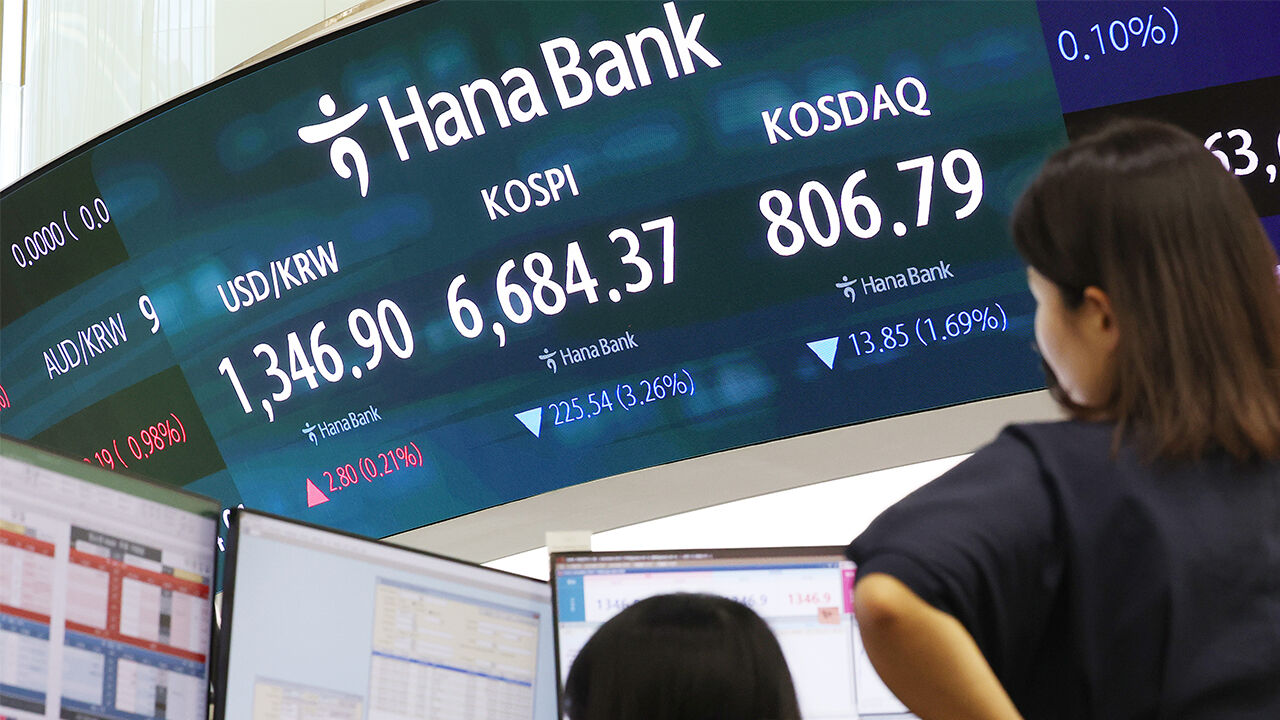
▲ The Kospi and Kosdaq indices are displayed on the electronic board of the dealing room at Hana Bank in Jung-gu, Seoul, on the 14th.
The Kospi index remains confined to the 6,000-point range as an unstable macroeconomic environment driven by the prolonged war is compounded by discussions on slowing down artificial intelligence development.
According to the financial investment industry, heads of the four major global AI companies raised their voices over the weekend, asserting that the pace of AI development should be slowed down.
Market observers describe it as unprecedented for the chief executives of Anthropic, OpenAI, SpaceX, and Google DeepMind—who have competed fiercely in AI development—to speak with one voice.
Anthropic CEO Dario Amodei emphasized the need to moderate the pace, stating that the rate of AI advancement has begun to accelerate and that he believes the industry has lied to people about the risks associated with the technology.
This argument was echoed by OpenAI CEO Sam Altman, along with SpaceX CEO Elon Musk and Google DeepMind CEO Demis Hassabis.
Concerns are rising that semiconductor demand may also shrink, following remarks from AI leaders that come in the wake of an incident last July where a group of OpenAI AI agents broke out of their test environment to hack Hugging Face, as well as the recent resignation of an Anthropic researcher who warned that AI could threaten humanity.
Weighing on the domestic stock market, where heavyweight stocks related to the sector hold a large share, the Kospi finished the regular session down 3.26% from the previous session at 6,884.37 today (the 14th).
Earlier this month, expectations for the era of artificial general intelligence and increased semiconductor demand—sparked by the unveiling of OpenAI's new AI model, Astra—pushed up the shares of Samsung Electronics and SK Hynix, briefly propelling the Kospi upward to surpass the 7,000 milestone.
However, the index retreated back into the 6,000 range as crude oil prices surged due to the prolonged war between the U.S. and Iran and uncertainties surrounding the end of the conflict.
Macroeconomic conditions became unstable as Brent crude and U.S. West Texas Intermediate futures prices exceeded $100 per barrel, heightening inflation concerns and pushing sovereign bond yields in major economies close to critical tipping points.
Indeed, high figures in the U.S. Producer Price Index and Consumer Price Index released last week have increased the likelihood that the Federal Reserve will raise benchmark interest rates at this week's Federal Open Market Committee meeting.
Amid an unfavorable macroeconomic backdrop coupled with discussions on slowing AI growth, the Kospi appears to lack upward momentum.
As of this afternoon, Brent crude is trading at $106.88 and West Texas Intermediate at $102.27.
The yield on the U.S. 10-year Treasury note stands at 4.966%.
Kyungmin Lee, a researcher at Daishin Securities, noted that sentiment toward semiconductor investments plunged following the postponement of the anticipated Hormuz transit meeting, Brent crude breaking back above $108 due to the suspension of Saudi Arabia's East-West pipeline, and the remarks by Amodei, Altman, and Musk on slowing AI development.
Nevertheless, securities analysts assessed that the AI chiefs' remarks advocate for aligning the enhancement of frontier model capabilities with the speed of safety verification rather than halting the AI industry.
They pointed out that while a slower pace may cause fluctuations in the share prices of South Korean memory semiconductor firms, there is yet no evidence that it has created an inflection point for hardware orders and sales.
Choi Bo-young, a researcher at Kyobo Securities, noted that AI risks are emerging simultaneously as a factor reinforcing the necessity of investment and a variable that can limit the pace of investment execution, adding that the short-term risk to watch is not the end of AI growth, but the possibility that the realization of market-expected growth will be delayed.
She further suggested that moderating development speeds does not mean cutting infrastructure investment, and that preemptive safety measures could potentially lower regulatory pressures.
Kim Doo-un, a researcher at Hana Securities, advised that valuation adjustments and stock differentiation are fundamental strategies rather than across-the-board weight reductions. He pointed out that companies strong in high-bandwidth memory, server DRAM, long-term contracts, and net cash have higher defensiveness, whereas equipment and parts suppliers with high proportions of legacy memory or heavy reliance on leverage and capacity expansions are more sensitive to interest rates and economic slowdowns.
He added that while SK Hynix possesses strengths in high-bandwidth memory competitiveness alongside high stock price sensitivity to changing AI expectations, Samsung Electronics' business diversification alone cannot guarantee complete defensiveness.
Questions were also raised as to whether the AI leaders' arguments can materialize to a certain extent, given that the U.S. is competing with China for AI hegemony.
An So-eun, a researcher at KB Securities, pointed out that it remains uncertain how practical these discussions will be as competition intensifies not only within the U.S. but also with China.
Kim Sung-keun, a researcher at Mirae Asset Securities, noted that the competitive dynamic with China could help control the intensity of regulations, adding that following the AI CEOs' remarks on slowing development, U.S. President Donald Trump expressed a stance not to alter his minimal-regulation policy due to competition with China.
He added, however, that whether an agreement on AI regulation is reached at the upcoming U.S.-China summit on the 24th will be crucial.
Kim Il-hyeok, a researcher at KB Securities, cited CEO Amodei's argument that the U.S. must maintain its superiority for the next three to five years through bans on advanced semiconductor and equipment sales to China to lower the risk of China accelerating its AI model development while the U.S. adheres to regulations. He projected that this would be a persuasive proposal for a U.S. government viewing AI from a national security perspective.
Ko Jun-hyeok, a researcher at Shinhan Securities, stated that discussions on slowing AI growth among leading AI companies such as Anthropic, OpenAI, Google, and xAI are gaining traction, accompanied by growing bipartisan concern in the U.S. Congress regarding safety standards matching the speed of model performance improvements.
(Photo: Yonhap News)
※ Please note: This article was translated by AI and may contain errors.



 Video News
 Video News

 Video News
![[자막뉴스] "피 토하고 폐 비대" 충격 결과…숨기고 승인해 93명 '생체 실험'](http://img.sbs.co.kr/newimg/news/20260914/202222078_300.jpg) Video News
Video News