
 KOR
KOR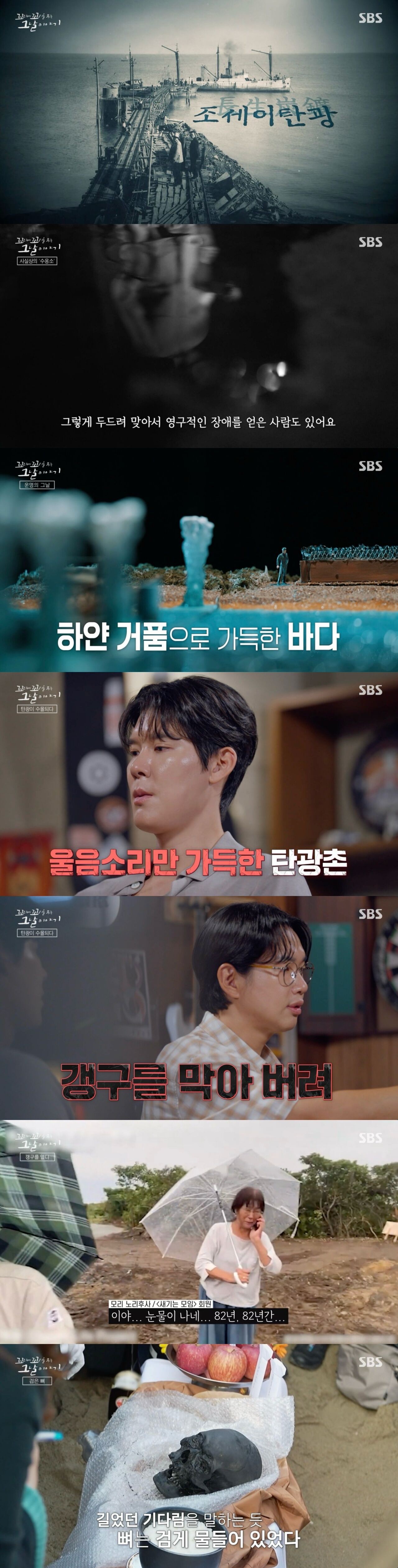
On the 10th broadcast of SBS's "Tails of Tales", the program shed light on that fateful day at the Chosei Mine under the subtitle "Black Bones - An Obituary Delivered 40 Years Later".
In 1991, people across the country received letters sent from Japan. The recipients shared one common thread: a family member had died on February 3, 1942, in Ube, Yamaguchi Prefecture, Japan.
The bereaved families knew nothing about what happened that day. However, there were those who vividly remembered.
In 1939, Seol Do-sul, a 21-year-old young man, was suddenly dragged off to Japan. There were hundreds of young men in the same situation. Filled with anxiety, they arrived at the Chosei Mine located in Ube, Yamaguchi Prefecture.
Under strict surveillance, they began working at the Chosei Mine, a submarine coal mine stretching beneath the ocean. In harsh conditions where the engine sounds of ships passing overhead could be clearly heard, countless young men had to work without ever being able to properly straighten their backs.
Because of this, the young men constantly looked for ways to escape, but that was practically impossible. They faced daily abuse from the Japanese overseers and gave up on escaping to avoid being beaten to death. Over a thousand Korean youths were forcibly brought there.
On that fateful day in 1942, Seol Do-sul was sleeping after finishing work. Awakened by the urgent shouts of an overseer, he went outside and witnessed the mine being submerged.
The area in front of the tunnel was packed with countless people. Many wailed in front of the tunnel entrance blocked by seawater, searching for their family members who had gone inside to work.
Even as time passed, no one was anywhere to be found to explain the situation inside the tunnel or what would happen next. Soon after, Japanese military police blocked the tunnel entrance right in front of the families desperately searching for those who had gone inside.
No one knew how many people died or how the accident happened. The bereaved families could not find the bodies of their loved ones, and the remaining family members had to go work at the very mine that had swallowed their families just to make a living.
After that day, Do-sul lived in seclusion, tormented by the guilt of having survived alone. Time flowed on until liberation arrived, and time passed further still until it became 1991.
Yamaguchi Takenobu was a high school teacher in Ube. Having belatedly learned about the Chosei Mine, he took an interest in the incident and gathered information piece by piece.
As time passed, he formed a group dedicated to carving the Chosei Mine submergence accident into history, gathering like-minded individuals to collect information about the incident. One day, Yamaguchi received word that a temple held a registry of the deceased.
He could not hide his shock upon seeing the registry. It contained the names of 183 people who had died due to the coal industry, which was a national policy of Japan at the time. Among them, 136 were Koreans.
However, the names listed were all Japanized names created through the forced changing of names. The first goal of the gathering was to erect a memorial stone inscribed with the names of the victims. They understood the pain of those called by their changed names, and to honor them, they wanted to find their real names and carve them onto the memorial stone instead of the Japanese names.
Discovering hometown addresses listed beneath the names, the group sent letters to South Korea and North Korea in 1991. They sent 118 letters to find their real names and received 17 replies.
Most of the replies revealed that families who had previously known nothing about the life, death, or whereabouts of their deceased relatives learned through the group's letters that they were victims of the Chosei Mine. The letters arriving 50 years later were essentially obituaries for their families.
Those who received the letters visited the Chosei Mine to mourn their families. They called out the names of their loved ones, who must have been somewhere out in the sea, and yearned for those who had departed.
In 2006, Chosei Mine survivor Seol Do-sul returned to that sea where he had left his friends behind 65 years ago. Gazing only at the remaining traces of the former mine site, he felt sorrow for his departed friends and shed tears.
Seol Do-sul could do nothing else except visit the temple where the memorial tablets of the deceased were gathered and bow before his friend's unfamiliar name.
It was revealed that officials inside the tunnel at the time were aware of abnormal water inflow phenomena. Although the miners working in the tunnel trusted and followed the supervisors as they observed the situation, the supervisors failed to do their proper jobs.
Japan needed a steady supply of coal for the war. Over the course of several days, they mined more coal than usual, and in the process, even removed coal pillars known as tanju. It was later revealed that this had led to the collapse.
Thanks to the efforts of the group, a memorial stone honoring the Chosei Mine victims was erected in 2013. The reason they went to such lengths was out of a sense of conscience.
The group's next objective was the excavation of the victims' remains, also meant to uphold human conscience. Following their relentless efforts, they succeeded in locating the tunnel entrance and opened the blocked tunnel mouth.
"Hey, the tunnel entrance is open," shouted the group. They were the ones who saw a ray of hope after 82 years. They then began work to excavate the remains.
Found inside the dark tunnel, the remains of the victims had turned black when they finally emerged into the world in 2025.
Mr. Seol Do-sul passed away without knowing that the tunnel had been opened or that the remains had been found.
Expressing apologies on behalf of everyone, Yoko from the group bowed her head and said, "While I cannot become a bereaved family member, I believe humans can sincerely understand that pain and make an effort to draw close to it. In that sense, I hope you will accept the pain of the bereaved families a little bit as your own and think of this as just the beginning," drawing attention.
In January of this year, the governments of both countries agreed at a South Korea-Japan summit to cooperate on DNA testing of the remains. Isn't the journey home for those sleeping beneath the sea truly just beginning now?
※ Please note: This article was translated by AI and may contain errors.
(SBS Entertainment News | Kim Hyo-jung)



 Video News
 Video News
 Video News

