
 KOR
KOR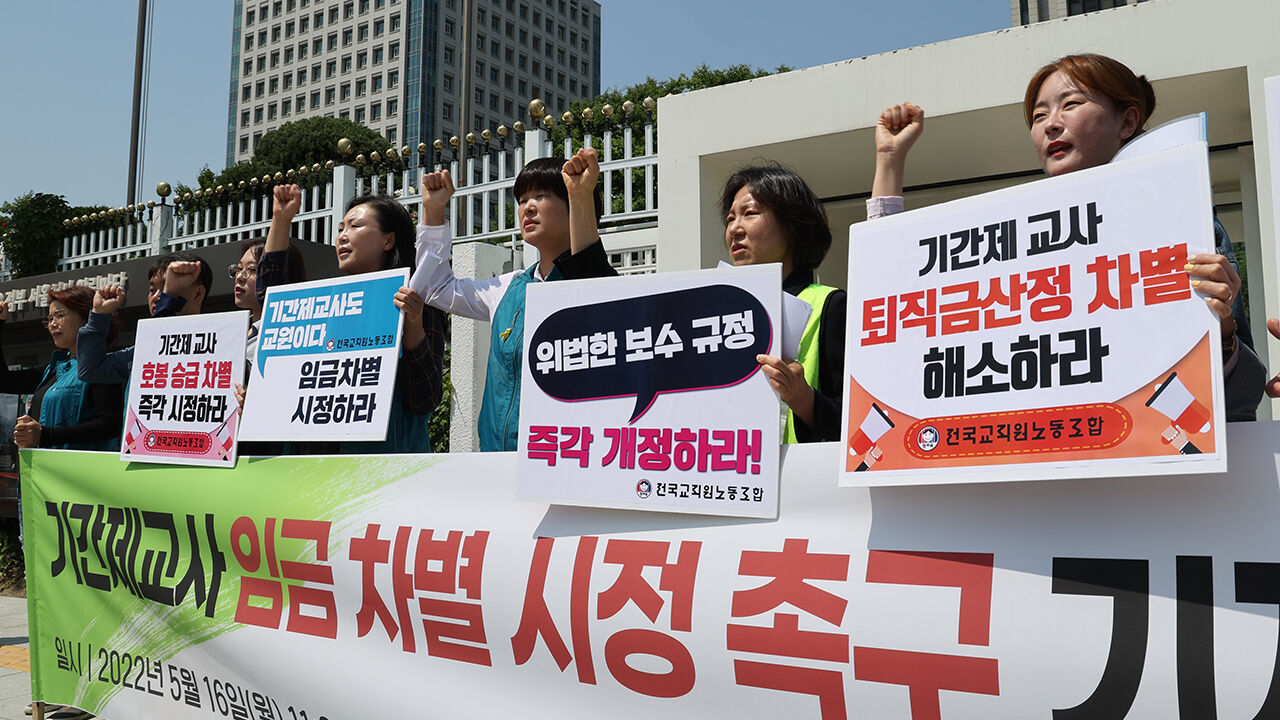
▲ Members of the Korean Teachers and Education Workers Union hold a press conference in May 2022 in front of the Government Complex Seoul in Sejong-ro, Seoul, urging an end to wage discrimination against contract teachers.
"The regular teacher whose position I was filling says they are returning to work the day before a national holiday. I ended up losing a total of 3.2 million won, including my monthly salary and holiday bonus." "You can't return to work like that these days. They were allowed to return because they had valid reasons; opportunistic returns like in the old days don't happen anymore, so don't feel wronged." These are posts frequently seen on social media regarding claims of so-called "opportunistic returns" by regular teachers.
The complaint is that regular teachers on leave for various reasons abruptly return right before vacation periods when there is little to no work, or ahead of holidays when bonuses are paid, leaving the contract teachers who were covering their duties suddenly unemployed and deprived of expected salaries and bonuses.
When such posts appear, counter-comments often follow, arguing that while such incidents did happen in the past, education authorities now advise taking leave and returning by semester, and that teachers say such "opportunistic returns" are rarely seen in reality.
In fact, education authorities have established guidelines to prevent the practice of returning during vacations or repeatedly cycling through leaves of absence and returns.
Complaints that contract teachers suffer harm because regular teachers on leave use the "trick" of temporarily returning only during vacation periods—when work burdens are lighter—have circulated for a long time.
Schools pay long-service allowances in January and July, and Lunar New Year holiday allowances around January or February, leading some teachers on leave to make early returns to collect these payments.
Contract teachers argue that this directly leads to harm for the substitutes filling their positions.
This is because they not only miss out on scheduled allowances, but also lose their jobs even before their contracted period expires.
Under operational guidelines for contract educational personnel issued by education authorities, contract teachers are hired as temporary replacements for staff on leave; thus, once a regular teacher returns to work, the contract is terminated even if time remains on the contract period.
If a contract teacher's period of service falls short of one year, they cannot receive severance pay, nor can they advance in pay grade.
One contract teacher asserted, "For instance, if your contract is terminated due to a regular teacher's return during winter vacation, you lose two months' salary during the break, holiday bonuses, and severance pay that you would have received had you completed a full year of service. If you add up all the financial losses, it comes to around 10 million to 20 million won."
In response, current full-time teachers claim that while such cases occurred in the past, they have nearly vanished today.
A 47-year-old teacher surnamed Kim, who has worked in middle and high schools in Gyeonggi Province for over 20 years, said, "I saw cases like that about a decade ago, but doing things that way is rare nowadays."
Another elementary school teacher surnamed Ko, also 47, said, "I have heard rumors that such people exist, but I have never actually seen it happen."
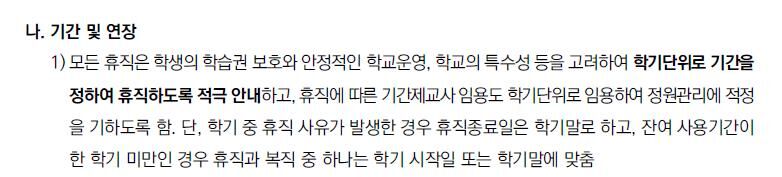
Currently, education authorities advise teachers to take leaves of absence on a semester basis whenever possible, taking into account students' right to learn, school operations, and issues involving contract teachers.
Personnel management manuals and guidelines for contract educational personnel issued by metropolitan and provincial offices of education also guide that leaves should be taken in semester increments, and prohibit contracts that exclude vacation periods when hiring contract teachers for a semester or longer.
Nonetheless, posts complaining of hardships caused by early returns of regular teachers can still be easily found on social media.
Ministry of Education data shows that more than 100 early returns have taken place annually in recent years.
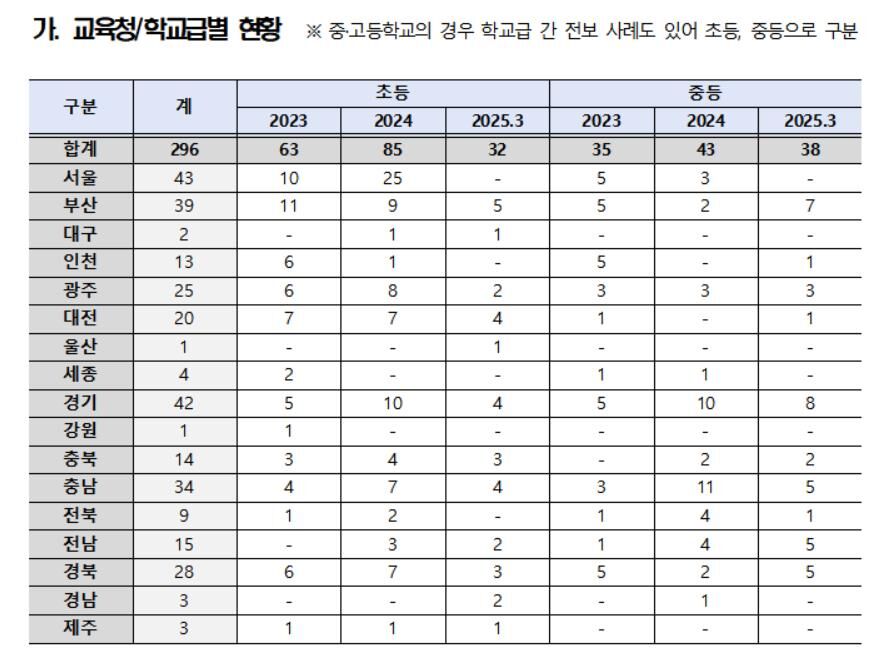
According to data on "early returns of teachers during vacation periods" obtained from the Ministry of Education by the office of Rep. Kim Moon-soo of the Democratic Party of Korea, a member of the National Assembly's Education Committee, a total of 296 teachers returned prematurely during vacation periods (December, January, July) before their originally requested reinstatement dates over a roughly two-year period from January 2023 to March 2025.
By year, there were 98 in 2023, 128 in 2024, and 70 between January and March 2025, averaging 23 cases per month in the first quarter of 2025 alone.
Looking into the reasons for early returns, education authorities explained that it is difficult to conclude these individuals returned to work aiming for vacation pay or holiday bonuses, as alleged in social media posts.
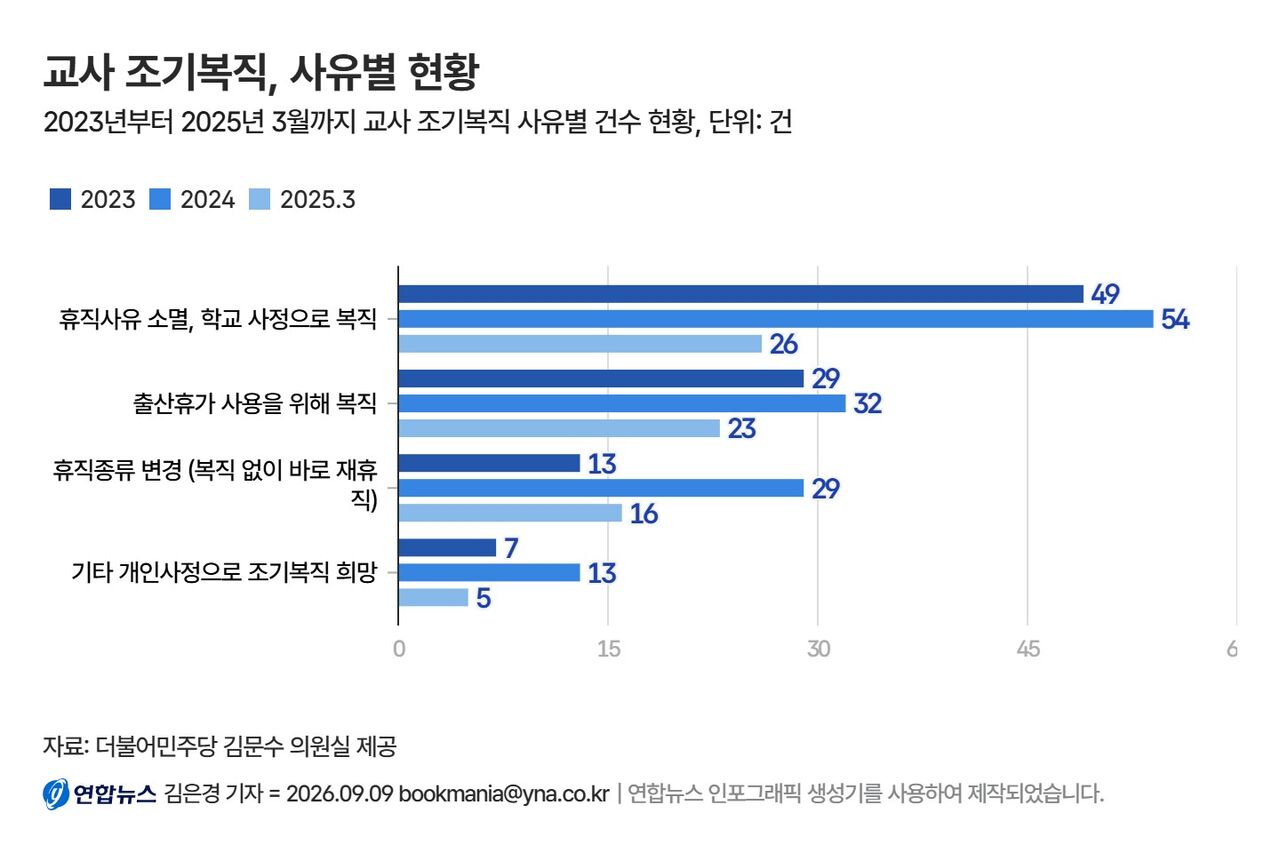
Breaking down the early returns during that period by cause, "extinction of reason for leave" accounted for the largest share at 129 people.
This was followed by "return to use maternity leave" with 84 people, "change in type of leave" with 58, and "desire for early return due to other personal circumstances" with 25.
"Extinction of reason for leave" refers to situations where the initial ground for taking leave ceases to exist, such as successful pregnancy (infertility treatment leave), conclusion of a spouse's overseas assignment (spousal accompaniment leave), death of a care recipient (family care leave), or recovery from illness (medical leave).
Under the State Public Officials Act, teachers must return to duty immediately once the reason for leave ceases to exist, making these cases unavoidable, an official from the Ministry of Education explained.
The official added that in cases of "returning to use maternity leave" or "changing the type of leave," contract teachers suffer no harm because the teachers enter another leave right away without returning to classroom duties.
"Returning to use maternity leave" applies when a teacher on parental leave prior to childbirth ends the leave and is reinstated on paper to apply for maternity leave.
Because employees cannot take leave days while on a leave of absence, they must officially return to duty for administrative processing.
A "change in type of leave" refers to cases where reinstatement occurs on paper as the leave category shifts, such as moving from parental leave to accompaniment leave upon accompanying a spouse on an overseas posting.
The only category of early return that can substantially impact contract teachers is "other personal circumstances."
These numbered 7 cases in 2023, 13 in 2024, and 5 in 2025 (January to March).
Furthermore, instances of "temporary return during vacation periods"—where a teacher returns early during break, works for a set period, and goes back on leave when the new semester begins—totaled around 10 cases at most.
According to data on temporary returns during vacations obtained by Rep. Kim's office from the Education Ministry, suspected instances of "opportunistic returns" stood at 6 in 2023, 12 in 2024, and 3 in 2025 (January to March).
"Even for early returns due to other personal circumstances, each individual case must be examined to determine whether it constitutes an opportunistic return," an official from the Ministry of Education said. "Because early return issues were raised in the past, metropolitan and provincial offices of education are currently administering the leave system strictly in accordance with relevant laws."
Contract teachers emphasized that while instances of such "opportunistic leaves and returns" may have decreased compared to before, they have not disappeared entirely.
Kwon Oh-gyun, director of policy at the KTU's Contract Teachers Committee, said, "Many complaints are received around January, when both long-service allowances and Lunar New Year allowances are paid."
Related organizations also stressed that even outside vacation periods, instances where contract teachers are forced to leave before completing their contract terms due to regular teachers' early returns remain frequent and are showing an upward trend.
Park Hye-seong, head of the National Union of Contract Teachers, said, "Looking at the number of counseling requests filed with the union, cases of contract teachers being dismissed due to regular teachers' early returns have actually increased compared to the past."
According to the KTU's Contract Teachers Committee, contract teachers whose contracts were terminated due to early returns numbered 61 in Seoul and Gyeonggi Province alone in 2024, and 71 in 2025.
Related groups also pointed out that rather than early returns during vacation periods themselves, the core issue lies in a structure where initial contract periods are not honored and contract teachers bear the brunt of the damages.
Park Young-jin, head of the KTU's Contract Teachers Committee, said, "While working conditions for contract teachers are comparable to civil servants, they are forced to leave unconditionally whenever a regular teacher returns. Shouldn't stability be guaranteed to ensure their livelihoods?"
Following concerns raised over this issue, the Anti-Corruption and Civil Rights Commission issued an institutional improvement recommendation in 2020. As a result, regulations were established requiring schools to provide 30 days' advance notice of termination to contract teachers or pay at least 30 days' worth of ordinary wages.
An education official who requested anonymity noted that although not captured in Education Ministry statistics, it is common practice to set contract terms to end right before school vacations from the recruitment stage.
"While there is an atmosphere of taking parental leave on a semester basis in line with Education Ministry guidelines, harm from regular teachers returning early frequently occurs in cases of medical leave or family care leave," the official said.
Replacing teachers mid-semester or mid-school year also affects students.
Park Hye-seong explained, "From the contract teacher's perspective, their connection with the children they were teaching is severed overnight and they cannot carry out their planned curriculum, but from the students' perspective, their teacher suddenly changes as well."
A contract teacher asked, "Some schools hire contract teachers only for short periods until vacation begins, but capable and experienced contract teachers do not apply for such posts. In the end, teachers with poor evaluations or disciplinary histories end up filling those spots. Would this situation truly be good for children?"
Contract teachers' organizations argued that resolving the issue requires authorities to step in and ensure contract periods are honored even when regular teachers return, rather than merely treating the regular teachers' early returns as the problem.
"A regular teacher who took parental leave might return early because they found someone to look after their child midway through, and I fully understand the regular teacher's position," said Park Young-jin. "Regular teachers should be able to take leave and return freely, while contract teachers should also have their contract terms guaranteed."
Given that the number of contract teachers is growing each year, observers predict such issues will become even more frequent.
Due to declining student numbers and rising numbers of teachers taking leave, the contract teacher workforce currently stands at around 80,000.
"This is because schools are choosing to fill regular teaching posts with contract teachers instead of recruiting regular staff, using them as a buffer against teacher reductions caused by falling student enrollment," Park Young-jin said.
An official from the Ministry of Education said, "From the contract teachers' perspective, they would desire 100% job security, but achieving that would mean completely prohibiting regular teachers from returning early. Because that poses difficulties of its own, we are striving to find a balance between regular and contract teachers under the current legal framework."
(Photo courtesy of Rep. Kim Moon-soo's office, captured from Incheon Metropolitan City Office of Education's 2024 Secondary Teacher Personnel Practical Guide booklet, Yonhap News)
※ Please note: This article was translated by AI and may contain errors.



 Video News
 Video News

 Video News
 Video News