
 KOR
KOR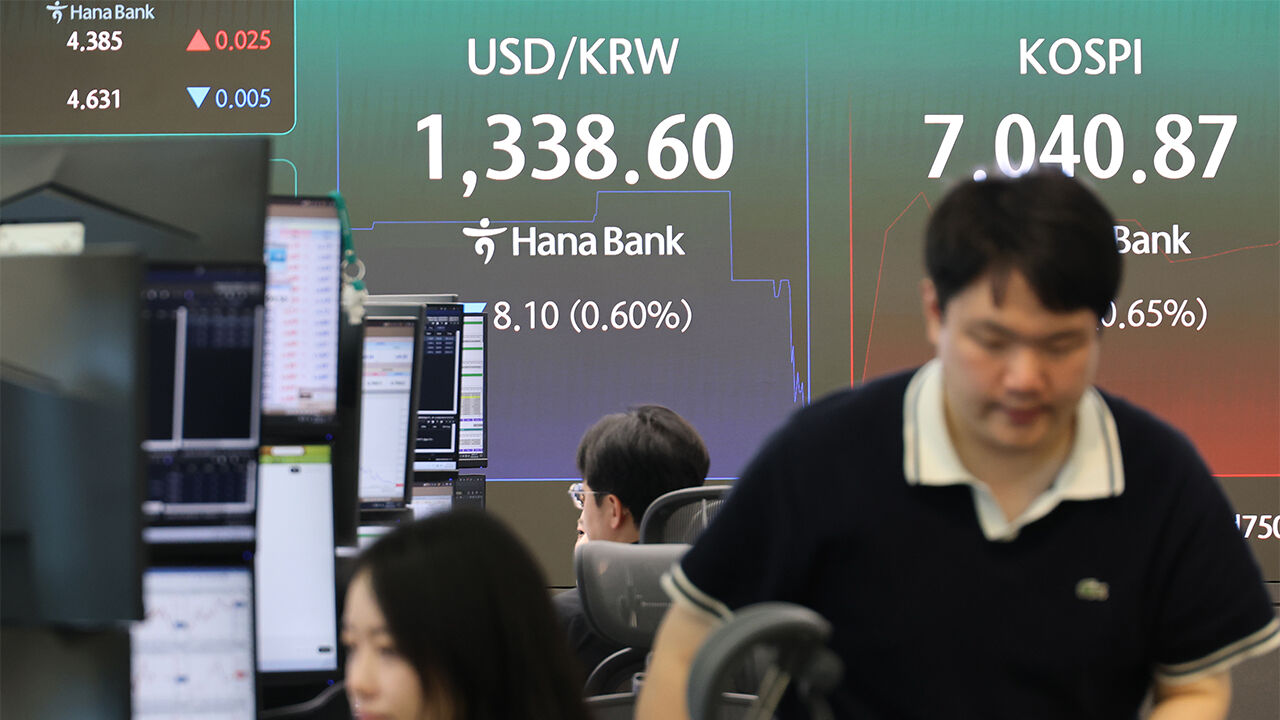
▲ Employees monitor the stock market and exchange rates at the headquarters of Hana Bank in Jung-gu, Seoul, on the 8th. (Photo: Yonhap News)
The KOSPI, which opened higher today (the 8th), reversed its gains near the end of the regular trading session, giving up the "7,000-pi" (KOSPI 7,000) milestone it had touched during the day.
The KOSPI closed down 40.87 points (0.58%) from the previous trading session at 6,954.52.
This marks the index's first decline in four trading sessions.
Starting 50.40 points (0.72%) higher than the previous session at 7,045.79, the index rose as high as 7,171.52 before turning downward late in the session, showing a pattern of starting strong and finishing weak.
In the KOSPI market, foreign investors and institutional investors continued their joint net buying for the fourth consecutive session, while individual investors recorded a net selling volume of over 3 trillion won.
Foreigners and institutions net bought 661.6 billion won and 649.5 billion won, respectively, while individuals net sold 3.0533 trillion won.
Other corporations posted a net buying advantage of 1.7588 trillion won.
In the KOSPI 200 futures market, foreign investors net bought 365 billion won.
The won-dollar exchange rate stood at 1,345.6 won, up 5.1 won in the Seoul foreign exchange market as of 3:30 p.m.
The KOSPI opened higher, led by large-cap semiconductor stocks amid a favorable sentiment boost in the sector triggered by OpenAI.
However, as macro issues stemming from external variables resurfaced in the afternoon, the gains narrowed before ultimately turning downward.
Saudi Arabia announced that multiple energy-related facilities in its southern region were hit by missile and drone attacks from the pro-Iran Houthi rebels in Yemen, resulting in fires and the temporary suspension of some operations.
As geopolitical risks persisted in the Middle East, international oil prices rose, with U.S. West Texas Intermediate (WTI) futures approaching $94 per barrel and Brent crude surpassing $98 per barrel as of this afternoon.
In the wake of this, the yield on 10-year U.S. Treasury bonds also surged to 4.8%.
Market sentiment is interpreted to have deteriorated further as caution flowed in ahead of U.S. inflation indicators, such as the Producer Price Index (PPI) and Consumer Price Index (CPI), scheduled for release later this week.
Additionally, tariff conflicts between the U.S. and Canada appeared to have acted as a burden on the stock market.
Samsung Electronics, which had driven the KOSPI with morning gains, finished down 0.19% at 269,500 won, while SK Hynix gave up almost all of its gains to close up 0.56% at 1,793,000 won.
The market was also thought to be influenced by projections that a selling wave worth 1.4 trillion won could emerge for the semiconductor "two top" during the regular reshuffling process of the KRX Semiconductor Index.
The KASDAQ index closed down 10.31 points (1.25%) at 811.88.
Starting 2.84 points (0.35%) higher than the previous session at 825.03, the index fluctuated briefly in the morning before regaining upward momentum, only to turn downward in the afternoon as macro issues came to the fore.
In the KASDAQ market as well, individuals and foreigners net bought 149 billion won and 60.7 billion won, respectively, while institutions net sold 217.8 billion won.
(Photo: Yonhap News)
※ Please note: This article was translated by AI and may contain errors.



 Video News
 Video News
 Video News

 Video News