
 KOR
KOR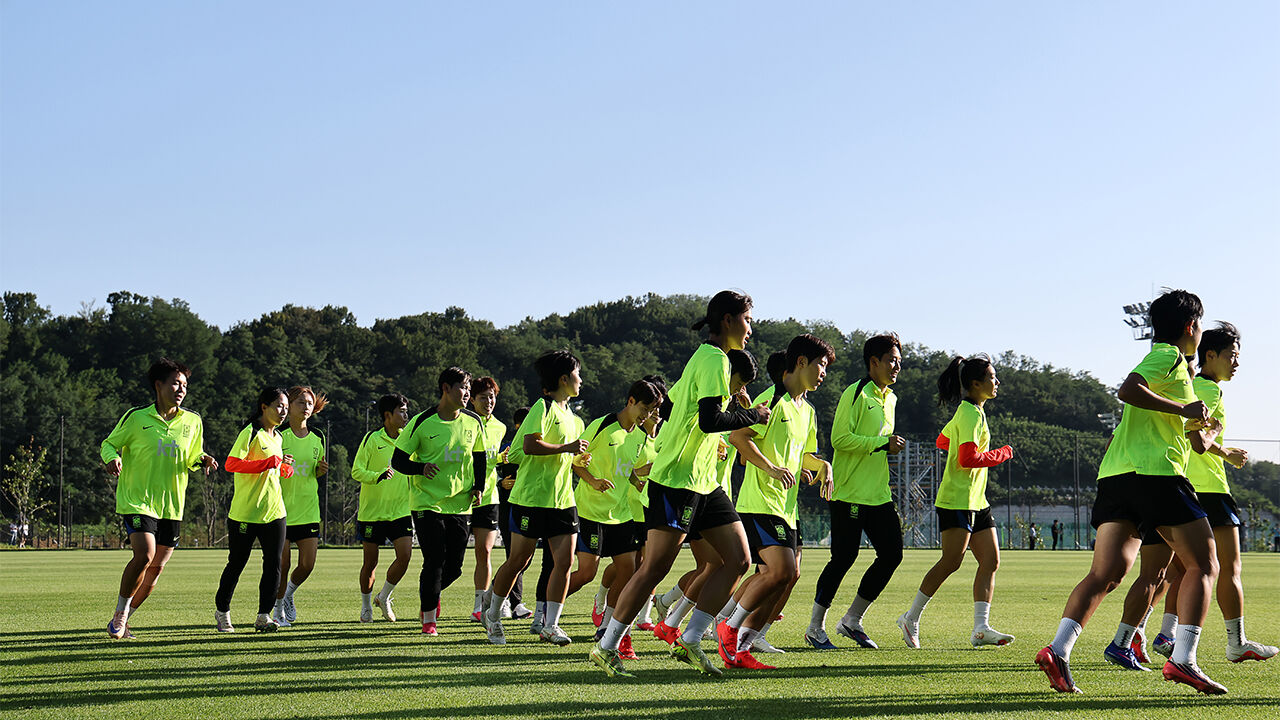
▲ The women's national football team competing in the 2026 Aichi-Nagoya Asian Games focuses on training at the Korea Football Park in Cheonan, South Chungcheong Province, on Sept. 7.
The women's national football team, led by head coach Shin Sang-woo, gathered at the Korea Football Park in Cheonan, South Chungcheong Province, today to kick off its final training camp ahead of the Asian Games.
Meeting with reporters ahead of the training session, coach Shin was asked about the team's goal for the tournament and bluntly stated, "I want to change the color of our medal."
Shin explained, "The women's national team has won up to the bronze medal (at past Asian Games). Our big goal this time is to reach the final and change the color of the medal."
However, when asked if people could expect a victory, Shin answered "Yes" without hesitation.
Key player Ji So-yun (Suwon FC Women), who is participating in her sixth and potentially last Asian Games, also expressed her determination, saying, "The color of our medal has never changed before. It feels like this is truly my last Asian Games, and I have a strong desire to change the color of the medal for once."
Shin shared a positive team atmosphere, stating, "As they have always done, senior players like Ji So-yun and Kim Hye-ri (Suwon FC) have taken the lead. Helping these players change the color of their medals is also my responsibility as coach. The younger players seem to share a strong desire to achieve this as well. The look in the players' eyes is sharp."
Women's football has been an official event at the Asian Games since the 1990 Beijing Games.
Over the past nine tournaments, China, North Korea, and Japan have split the gold medals three times each.
Defending champion Japan, which has reached the final in five consecutive tournaments and won three times including two straight titles, is considered the strongest favorite to win this tournament, backed by the advantage of being the host country.
South Korea's best-ever finish at the event is the bronze medal.
After winning three consecutive bronze medals starting from the 2010 Guangzhou Games, the team was eliminated in the quarterfinals at the previous Hangzhou Games.
The team is challenging for a medal again for the first time in eight years.
In this tournament, 12 countries will be divided into three groups of four teams to play the group stage. The top two teams from each group and the two best third-place teams will advance to the quarterfinal knockout stage to continue competing for medals.
Placed in Group F, the national team will face Myanmar in its opening match on the 14th, followed by matches against Bangladesh on the 17th and North Korea on the 21st.
All group-stage matches will be played at Nagai Stadium in Shizuoka.
The quarterfinals will be held on September 25, the semifinals on September 29, and the final and third-place playoff on October 2.
If South Korea passes the group stage in first place, it will be able to play subsequent matches in Shizuoka without having to relocate.
For this reason, the third match against North Korea, which is likely to determine the group leader, is crucial.
Shin said, "To ride a good momentum, we must beat North Korea. Only then can we change the color of the medal as we aim to." Ji So-yun also predicted, "To climb higher, we have to scale the mountain called North Korea. All the players know this well, but facing North Korea is very tricky and difficult. In the end, it will be a battle of mental strength. The match result will change depending on who makes fewer mistakes."
Ji added, "To change the color of the medal, we have to defeat the powerhouses. We have played competitive matches against strong teams during past East Asian Cups and Asian Cups. This time, it seems it will matter who can concentrate better and has a more desperate desire to win the gold medal."
Ji also maintained her guard against Myanmar, the opponent in the opening match that will significantly impact the team's overall tournament performance.
Coincidentally, the Myanmar national team is led by Colin Bell, who previously managed the South Korean women's national team before Shin Sang-woo.
Ji said, "Coach Bell knows us inside and out, and we know Coach Bell inside and out too. We need to button our first button right, but it looks like it's going to be a very tough match."
Twenty players from the WK League, the domestic women's semi-professional football league, out of the 23 players on the final roster participated in today's first training session.
The national team will depart for Japan on the 10th.
Overseas-based players Choo Hyo-joo and Jung Min-young (both of Ottawa Rapids) from the Canadian stage, along with forward Jung Da-bin (Stabæk) playing in Norway, are scheduled to join the national team locally after the opening group match against Myanmar.
(Photo: Yonhap News)
※ Please note: This article was translated by AI and may contain errors.




 Video News
 Video News
 Video News
