
 KOR
KOR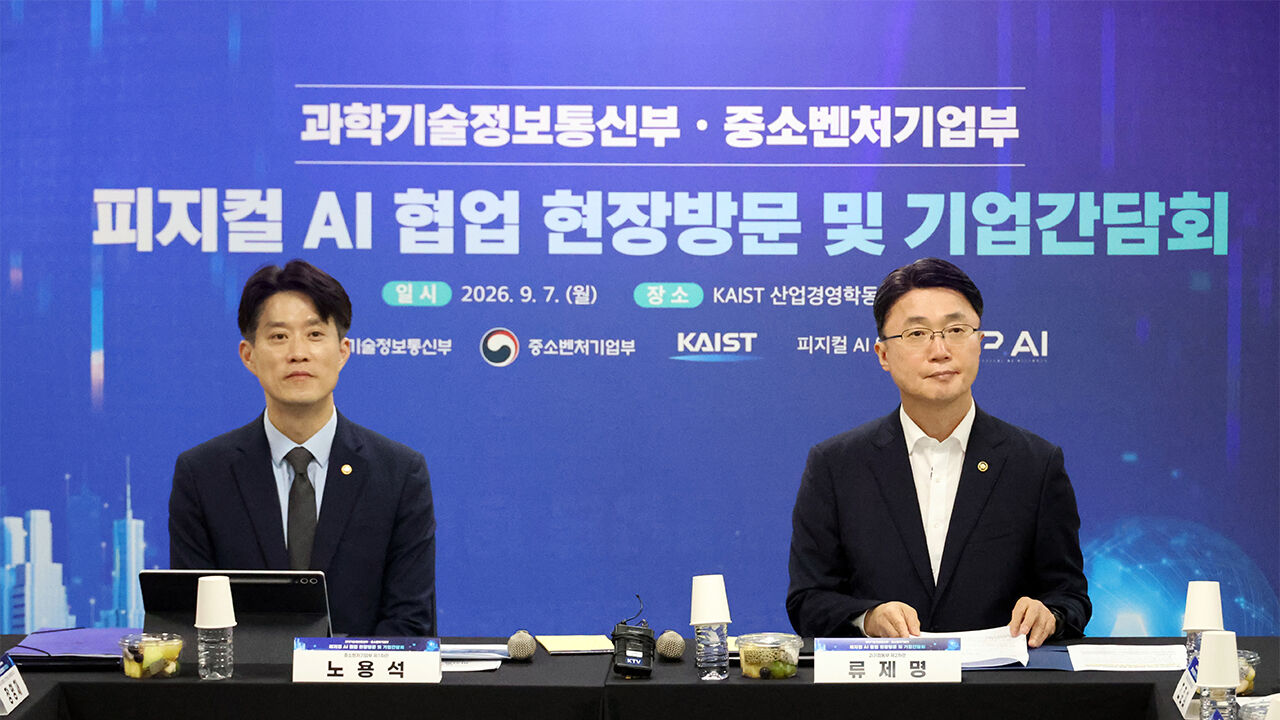
▲ Ryu Je-myung, 2nd Vice Minister of Science and ICT, and Noh Yong-seok, 1st Vice Minister of SMEs and Startups, visit the Korea Advanced Institute of Science and Technology (KAIST) on the afternoon of the 7th to tour the physical AI collaboration site and hold a joint inter-ministerial corporate meeting.
The government has launched a full-cycle support initiative—ranging from technology development to on-site expansion—for small and medium-sized manufacturing companies struggling to adopt physical artificial intelligence (AI).
The Ministry of Science and ICT (MSIT) and the Ministry of SMEs and Startups (MSS) held a corporate meeting today (the 7th) at the KAIST Physical AI Demonstration Lab, bringing together physical AI companies and manufacturing firms.
Organized to discuss cooperation measures for adopting and spreading physical AI in small and medium-sized manufacturing companies, the meeting proceeded in the order of a physical AI demonstration lab tour, an introduction to joint cooperation plans between the two ministries, and a meeting between supply and demand companies.
Recently, manufacturing sites are rapidly transitioning into the era of physical AI, where AI perceives its surrounding environment and performs tasks through autonomous decision-making. However, small and medium-sized manufacturers face difficulties in applying new technologies to their sites due to a lack of professional talent, data, and experience.
In response, the two ministries are promoting the adoption and expansion of physical AI in small and medium-sized manufacturing companies through "Everyone's AI Factory Manager," a physical AI-based manufacturing operation platform, and "Smart Manufacturing Innovation."
Based on full-stack technologies secured through demonstrations in Jeonbuk (unmanned factory control and operation) and Gyeongnam (ultra-precision manufacturing intelligence), the MSIT will support the phased adoption by small and medium-sized manufacturing companies.
In the first phase this year, consulting will be provided for the adoption of Autonomous Mobile Robots (AMRs) and Automated Guided Vehicles (AGVs). In the second phase next year, support will expand to include consulting for heterogeneous facility adoption and the provision of precision manufacturing data. From 2028 onward in the third phase, support will extend to integrated operation management for all logistics and production processes, along with the provision of operating systems.
The MSS will establish a specialized support program so that physical AI technology can be implemented in actual small and medium-sized manufacturing sites through smart factories.
It plans to help small and medium-sized enterprises utilize the "Everyone's AI Factory Manager" service while simultaneously pursuing the establishment of smart factories, and to spread excellent demonstration results through "Manufacturing AI 24," an integrated manufacturing AI support platform to be established in the future.
The two ministries will also plan and promote joint research and development (R&D) to secure future competitiveness in physical AI, focusing on new growth fields such as new security, pharmaceutical bio, climate tech, and K-consumer goods.
Taking this inter-ministerial collaboration as an opportunity, the Physical AI Alliance plans to form and operate a task force (TF) specialized in small and medium-sized manufacturing to discover on-site demand and continuously support on-site application through connection with technology supply companies.
Companies attending the meeting suggested expanding demonstration opportunities, supporting data utilization, nurturing professional talent, and strengthening connections between projects.
Ryu Je-myung, 2nd Vice Minister of Science and ICT, pointed out, "For physical AI to create substantial results in industrial sites, it is most important not to stop at developing excellent technology, but to build a virtuous cycle system that connects with the demands of manufacturing sites, leading to demonstration and expansion."
He also emphasized, "Centered around the Physical AI Alliance, we will pool the capabilities of related ministries, industry, academia, and research institutes to actively support domestic technologies so they can be applied to actual manufacturing sites."
Noh Yong-seok, 1st Vice Minister of SMEs and Startups, stated, "To ensure that this collaboration goes beyond the simple application and verification of physical AI in individual companies and leads to the vitalization of the physical AI ecosystem, we will also push to establish a data-based feedback system so that small and medium-sized enterprises can utilize excellent performance outcomes."
(Photo: Yonhap News)
※ Please note: This article was translated by AI and may contain errors.




 Video News
 Video News
 Video News
