
 KOR
KOR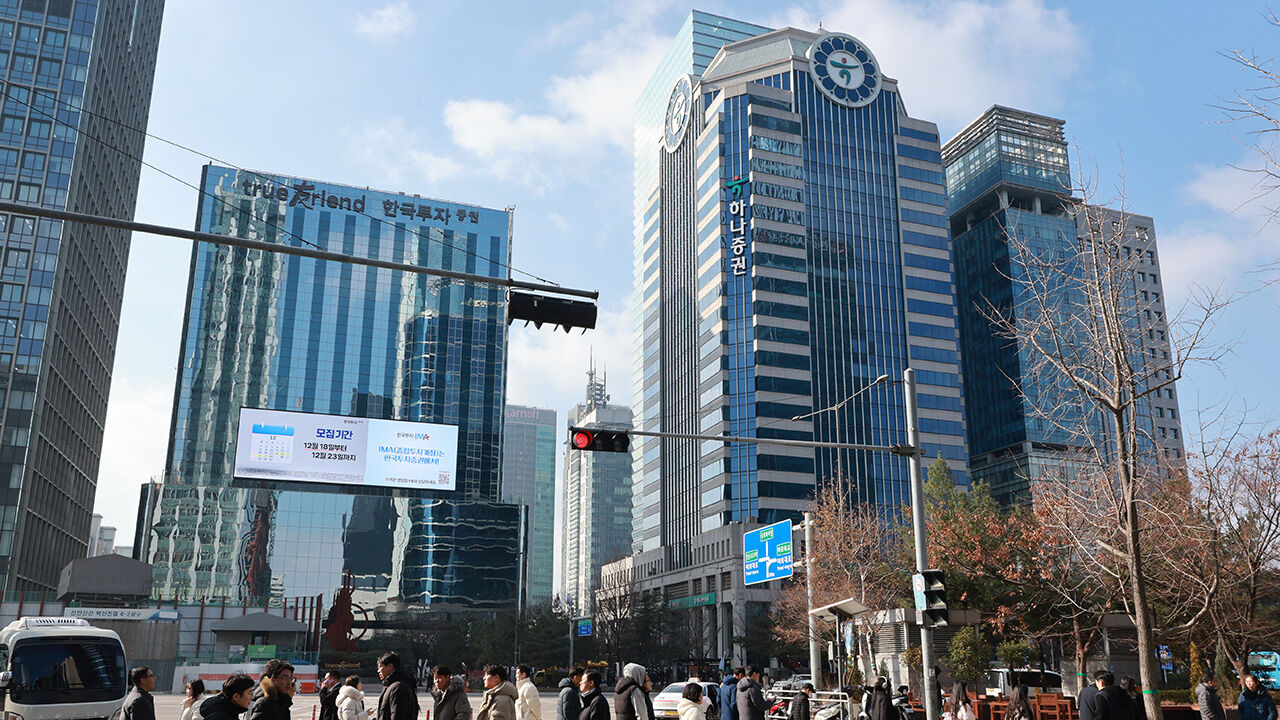
▲ Yeouido financial district
As trading in the domestic stock market has noticeably contracted since August of this year, earnings expectations for major securities firms for the third quarter (July–September) are also being lowered.
While brokerage income, which propelled securities firms' earnings amid the stock market boom that continued from the second half of last year, is slowing down, the burden of trading profit and loss due to heightened stock market volatility is also compounding the situation.
According to the financial investment industry on today (the 7th), the third-quarter operating profit consensus (forecast) for the securities sector has been revised downward by 11.61%, from 2.3942 trillion won to 2.1164 trillion won over the past month.
This tally includes the earnings forecasts for four securities firms: NH Investment & Securities, Samsung Securities, Mirae Asset Securities, and Daishin Securities.
Over the same period, the third-quarter net profit forecast for these securities firms was also lowered by 2.46%, from 1.5706 trillion won to 1.5319 trillion won.
In particular, the downward revision of Mirae Asset Securities' earnings forecast was prominent.
The third-quarter operating profit consensus was lowered by nearly 40%, from 720.7 billion won a month ago to 447 billion won, and the net profit forecast was also revised downward by 12.76%, from 277.9 billion won to 242.5 billion won.
Following the release of second-quarter earnings on the 12th of last month, target prices for Mirae Asset Securities have also been lowered consecutively.
Regarding Mirae Asset Securities, Samsung Securities lowered its target price from 75,000 won to 50,000 won, Meritz Securities from 60,000 won to 50,000 won, Daishin Securities from 62,000 won to 44,000 won, and Yuanta Securities from 93,000 won to 75,000 won.
These securities firms focused on changes in fair value resulting from fluctuations in SpaceX's stock price.
However, while lowering its target price, Samsung Securities upgraded its investment rating by one notch from Neutral to Buy.
Samsung Securities researcher Jung Min-ki explained, "Despite the lower target price reflecting the stock market slowdown, adequate upside potential has been secured," adding, "Additional premiums could be provided if future growth opportunities materialize, such as the reinforcement of global business and the launch of an integrated digital asset platform."
On this day, Mirae Asset Securities' shares closed at 34,700 won, up 0.73% from the previous session.
The decline in stock trading value is cited as the primary background for the lowered earnings forecasts of securities firms.
According to the Korea Exchange, the daily average trading volume in the domestic stock market from the beginning of the third quarter through today stood at approximately 905.53 million shares, plunging 49.6% from the second quarter (1.79717 billion shares).
Consequently, the daily average trading value also decreased by 35.2% over the same period, falling from 55.9269 trillion won to 36.2671 trillion won.
As trading values surged alongside the stock market boom from the second half of last year, securities firms' brokerage revenue also grew steeply, but concerns are rising that the exact opposite effect may occur as trading contracts in the third quarter.
According to the Financial Supervisory Service's Financial Statistics Information System, as of the first quarter of this year, brokerage commission income as a proportion of total fee income among major securities firms was highest at KB Securities with 76%, followed by Kiwoom Securities at 75% and Mirae Asset Securities at 73%.
The stock market slump can act as a burden not only on brokerage operations but also on the trading division, where securities firms invest in stocks and bonds using their own capital.
In particular, as stock market adjustments and volatility expanded entering the third quarter, analysis suggests that securities firms with relatively large stock exposures in Principal Investment (PI) and trading divisions could experience even greater volatility in operating profit and loss.
An industry official who requested anonymity said, "There is a possibility that the trading division will take a heavier hit from stock market conditions than brokerage," adding, "Securities firms that performed well in their trading operations through the first half of the year may face base effect burdens as those effects dissipate in the second half."
The official explained, "Among them, Kiwoom Securities has a relatively high proportion of stocks operated through PI compared to other securities firms," and noted, "The company previously stated in a conference call that its stock assets under management in the PI division amount to about 1 trillion won."
The official added, "If stock market volatility expands, the volatility of trading profit and loss could also grow."
Samsung Securities researcher Jung Min-ki pointed out in a report at the end of July regarding Kiwoom Securities, "While shrinking trading values have a negative impact on all securities firms equally, given the relatively high contribution of the PI book to trading performance, the earnings impact from the recent stock price decline phase must be closely monitored."
At the same time, researcher Jung estimated Kiwoom Securities' stock trading-related profit for the first half of the year to be around 200 billion won.
In fact, practitioners handling proprietary capital management within securities firms are also voicing grievances over the burden caused by expanding market volatility.
An official from a securities firm's stock trading team said, "As volatility in the market grows heading into the second half, risk management is becoming trickier," adding, "In the case of stocks, we are selecting stocks with relatively low volatility or flexibly adjusting the proportion of stock operations according to market conditions."
The official further explained, "Bond operating conditions are also not easy, as bond prices fall when interest rates rise."
Meanwhile, some opinions suggest that attention should be paid to annual Return on Equity (ROE) based on the profits accumulated up to the first half of the year, rather than the third-quarter earnings slowdown itself.
KB Securities researcher Kang Seung-gun maintained a "Positive" investment rating for the securities sector in a report, stating, "Despite concerns over deteriorating investment sentiment and declining trading values, considering the securities sector's changed profit structure and ROE, we judge that investment appeal exists at current valuations."
(Photo: Yonhap News)
※ Please note: This article was translated by AI and may contain errors.




 Video News
 Video News
 Video News
