
 KOR
KOR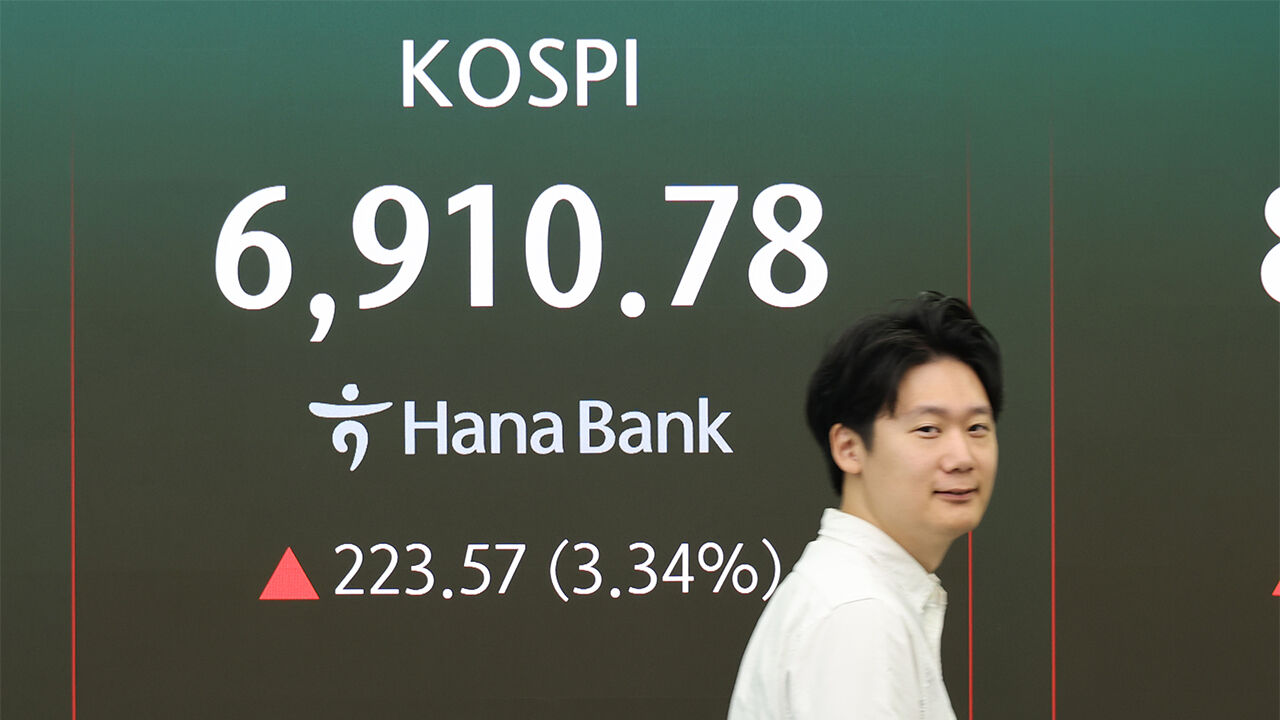
▲ Employees monitor the stock market and exchange rates at the dealing room of the Hana Bank headquarters in Jung-gu, Seoul, on the 7th.
Goldman Sachs has maintained its target for the KOSPI, assessing that the duration of the earnings cycle for South Korean memory semiconductor companies is being underestimated.
According to Bloomberg on the 7th, Tim Moe, Chief Asia-Pacific Equity Strategist at Goldman Sachs, stated in an interview conducted on the 4th, "We are still maintaining that stance. This is based on the judgment that earnings will back it up."
He added, "The market is underestimating the duration of this earnings cycle."
Previously, he raised the KOSPI target from 9,000 to 12,000 in early June, and early last month, he characterized the decline in June as a sharp correction within a major bull market while maintaining the target.
He projected that the memory supply shortage caused by data center competition will intensify further next year, estimating that the capital expenditure scale of U.S. big tech companies next year will be revised upward from the previous forecast of $800 billion to $1.2 trillion.
He remarked, "Hyperscalers are in a situation where they must continue to spend even if they do not make money," adding, "This is good for memory because it will drive computing demand that requires a massive amount of memory."
He estimated the earnings growth rate of KOSPI-listed companies this year at around 360%, while projecting it to slow to 35% next year.
He explained that the KOSPI target is based on 7.5 times the 12-month forward earnings, whereas the current index is trading at 5.3 times, which is roughly half the 7-year average.
He added that if South Korean companies achieve their earnings forecasts, the KOSPI target of 12,000 "will not look absurd."
He acknowledged risks from competitors such as China's ChangXin Memory Technologies (CXMT) and the possibility of political backlash against the expansion of U.S. data center construction, but projected that fundamentals will continue to favor advanced memory semiconductor companies for the next several years.
(Photo: Yonhap News)
※ Please note: This article was translated by AI and may contain errors.




 Video News
 Video News

