
 KOR
KOR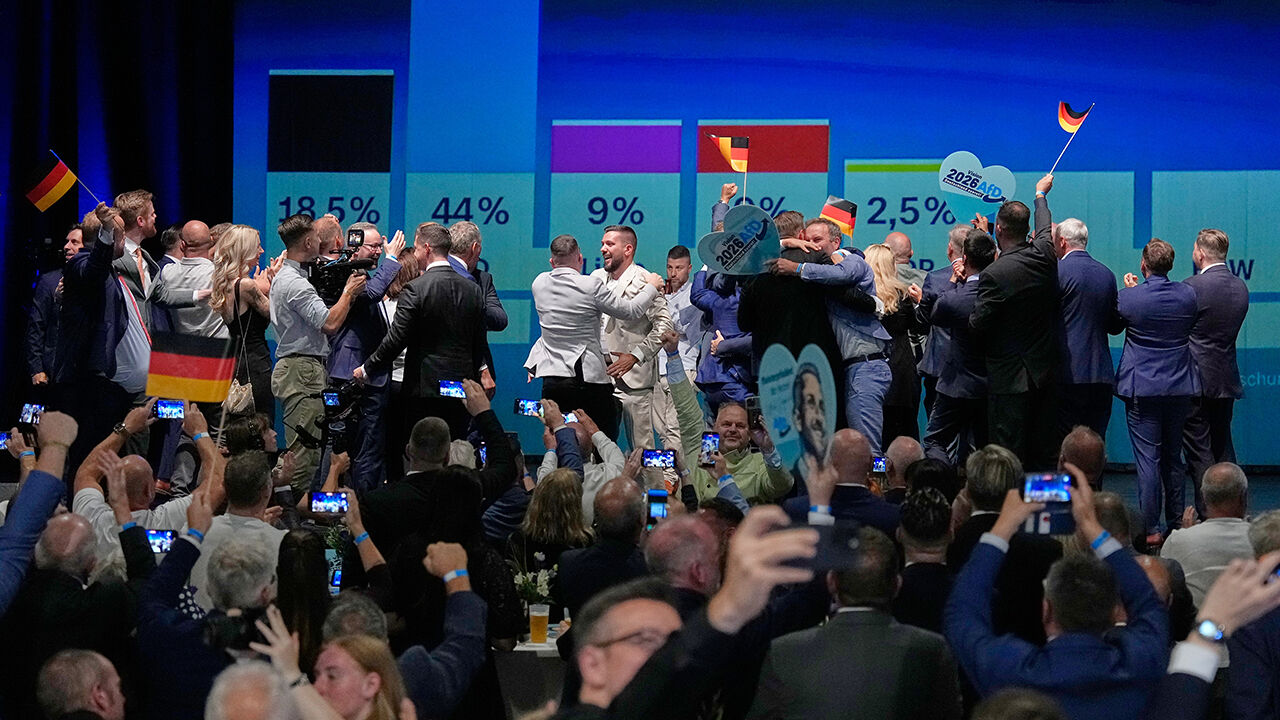
▲ AfD members celebrate
In the state parliamentary election held in the eastern German state of Saxony-Anhalt on the 6th (local time), the far-right Alternative for Germany (AfD) won a landslide victory with over 40 percent of the vote.
However, the party failed to secure a majority of seats, leaving it uncertain whether it will successfully take power in a state government for the first time since its founding.
According to the Saxony-Anhalt State Returning Officer, with 95 percent of the votes counted as of 11:10 p.m. on this day, the AfD secured 44.6 percent of the vote, surpassing the center-right Christian Democratic Union (CDU, 16.9 percent) to solidify its position as the largest party.
The center-left Social Democratic Party (SPD) recorded 9.1 percent, the Greens 8.9 percent, and the Left Party 8.4 percent, respectively.
The AfD's vote share in this election more than doubled from the 20.8 percent it received in the previous Saxony-Anhalt state election in 2021.
This marks the highest vote share the party has ever achieved in any state or federal parliamentary election since its founding.
Ulrich Siegmund, the AfD's candidate for state premier in Saxony-Anhalt, declared that they "made history" and stated that the election result is "also a signal sent to Berlin."
Public broadcaster ARD projected, based on exit polls and interim vote counts, that the AfD would be allocated 39 out of the 83 seats in the state parliament, falling short of a majority.
The total number of seats and their distribution among parties are subject to change depending on the final election results.
Even if the AfD fails to form a single-party government, the possibility remains for it to take power by forming a coalition government with a minor party.
As a result, the Sahra Wagenknecht Alliance (BSW), a radical leftist party that has indicated a willingness to cooperate with the AfD—unlike other parties that uphold the so-called "firewall" principle—has emerged as a "kingmaker."
If the BSW clears the 5.0 percent vote threshold required for seat allocation and enters the state parliament, its combined seat count with the AfD could exceed the halfway mark, enabling them to form a coalition.
As of 11:10 p.m., the BSW's vote share stood at 5.2 percent.
The BSW, a successor of the former East Germany's ruling communist party, aligns with the AfD on hardline anti-immigration policies and a soft approach toward Russia, while taking a critical stance against other parties' firewall policy of refusing cooperation with far-right parties.
However, it remains unclear whether a coalition between the two parties, positioned at opposite extremes of the political spectrum, will ultimately materialize.
AfD co-leaders Alice Weidel and Tino Chrupalla stated that they are open to coalition negotiations.
On the other hand, candidate Siegmund maintains the stance that he will take power only if a single-party government can be formed, revealing differing opinions within the party.
Amira Mohamed Ali, co-leader of the BSW, has instead proposed electing a "non-partisan" state premier rather than Siegmund.
Siegmund warned that a re-election could be triggered if coalition talks fall through and government formation fails.
The AfD has promised ▲ deporting undocumented immigrants, ▲ mandating work for asylum seekers, ▲ scaling back support for Ukrainian refugees, ▲ strengthening patriotic education such as hoisting the German flag, and ▲ reducing subsidies for public broadcasters.
It has also put forward pledges with potential unconstitutional elements, such as creating a "voluntary citizen patrol" to maintain public order and separating classrooms for students from refugee families.
Candidate Siegmund, who is 35 years old this year, has led the electoral sensation and emerged as a key figure in the AfD, which is also leading nationwide approval ratings.
A former member of the CDU, he is evaluated for capturing the younger demographic through social media and appealing to older generations with a relatively neat and friendly appearance.
Within the party, he is praised as "everyone's sweetheart" and the "type mothers-in-law would love."
However, he is embroiled in controversy for having attended a mass deportation meeting of German-speaking far-right figures in 2023 that sparked discussions about banning the AfD, while his aides have been linked to neo-Nazi groups banned from operating by the Federal Constitutional Court.
The weekly magazine Der Spiegel called him "the most dangerous man in Germany."
Saxony-Anhalt has a population of 2.12 million and 1.69 million eligible voters, making it the sixth-smallest among Germany's 16 states.
The AfD has long used former East German regions like Saxony-Anhalt—which lag behind West Germany economically and have smaller immigrant populations—as its stronghold.
Advocating for hardline anti-immigration policies and a stronger German national identity, the AfD has won a few mayoral seats in small local municipalities since its founding in 2013, but has never governed at the state level.
This election drew intense attention due to the possibility of a far-right state government emerging in Germany for the first time in some 80 years since the fall of the Nazi regime.
Voter turnout was provisionally tallied at 74.5 percent, recording the highest level for a Saxony-Anhalt state election since German reunification.
Voter turnout in the 2021 state election was 60.3 percent.
On the 20th of this month, a state parliamentary election is scheduled in Mecklenburg-Vorpommern, another former East German region where the AfD enjoys close to 40 percent support.
(Photo: AP, Yonhap News)
※ Please note: This article was translated by AI and may contain errors.



 Video News
 Video News
 Video News

 Video News