
 KOR
KOR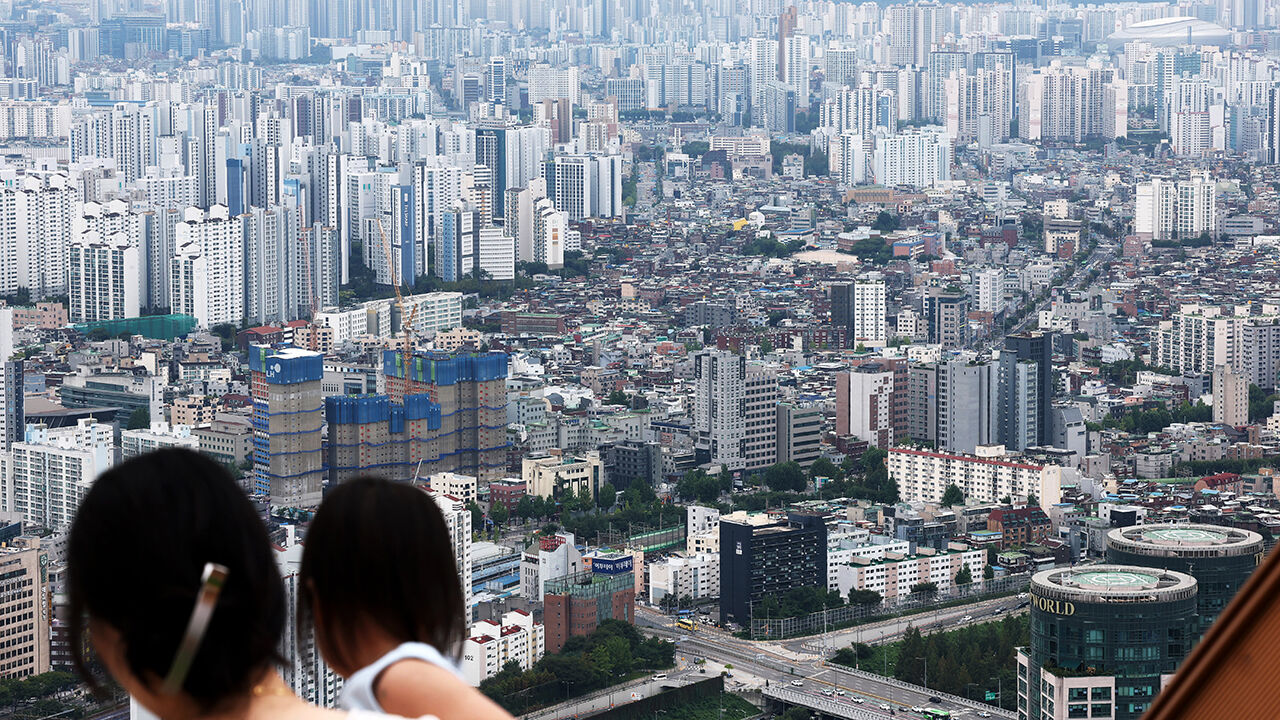
▲ Apartments viewed from the 63 Building observatory
An analysis has shown that if Seoul's rising housing prices coincide with the government's overhaul of the comprehensive real estate holding tax, the number of apartments subject to the holding tax could increase significantly even in non-Gangnam areas.
Based on the top five complex market prices in each of Seoul's 25 autonomous districts, there are currently 19 districts with complexes subject to the comprehensive real estate holding tax. However, by 2030, this is projected to expand to 22 districts under non-resident criteria, meaning residents across almost all of Seoul except for Gangbuk, Geumcheon, and Dobong districts will pay the holding tax.
According to an analysis of 34-pyeong apartments across 125 complexes—comprising the top five KB market price complexes in each of Seoul's 25 autonomous districts—based on a simulation model submitted by KB Kookmin Bank to Representative Shin Dong-wook of the People Power Party on the National Assembly's Political Affairs Committee, 78 complexes across 19 districts are subject to this year's holding tax under the simulation.
Assuming that Seoul apartment prices maintain the same growth rate (11%) as the past year (from June 2025 to May 2026), the figures are projected to increase to 101 complexes across 22 districts under non-resident criteria by 2030.
Taxable targets will newly emerge even in Gwanak, Nowon, and Jungnang districts, where none of the five sample complexes currently pay the holding tax. As the taxation scope broadens to most autonomous districts excluding Gangbuk, Geumcheon, and Dobong, 23 out of 47 currently tax-exempt complexes will newly pay the holding tax by 2030.
Four complexes each will be added in Gangseo, Gwanak, Guro, and Eunpyeong districts, three in Seongbuk district, two in Jongno district, and one each in Nowon and Jungnang districts.
For instance, a 34-pyeong unit at DMC SK View in Eunpyeong District is currently exempt from the holding tax, but it is calculated to incur the holding tax under non-resident criteria starting in 2029, paying approximately 1.13 million won by 2030.
The analysis showed that the number of taxable targets will temporarily decrease right after the tax system reform before rising again as housing price increases accumulate.
Taxable complexes under non-resident criteria will decrease from 78 this year to 68 in 2027, before continuously increasing to 82 in 2028, 94 in 2029, and 101 in 2030.
The scale of the tax burden increase is even larger. The total comprehensive real estate holding tax amount, reflecting the total number of households across all 125 complexes, is estimated to surge 8.9-fold from 58.9 billion won this year to 526.2 billion won by 2030 under non-resident criteria.
Under owner-occupancy criteria as well, the amount will increase 5.7-fold to 334.7 billion won.
When taking a simple average of the holding tax per unit across the complexes, the amount jumps from 951,338 won this year to 8.428,401 won under non-resident criteria (8.9 times) and 5,549,778 won under owner-occupancy criteria (5.8 times) by 2030.
This upward trend has been relatively steep in non-Gangnam areas, where the current holding tax burden is small.
The combined holding tax for major complexes in Eunpyeong, Guro, Seongbuk, Gangseo, Dongdaemun, Gwanak, Nowon, and Jungnang districts will increase from about 720,000 won this year to approximately 40.58 million won by 2030 under non-resident criteria.
Even assuming that the housing price growth rate slows down to an annual 5.5%, which is half of the rate recorded over the past year, the tax burden is analyzed to increase significantly.
Under this scenario, taxable targets under non-resident criteria in 2030 are projected at 82 complexes across 19 districts, with four currently tax-exempt complexes newly included, all of which are located in Gangseo District.
The total holding tax for all 125 complexes is calculated to reach 292.6 billion won under non-resident criteria by 2030—about five times this year's figure—and 171.9 billion won under owner-occupancy criteria, a 2.9-fold increase.
As a representative example, for a 34-pyeong unit at Godeok Grashium in Gangdong District, this year's holding tax is about 570,000 won. Even assuming housing prices rise by 5.5% annually, it will swell about fivefold to approximately 2.88 million won under non-resident criteria by 2030, and rise to about 6.59 million won by 2030 if an 11% annual increase is assumed.
While the extent to which holding tax-imposed areas will expand depends heavily on the pace of housing price increases, a cumulative rise above a certain level means the tax burden on existing taxable targets could grow substantially.
Reflecting the government's tax reform bill and revisions, this scenario applied a basic deduction of 1.4 billion won for owner-occupants and 1.2 billion won for non-residents from 2027 onward, along with a fair market value ratio of 70% and a tax burden ceiling of 150%.
Representative Shin Dong-wook pointed out, "Although the government's tax reform proposal was partially revised, it has brought great confusion to the real estate market," adding, "Going forward, the comprehensive real estate holding tax will effectively become a 'Seoul citizen tax' levied even on ordinary citizens who own a single home in Seoul."
(Photo: Yonhap News)
※ Please note: This article was translated by AI and may contain errors.




 Video News
 Video News
 Video News
 Video News