
 KOR
KOR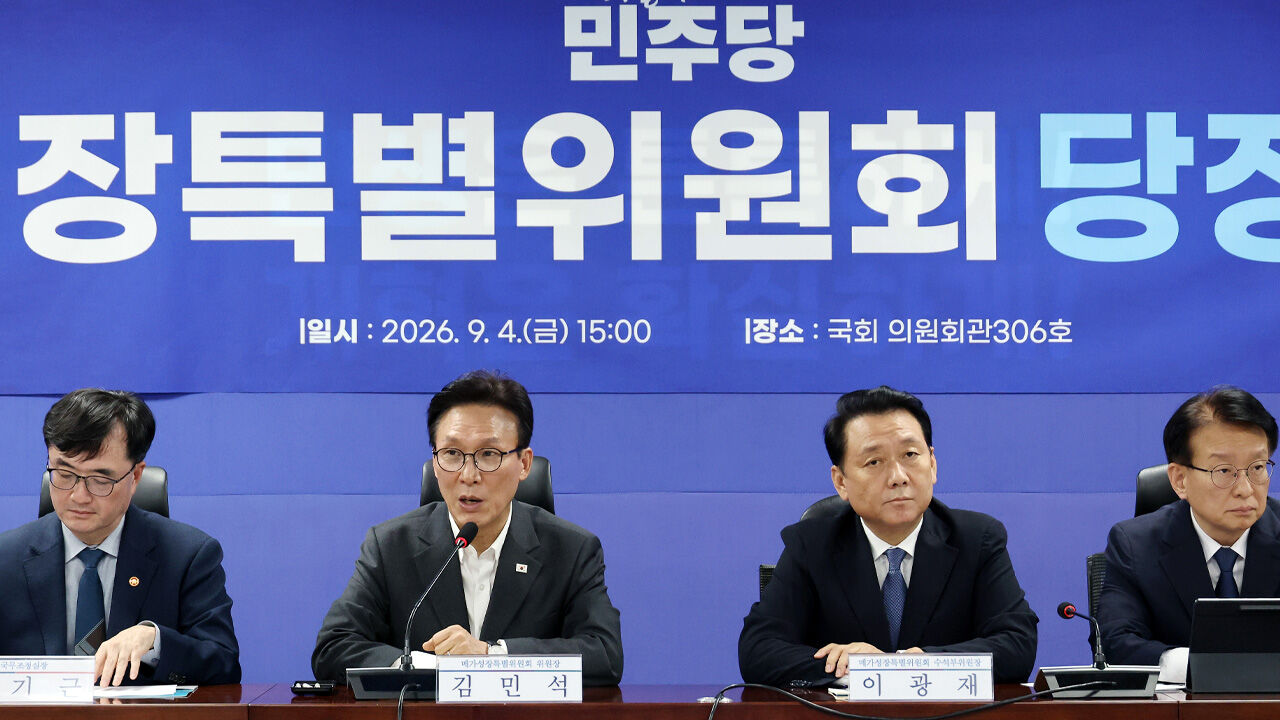
▲ Democratic Party leader Kim Min-seok speaks during a party-government consultative meeting of the Mega Growth Special Committee held at the National Assembly Members' Office Building on the 4th.
The Democratic Party and the government have decided to propose the "Mega-Special Zone Special Act" bill to support mega projects within this month and process it in the National Assembly within the year.
The ruling party's Mega Project and Regional Growth Special Committee held a party-government consultative meeting at the National Assembly today (the 4th) and received a report from Office for Government Policy Coordination Minister Lim Ki-keun on the contents and provisions of the Mega-Special Zone Special Act prepared by the government.
Rep. Chang Cheol-min, the secretary of the special committee, explained in a briefing after the meeting, "There have been several reports from government ministries regarding the mega-special zone, but this was the first time we saw the drafted provisions." He added, "Since the bill is not being proposed as-is, we discussed legislative strategies today."
Rep. Chang said, "Given the speed of party-government coordination, the bill will naturally be proposed within September," and added, "With next month's parliamentary audit approaching, the bill must be proposed this month if it is to pass within the regular session of the National Assembly."
Rep. Park Sang-hyeok, the ruling party's secretary for the National Assembly's House Steering Committee, has decided to representatively propose the bill.
Rep. Chang stated, "Because the special act contains a lot of content, it is difficult to make it a 100% complete bill from the start," and added, "Rather than proposing it as an official party bill, we will propose it as lawmakers' legislation in the committee and enhance its completeness through debate."
He continued, "We plan to follow the legislative steps to pass the special act through the process of making it a party platform."
Regarding whether the special act bill will include contents to ease the 52-hour workweek, Rep. Chang explained, "There seems to be some misunderstanding (in some circles), but there are no legal provisions worded like an exception to the 52-hour workweek."
Rep. Chang said, "There are already contents known as white-collar exemption (easing working hour regulations for high-income professionals) or selective working hour systems," and added, "Even the white-collar exemption is not stated in the law as an exception to the 52-hour workweek."
He added, "This is my personal view, but (the government bill) contains the government's deliberation on how to shape a Korean-style version of the white-collar exemption system into provisions."
Democratic Party leader Kim Min-seok said in his opening remarks, "We view the integrated Jeonnam-Gwangju region as a testbed for mega growth," and added, "Improvements in settlement conditions, enhancement of cultural quality, and improvement of the medical environment must move together."
Policy Committee Chair Kwon Chil-seung said, "We are well aware of the concerns raised by the labor sector regarding labor-related (corporate) privileges (for the mega-special zone)," and added, "A social grand compromise process to gather the opinions of the parties involved is necessary to harmonize regulatory innovation to boost corporate competitiveness with the protection of workers' rights and interests."
Office for Government Policy Coordination Minister Lim Ki-keun said, "Through the mega-special zone, we will provide unprecedented regulatory exemptions to investing companies," and added, "We will create regional growth hubs equipped evenly with housing, transportation, education, medical care, culture, and a small and medium-sized enterprise ecosystem."
Attendees from the government side at the party-government consultation that day included Minister Lim, Vice Minister of Trade, Industry and Energy Moon Shin-hak, and Lee Byung-hun, acting chairperson of the Presidential Committee for Balanced National Development.
(Photo: Yonhap News)
※ Please note: This article was translated by AI and may contain errors.



 Video News

 Video News
 Video News
