
 KOR
KOR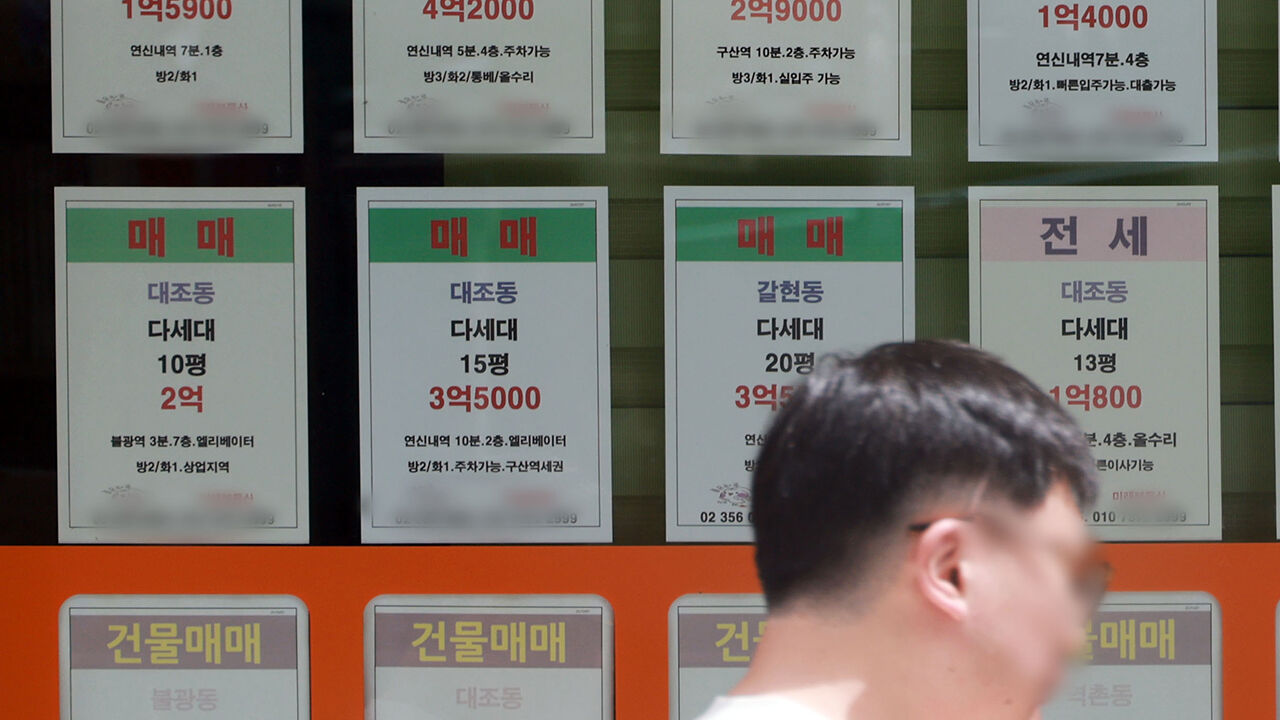
▲ A real estate agency in Seoul
The popularity of the Bogeumjari Loan appears to be waning as fixed interest rates have risen steeply recently.
According to the Korea Housing Finance Corporation (KHFC) today (the 2nd), new Bogeumjari Loan sales in July reached 1.6127 trillion won, a sharp 25.4% plunge from June (2.1623 trillion won).
This was the lowest figure in 13 months since June of last year (1.5714 trillion won).
The Bogeumjari Loan is a long-term, fixed-rate, installment-repayment mortgage supplied by the Korea Housing Finance Corporation.
It is available for those purchasing a home valued at 600 million won or less with a combined annual household income of 70 million won or less, with a maximum loan maturity of up to 50 years.
Monthly sales of this product dropped to 283.2 billion won in May 2024 before gradually increasing, surpassing 1 trillion won in November of that year and 2 trillion won in September of the following year.
Entering this year, sales reached 2.5675 trillion won in February, marking a high not seen in two years and three months since November 2023 (3.0688 trillion won), but have steadily declined again since March.
Analysts attribute the recent sluggishness in Bogeumjari Loan sales to its diminished rate competitiveness compared with mortgage loans offered by commercial banks.
The KHFC raised Bogeumjari Loan rates for five consecutive times: by 0.25 percentage points (p) in January, 0.15 percentage points in February, 0.30 percentage points in April, 0.25 percentage points in May, and 0.30 percentage points in July.
Consequently, the base interest rate for the "Akhim-e Bogeumjari Loan" has risen to between 4.90% (10-year maturity) and 5.20% (50-year maturity) per annum.
This lower bound is higher than the variable mortgage rates of the five major banks (KB Kookmin, Shinhan, Hana, Woori, and NH Nonghyup) as of the 28th of last month, which ranged from 4.38% to 6.46% per annum based on the new COFIX.
In particular, for the "u-Bogeumjari Loan," which is applied for via the KHFC website, the minimum applicable interest rate in July reached 5%, marking the highest level in 14 years since July 2012 (5%).
As fixed rates have recently risen above variable rates, the phenomenon of loan demand shifting toward variable-rate products has persisted for a considerable period.
This is because 5-year bank bonds, which serve as the benchmark rate for fixed-rate mortgages and other loans, have been pre-reflecting expectations of benchmark interest rate hikes.
According to the Bank of Korea, the proportion of fixed-rate mortgage loans at depository banks in July stood at 31.9%, dropping to its lowest level in 12 years and 5 months since February 2014 (31.8%).
Bogeumjari Loan rates are determined based on factors such as 5-year Treasury bond yields and the issuance rates of mortgage-backed securities (MBS) by the Korea Housing Finance Corporation.
An official from the Korea Housing Finance Corporation stated, "Loan demand has partially declined due to rising interest rates," adding, "Even if the Bogeumjari Loan maintains rate competitiveness, if the absolute interest rate level is high, the repayment burden increases and overall demand can shrink."
(Photo: Yonhap News)
※ Please note: This article was translated by AI and may contain errors.



 Video News
 Video News
 Video News
 Video News
 Video News