
 KOR
KOR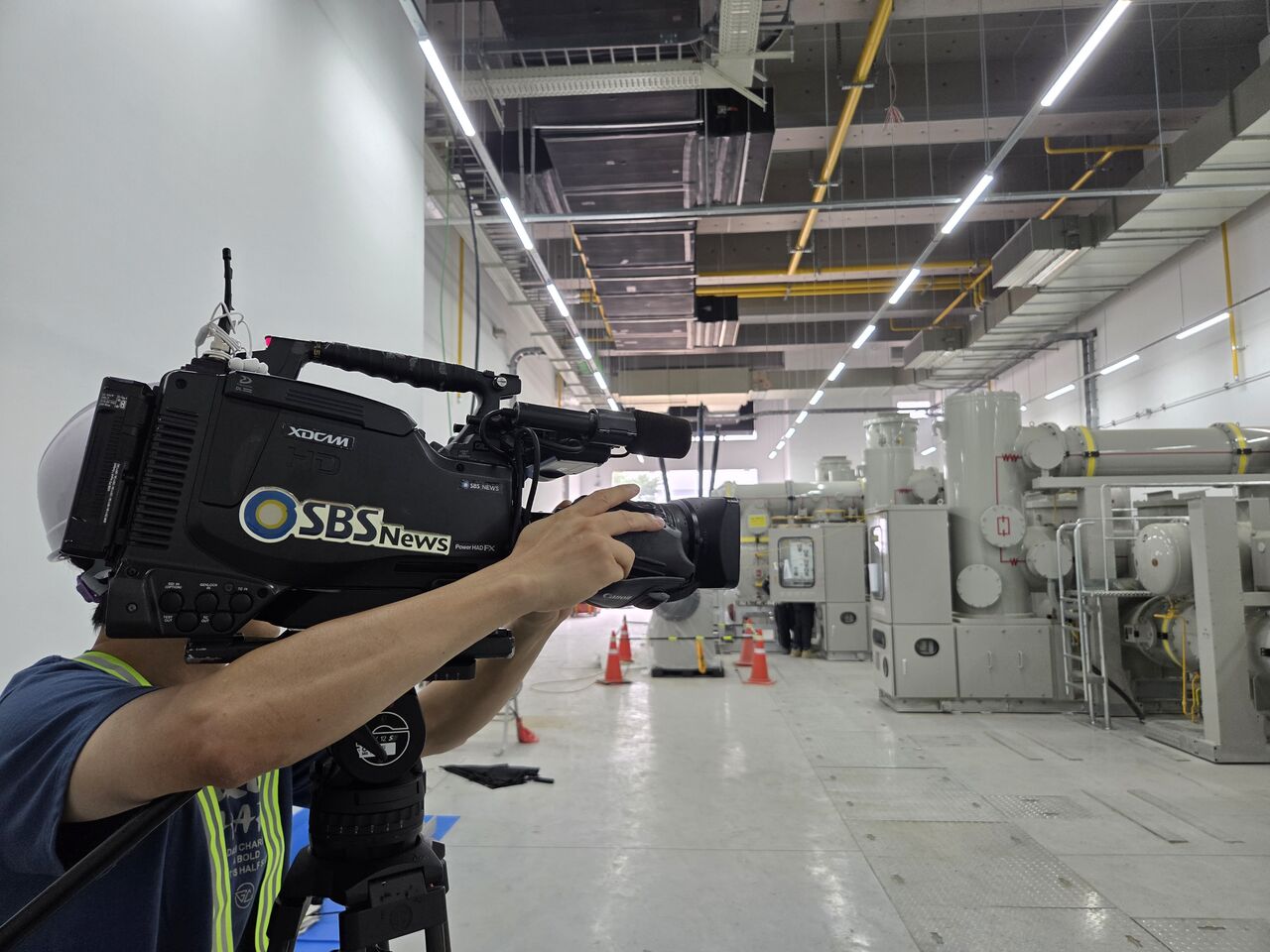
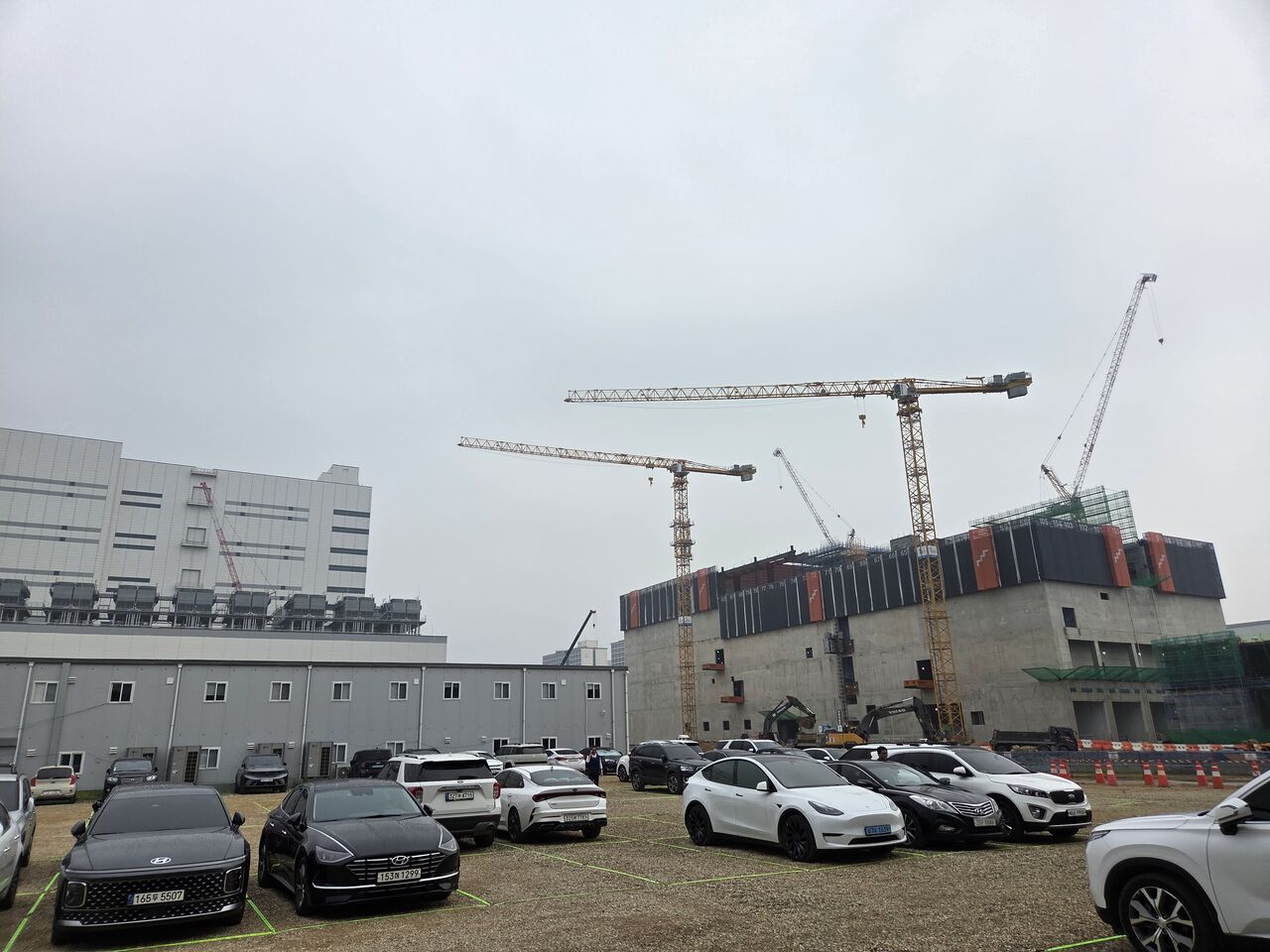
Building 1 is scheduled for completion in June next year, and its capacity has already been fully sold out. Buildings 2 and 3 will be built additionally by 2028, according to LG Uplus.
The electricity secured by this facility from KEPCO is 200 megawatts. Operating at full capacity year-round, this equals the annual electricity consumption of 590,000 households. It is a capacity capable of running tens of thousands of state-of-the-art AI semiconductors. This is the only data center in the Seoul metropolitan area to secure such a massive amount of power.
If Demand Fluctuates, Everything Shakes
The Basic Plan is a 15-year statutory plan formulated every two years under the Electricity Business Act. A steering committee made up of private experts appointed by the government draws up a working draft, and the government finalizes it. It first forecasts how much electricity will be needed and determines the proportions of nuclear, coal, LNG, and renewable energy, as well as the scale of the transmission grid accordingly. If the starting point—the demand forecast—falters, all subsequent calculations are thrown off.
The demand forecast is derived by adding additional demand from semiconductors and data centers and electrification demand to "model demand" based on economic growth rates, and then subtracting demand management and load shifting effects from energy saving and efficiency improvements. The biggest change this time is the additional demand from semiconductors and data centers.
■ Basic Plan Shifted with Every Administration
The Basic Plan for Electricity Supply and Demand has been established on a two-year cycle since the first plan in 2002. Although it is a 15-year plan looking ahead, the roles of nuclear power and renewable energy have reversed whenever administrations changed.
8th Plan (2017): The Moon Jae-in administration's energy transition policy was reflected. Six planned new nuclear power plants were scrapped, and lifespan extensions for 10 aging reactors were halted. Wolsong Unit 1 was also excluded from the supply list.
9th Plan (2020): Thirty coal-fired power plants reaching their 30-year operational limit by 2034 were to be shut down, with 24 of them converted to LNG.
10th Plan (2023): Under the Yoon Suk Yeol administration, the direction shifted again. The resumption of construction for Shin-Hanul Units 3 and 4 was reflected in the plan, and the share of nuclear power generation in 2030 rose to 32.4%.
11th Plan (February 2025): Two new large-scale nuclear reactors and one Small Modular Reactor (SMR) were included. The working draft initially proposed up to three large reactors, but as opposition parties pushed back during reporting to the National Assembly, the government adjusted the plan by reducing one nuclear reactor and increasing solar power by 2.4 gigawatts. The site for the two large nuclear reactors was selected as Yeongdeok, North Gyeongsang Province, in June this year, and the site for the SMR was chosen as Gijang, Busan.
12th Plan (In Progress): This is the first Basic Plan overseen by the Ministry of Climate, Energy and Environment following the change of administration. It adopted an "open" format featuring repeated public forums starting from the tentative draft stage. Whether additional nuclear power plants will be built beyond those reflected in the 11th Plan will be decided in this plan.
Four Months, 26 Nuclear Reactors
At the third public forum in April, the steering committee for the 12th Basic Plan projected peak power demand in 2040 at 131.8 to 138.2 gigawatts. Additional demand for semiconductors and data centers was estimated at around 4 gigawatts each.
Two months later, the game changed completely. On June 29, the government announced the "Three Mega Projects." Minister of Climate, Energy and Environment Kim Sung-whan summarized the background of the surge in demand at the forum: the completion timeline for the Yongin Semiconductor Cluster was accelerated, a new plan was established to build four semiconductor plants in the Honam region, and previously unprojected demand for AI data centers was added. The site for the Honam semiconductor cluster was later designated at Gwangju Military Airport in July.
The recalculated results were presented at the fifth public forum held at the National Assembly on August 20.
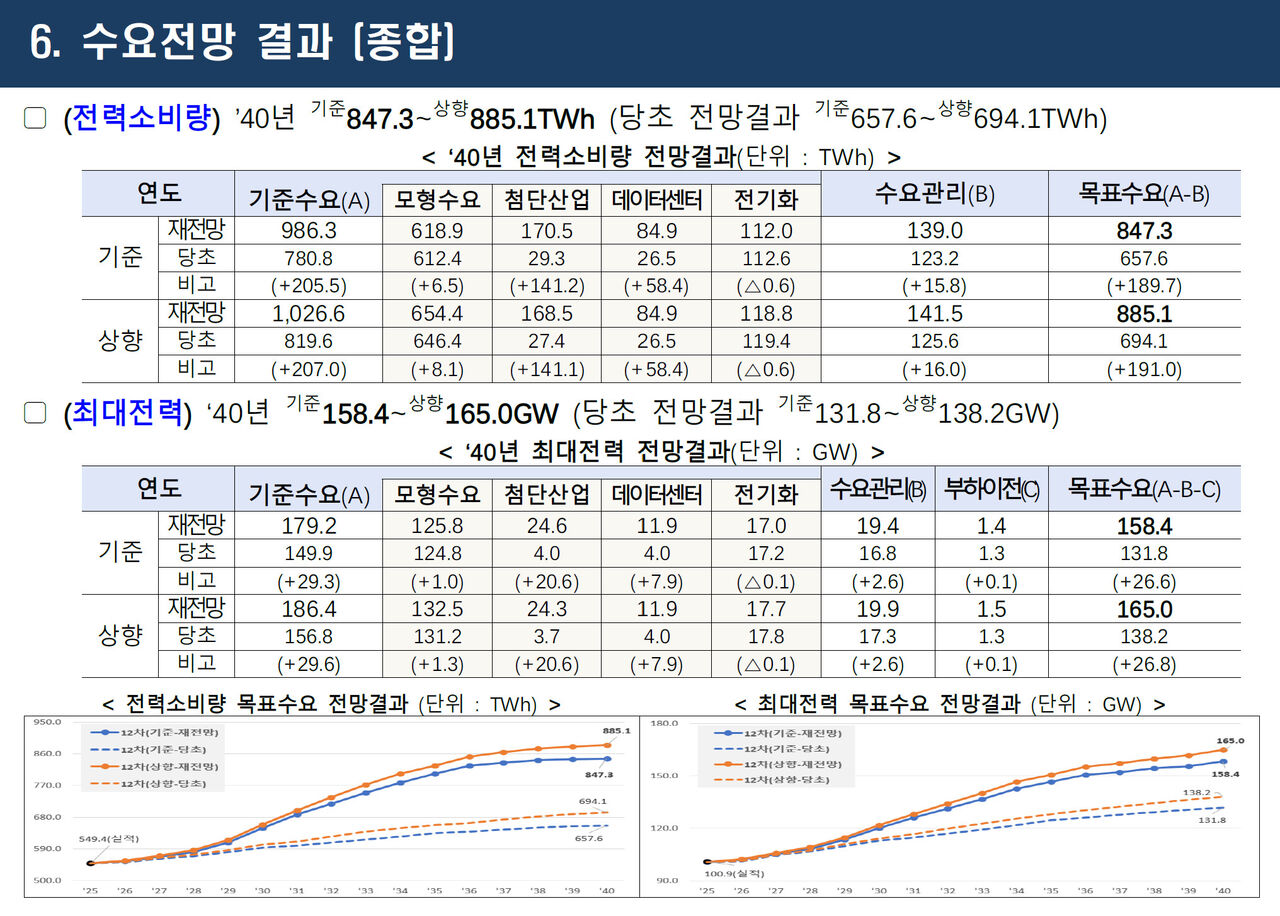
Peak electricity demand for 2040 was estimated at 158.4 to 165.0 gigawatts—an increase of nearly 27 gigawatts compared to four months ago.
Professor Yoo Seung-hoon of Seoul National University of Science and Technology offered this comparison: "Compared to the figures announced in April, demand grew by 26.6 gigawatts in just four months. That is an amount requiring us to build as many new nuclear reactors as currently exist in our entire country." South Korea currently operates 26 nuclear reactors with a total capacity of approximately 26 gigawatts. Converted to the latest large-scale reactors (1.4 GW class), it corresponds to 19 units.
Professor Choi Yong-ok of Chung-Ang University, a member of the demand planning committee for the 12th Basic Plan who presented the revised forecast, explained:
"Demand did not increase because we raised the economic growth rate assumptions. Incorporating large-scale investment plans in semiconductors and AI data centers that materialized since late June accounts for most of it."
92% for Semiconductors, 52% for Data Centers
"We did not reflect all announced investment plans directly into demand. We reviewed the implementing entities, the specificity of investment plans, project progress, and market uncertainties. Deeming semiconductors and AI data centers to carry different levels of uncertainty, we applied different methods of reflection."
Semiconductor companies presented a potential demand of approximately 40 gigawatts based on contracted electricity, citing the early completion of the Yongin cluster, new projects in Honam, and fab expansions in Pyeongtaek and Cheongju. Of this, 36.8 gigawatts were reflected. In contrast, for data centers, only the concrete Phase 1 capacity of 10.8 gigawatts out of 20.8 gigawatts in corporate investment plans was included. In his presentation, Professor Choi stated, "The 10 gigawatts in Phase 2 were not reflected in this forecast," adding that they will monitor market conditions and actual project progress.
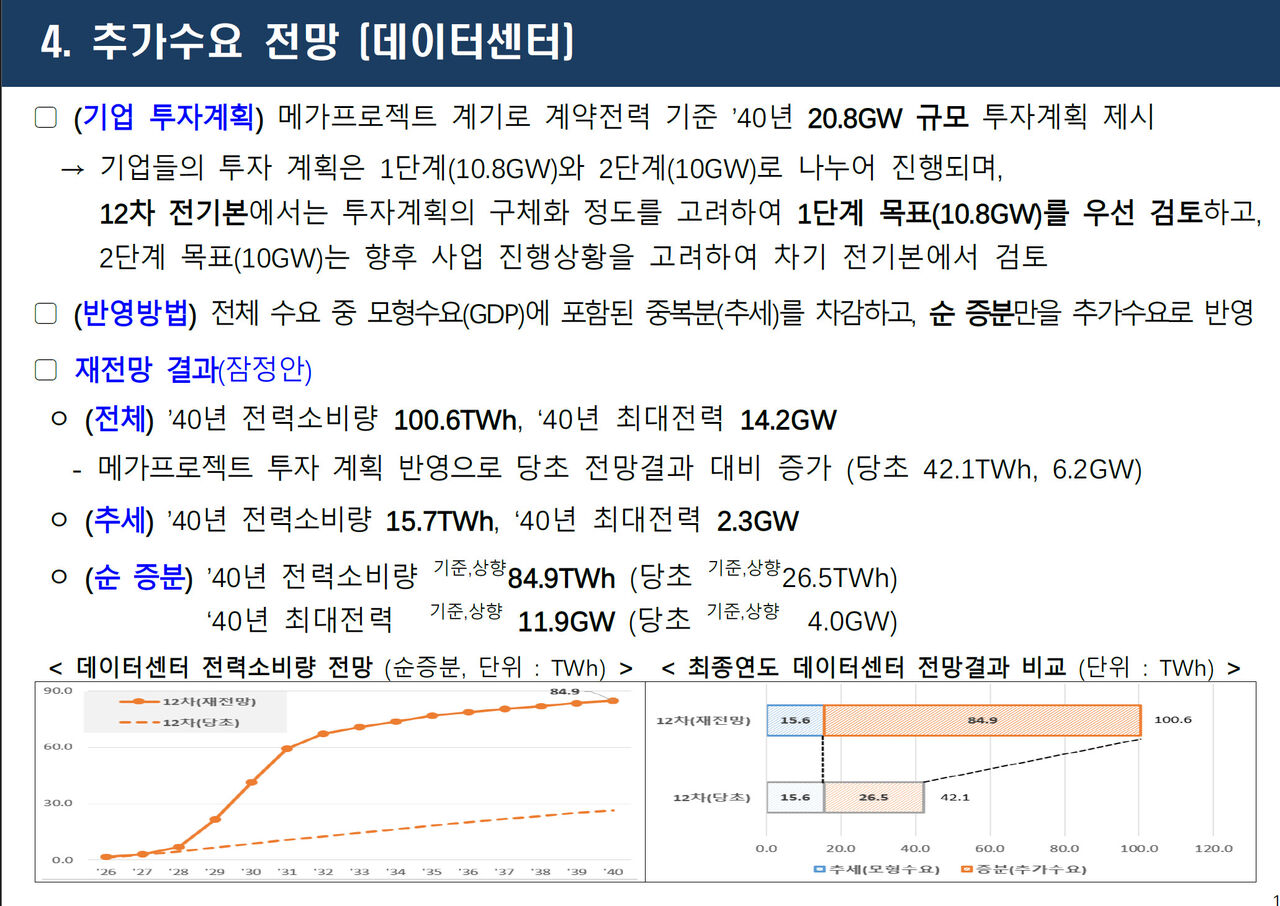
The 36.8 gigawatts and 10.8 gigawatts represent the volumes initially decided to be incorporated into this forecast from corporate investment plans. Adjusting these so they do not overlap with existing growth trends and reflecting load characteristics during peak power hours resulted in additional 2040 demand calculated at 24.3 to 24.6 gigawatts for semiconductors and 11.9 gigawatts for data centers.
Compared with the April forecast, semiconductors rose by 20.6 gigawatts and data centers by 7.9 gigawatts. Combining both yields 28.5 gigawatts. Combining changes in model demand and electrification demand, along with enhanced demand management and load shifting effects, resulted in a net increase in the final peak power forecast of 26.6 to 26.8 gigawatts.
Why treat semiconductors and data centers differently?
Professor Yoo, who served as head of the steering subcommittee for the 9th Basic Plan, considered this judgment reasonable.
"Data centers often apply to use 100 units of electricity, but in reality, they frequently use only 30 or 50."
He also added his personal experience: "During the 9th and 10th plans as well, there were fierce debates over whether to reflect everything. In the end, we only reflected about half back then too, and that turned out to be the right call."
As evidence, he cited current demand: "Currently, the electricity demand of all data centers across the country is only 1 gigawatt. We need to look prudently at whether it will truly expand by 15 times."
Professor Choi also explained during the presentation why semiconductors were assessed favorably: "The most important reason is the business entity." The fact that globally proven corporations like Samsung Electronics and SK Hynix are directly investing determined the feasibility assessment. In Professor Yoo's words, these are "tangible" investments, like the Pyeongtaek expansion and the pace of construction in Yongin.
Formulas Are Visible, but Criteria Are Not
The renewable energy forecast released by the same steering committee on August 26 was different. It provided a formula showing that 45 gigawatts of offshore wind power was calculated by adding the current 0.4 gigawatts, 24.6 gigawatts of existing permitted volume, and 20 gigawatts of newly planned site allocations. The supply side showed the math, but the demand side has yet to do so.
Environmental groups issued statements demanding verification of what constitutes confirmed demand versus potential demand. They argued that it remains unclear whether Phase 1 data centers will even operate at full capacity as planned. Underneath lies the suspicion that inflating demand might be used to justify adding more nuclear power plants.
The demand management target intended to reduce consumption through energy saving and efficiency improvements was also raised in the baseline scenario from 16.8 gigawatts in April to 19.4 gigawatts. This aims to save an amount equivalent to two large nuclear reactors, but the presenter themselves called it a "fairly challenging goal." If the goal is not met, electricity will fall short by that exact amount.
Inflating demand leads to building power plants that won't be used, and those costs are passed on to electricity bills. Conversely, underestimating demand leaves factories without power. Minister Kim acknowledged this dilemma at the forum.
"Accurately predicting electricity demand through 2040 is virtually close to impossible."
Professor Yoo's answer is a phased response: "If data centers increase faster than expected, responding by building more power plants at that time will not be too late."
Professor Yoo also added a prerequisite: "Conversely, the three mega projects must succeed so that this does not result in excess capacity." For the demand forecast to be accurate, the factories that will create that demand must actually be built and run. On the other hand, demand could grow even further. For the Honam semiconductor cluster, adding two more fabs on top of the four previously planned is currently being reviewed.
Remaining Bill
The first answer on the supply side came on August 26. At the sixth public forum, the steering committee released a tentative projection to expand commercial renewable energy facilities to 100 gigawatts by 2030 and 220 gigawatts by 2040. That is six times the current 37 gigawatts. Solar power accounts for most of it at 155 gigawatts, while offshore wind power, currently at only 0.4 gigawatts, is planned to expand to 45 gigawatts.
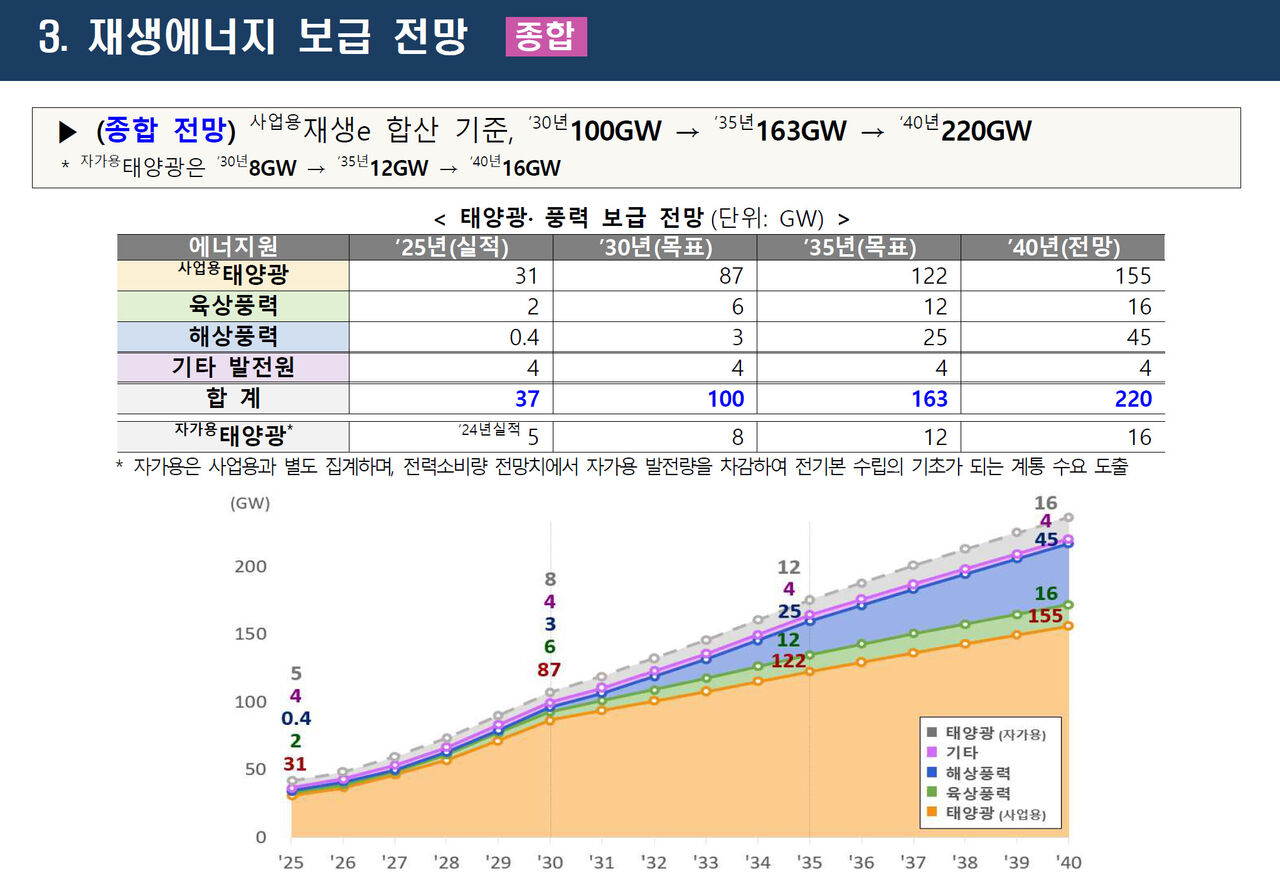
However, installed capacity differs from actual power generation. At the forum on the morning of August 20, an analysis showed that the annual power generation from 100 gigawatts of renewable energy would cover about 58% of the annual electricity consumption of the mega projects. The industrial sector shares this view. At a national briefing in June, Samsung Electronics Vice Chairman Jun Young-hyun suggested to the government expanding nuclear power and LNG combined heat and power generation to compensate for the intermittency of renewable energy. This is a request from the side that will consume the most electricity.
Moves regarding nuclear power are accelerating. In a recent written response to the National Assembly, the Ministry of Climate, Energy and Environment made it official that it is reviewing whether to include new nuclear power plant construction and will consult on extending the permitted continuous operation period of nuclear reactors from 10 years to 20 years.
When asked if the timing works, Professor Yoo pointed to available sites as evidence: "Even if public deliberation takes time, utilizing currently secured sites would mean no major issues in supplying electricity by building nuclear power plants in a timely manner." Spare sites exist in Kori, Yeongdeok, and Hanbit, saving three to four years needed for site designation.
Cost issues also remain. Professor Yoo highlighted the funding structure of the transmission grid: "Because KEPCO is required to bear 100% of the cost for the transmission grid, it becomes a factor driving up electricity bills. For railway and highway networks, 30% to 50% of the funding comes from state funds." He suggested that follow-up measures are needed to transition the transmission grid to a similar structure.
Right after the presentations at the August 20 forum, the moderator summarized: "This is not a place to announce finalized figures, but a forum to disclose them and undergo verification." This number, which surged by the equivalent of 19 nuclear reactors in just four months, will be finalized by the end of the year after going through a government draft in October.
※ Please note: This article was translated by AI and may contain errors.





 Video News
 Video News