
 KOR
KOR
▲ The Bank of Korea
With the Bank of Korea's (BOK) August Monetary Policy Board meeting just a day away, the financial investment industry is paying the closest attention to whether the benchmark interest rate will be hiked or frozen, as forecasts remain divided.
However, market watchers point to the dot plot—which contains the monetary policy board members' interest rate projections—as the core variable that will dictate market volatility thereafter.
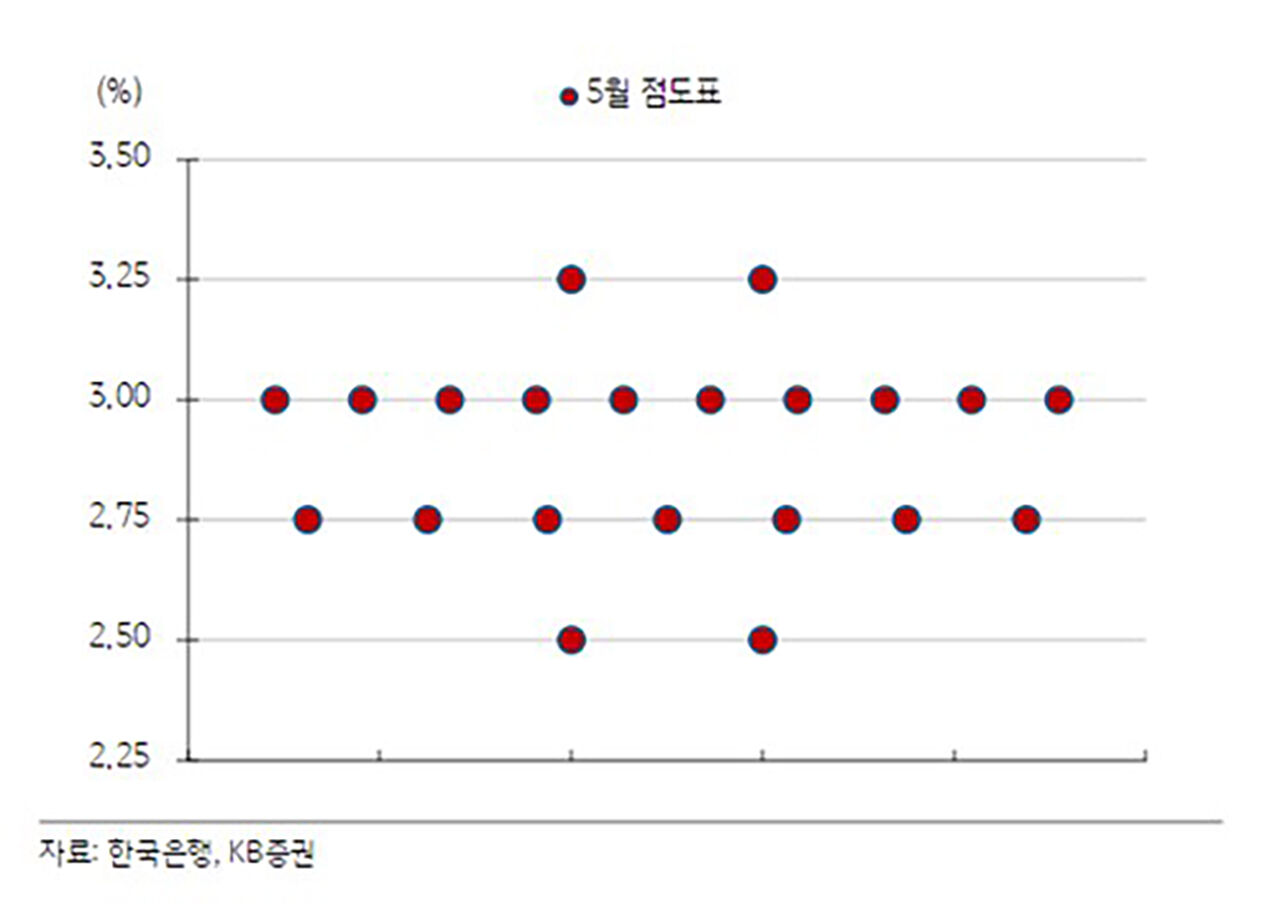
According to the financial investment industry on August 26, the BOK will not only decide on whether to raise the base rate at the policy board meeting on August 27, but also release updated economic forecasts and a six-month base rate dot plot.
Market forecasts for interest rates are split.
Opinions are evenly matched between expectations for consecutive hikes following July and a freeze.
Those expecting a freeze emphasize that the situation is not urgent enough to require the BOK to pursue consecutive base rate hikes.
They also cite the expiration of the term of former BOK Senior Deputy Governor Rhee Sang-hyung, who had shown hawkish tendencies.
If the rate is frozen, they expect two dissenting votes for a hike, including board member Chang Yong-sung.
On the other hand, while headline inflation has slowed, core consumer inflation remains high and oil prices have rebounded, serving as factors that raise the possibility of consecutive hikes.
Upside risks to growth have also grown, increasing the likelihood that demand-side inflationary pressures will persist for a prolonged period.
According to the Korea Financial Investment Association the previous day, a bond market survey conducted last week showed that 79% of 100 respondents predicted a rate freeze by the BOK, while 20% expected a hike.
Attention is expected to shift toward the dot plot following the rate decision.
The financial investment industry anticipates that in this dot plot, which contains rate projections through the first quarter of next year, the median value will rise from 3.00% in last May to 3.25%, and the upper bound will increase from 3.25% to 3.50%.
Im Jae-gyun, an analyst at KB Securities, analyzed, "As the market has already priced in a terminal base rate of up to 3.50%, there will be no major shock unless a dot projecting 3.75% is presented."
Conversely, some evaluations suggest that if the number of dots below 3.25% increases, concerns over tightening could be alleviated.
A bond trader at a securities firm said, "While the base rate decision itself is the most important aspect of this Monetary Policy Board meeting, the dot plot is also crucial," adding, "We need to examine whether more dots are clustered at 3.25% or 3.50% on the dot plot."
Economic forecast figures are also materials that need to be examined.
The prevailing view is that the BOK will maintain its annual inflation forecast at 2.7% while revising core consumer inflation upward, and raise its annual growth forecast to the 3.2 – 3.3% range.
Cho Yong-gu, an analyst at Shinhan Securities, predicted, "If the growth forecast does not deviate significantly from market expectations and the median value of the dot plot within the next six months is positioned at 3.25%, market interest rates will show a stable trend rather than additional surges."
The trajectory of government bond yields after the monetary policy meeting is expected to vary by maturity.
Short-term yields could experience increased volatility around the time of the base rate decision.
In particular, as yields on 91-day Certificates of Deposit (CDs) have not fully reflected base rate hikes thus far, an August rate hike could cause yields to rise in the short term, and even in the event of a freeze, yields could rise by reflecting a rate hike in October.
As long-term yields are influenced more heavily by expansionary fiscal policies, government bond supplies, and long-term US yields rather than monetary policy, market attention is expected to focus on next year's budget bill and the government bond issuance plan, which are set to be unveiled as early as the end of this month.
Kim Myung-sil, an analyst at iM증권 who forecasts an August rate hike, said, "Following the BOK decision, we expect a yield curve steepening path where the spread between short- and long-term yields widens again due to the combination of short-term material exhaustion-driven strength and long-term supply burdens."
(Photo: Yonhap News)
※ Please note: This article was translated by AI and may contain errors.



 Video News


 Video News