
 KOR
KOR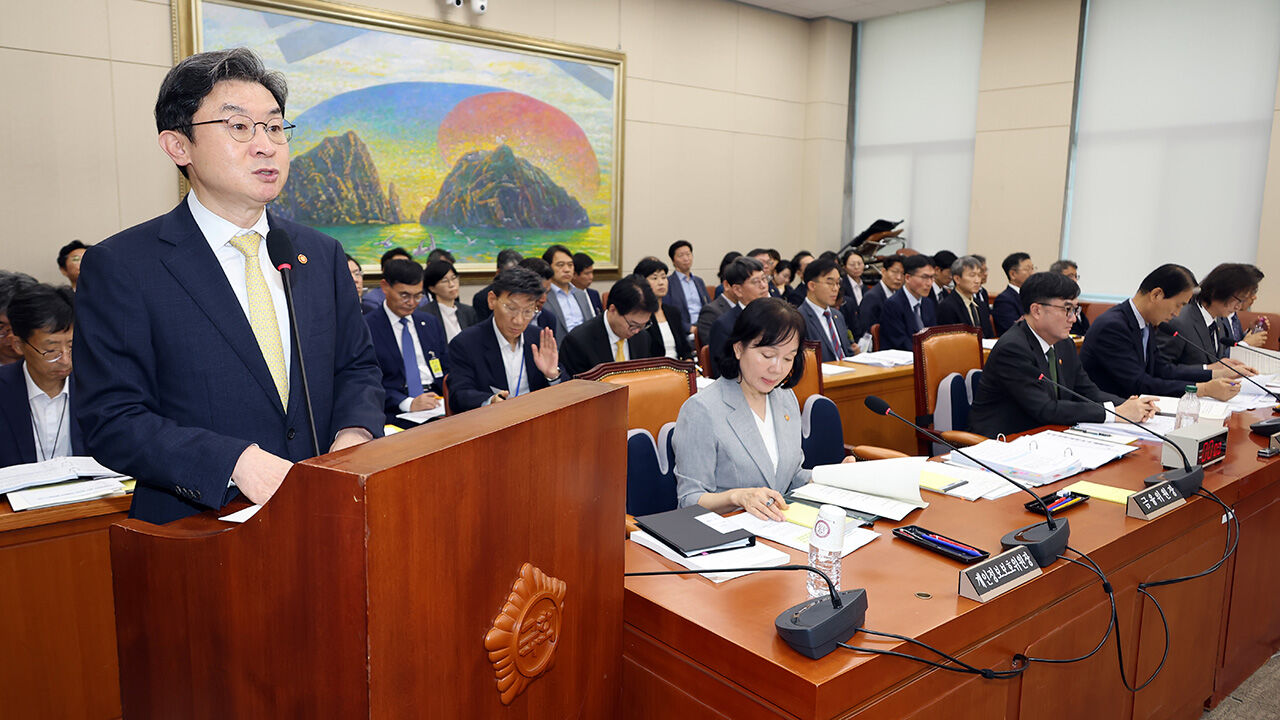
▲ Financial Services Commission Chairman Lee Eok-won delivers the closing report for the fiscal year 2025 at the first full meeting of the National Policy Committee at the National Assembly on the 24th.
Financial Services Commission Chairman Lee Eok-won stated today (the 24th) that the "union member sale price" will serve as the standard for reforming the loan-to-value (LTV) calculation method for relocation loans.
Chairman Lee made the remark during an afternoon session of the National Assembly's National Policy Committee in response to a query from People Power Party lawmaker Kim Jae-seop, who requested specific criteria for calculating LTV on relocation loans.
During the announcement of comprehensive real estate financial policies on the 13th, the Financial Services Commission reformed its calculation method to base LTV screenings for relocation loans on the larger amount between the pre-project asset appraisal value and the post-project asset appraisal value.
In response to Lawmaker Kim's point that specific criteria regarding the post-project asset appraisal value are necessary to prevent confusion in the field, Chairman Lee stated, "It will be based on the union member sale price. Once the management and disposal plan is authorized, the union member sale price is determined, which then becomes the collateral value."
Specifically, the "union member sale price" mentioned by Chairman Lee refers to the estimated value of the planned building finalized at the time of authorization for the management and disposal plan.
In other words, it is the amount reported in accordance with the Act on the Maintenance and Improvement of Urban Areas and Dwelling Conditions for Residents.
Regarding the upward adjustment of the household loan total growth rate target, he explained, "When we initially proposed 1.5%, the nominal economic growth rate was 4.9%, but economic conditions have improved and it has become 13%. Due to rising demand and increased housing transaction volume, we took this measure by examining the actual demand portion; it does not mean we are simply granting all loans without restriction."
Addressing the "Youth Future Bogeumjari Loan," which opposition lawmakers criticized as trapping young people in non-apartment housing, he clarified, "Using this product does not cause individuals to lose their first-time homebuyer benefits. It simply provides a new, additional option."
Meanwhile, in response to questions from People Power Party lawmakers asking whether "stress tests" were conducted prior to the introduction of single-stock leverage exchange-traded funds (ETFs), he replied, "We examined what needed to be evaluated step-by-step by institution regarding the impact of the introduction."
This is interpreted to mean that while the single-stock leverage system did not constitute a new or strengthened regulation subject to regulatory review—and thus did not require a regulatory impact analysis—various review and evaluation procedures mandated during legal amendments were duly fulfilled.
(Photo: Yonhap News)
※ Please note: This article was translated by AI and may contain errors.



 Video News

 Video News

