
 KOR
KOR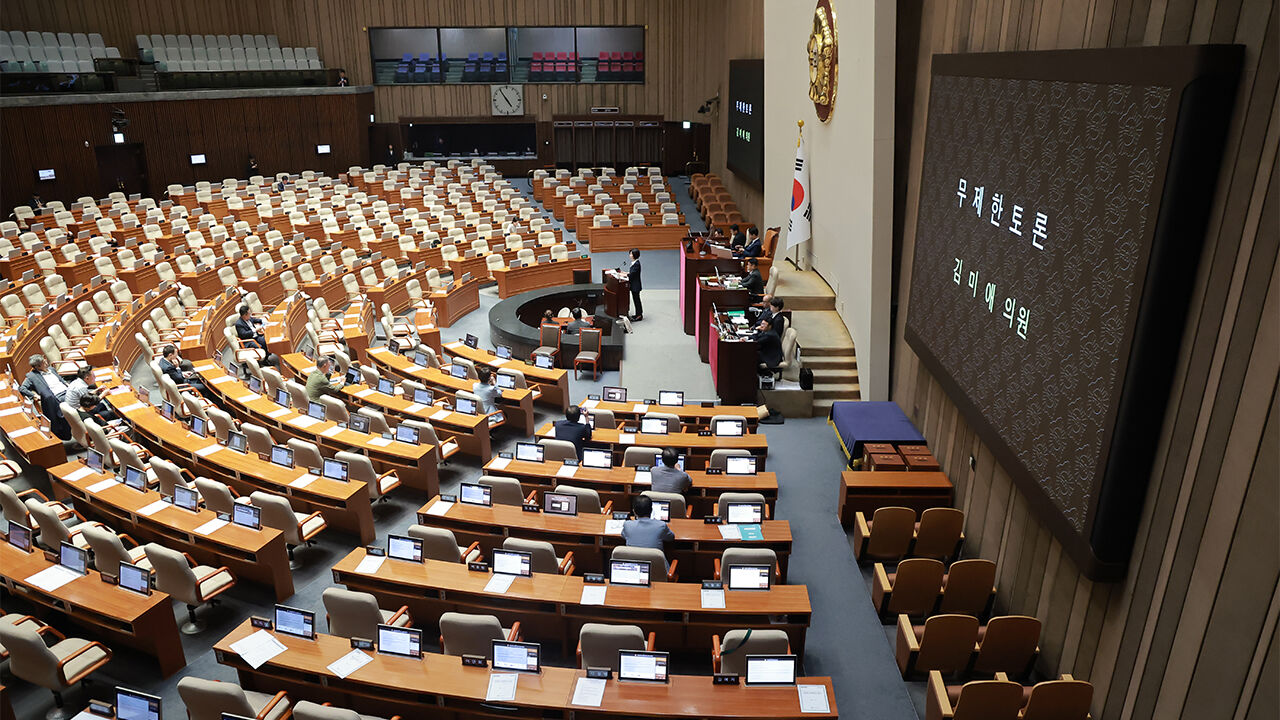
▲ The National Assembly (File photo)
The reason the government decided to create the "Future Response Fund" is to swiftly deploy anticipated massive additional tax revenues next year into strategic investments to rebound potential growth rates.
This stems from a sense of urgency that exhausting additional tax revenues from a short-term perspective or allocating them solely to fiscal soundness management could lead to missing the golden opportunity at a turning point of "great transformation."
It also reflects the resolve to create a platform on this occasion that can achieve stabilization and efficiency, moving away from the mismatched patterns of tax revenue and fiscal deployment.
However, some views suggest that as the government uses massive amounts of state funds in the form of a fund relatively free from parliamentary control, it could effectively degenerate into executing "constant supplementary budgets" without the consent of the National Assembly.
Projections suggest that the scale of the Future Response Fund could exceed 100 trillion won, and its specific scale and projects are scheduled to be included in the budget bill to be announced soon.
According to the "Future Response Fund Implementation Plan" released by the Ministry of Planning and Budget today (August 21), the financial resources of the Future Response Fund consist of four categories: ▲ additional tax revenue, ▲ excess tax revenue, ▲ remaining resources from the settlement of revenues (world surplus), and ▲ operating profits from idle funds.
The main source of income is projected to be additional tax revenue.
If the national tax revenue budget for the following year, announced by the government every August, exceeds the national tax trend value, the excess amount is recognized as "additional tax revenue" and transferred to the Future Response Fund.
If it falls below the trend value, funds are transferred from the fund to the general account.
Excess tax revenue is re-estimated based on actual taxes collected every September. If the national tax revenue budget is larger than the revenue budget originally projected the previous year, the increased amount is accumulated in the fund.
Likewise, if a revenue deficit occurs, funds are transferred out from the fund.
Remaining resources from the world surplus accumulate the resources left over after sequentially going through the settlement of grants-in-aid, contributions to the public fund repayment fund, and national debt repayment from the world surplus.
Profits earned by investing in promising assets such as bonds and stocks will also serve as financial resources.
The Future Response Fund is scheduled to be used in four major areas: ▲ youth, ▲ growth engines, ▲ regions, and ▲ education and talent.
The Ministry of Planning, as the fund management entity, will be in charge of overall operation, and relevant ministries will directly execute fiscal projects utilizing the fund's resources.
A public-private joint fund management deliberation committee involving experts and relevant ministries will be formed, and subcommittees for each investment sector will also be established.
The government stated that it will invest in projects meeting the "NEXT principles," which stand for New-capital, Enterprising, fleXible, and Timely.
Specific projects are scheduled to be revealed when the budget bill is announced.
The government chose a fund rather than the regular budget by utilizing additional and excess tax revenues for the sake of a "speed battle."
According to Organisation for Economic Co-operation and Development (OECD) forecasts, South Korea's potential growth rate, which can be considered the economic foundation, is projected to plummet from over 9% in the late 1980s to 1.7% this year.
There are also forecasts that it will drop to the 0% range in the 2040s.
The judgment is that now, facing the "golden time" of the artificial intelligence (AI) great transformation, we must make bold and speedy investments with the additional tax revenue coming in from the semiconductor boom to unlock growth engines for our economy.
An official from the Ministry of Planning said, "If we exhaust this additional tax revenue as temporary consumable spending for short-term economic stimulus or focus solely on managing fiscal soundness, there is a concern that we will miss the turning point of great transformation."
The government explains that the Future Response Fund also acts as a "fiscal reservoir" that can mitigate and absorb the massive tax revenue volatility that occurs due to our economic structure, which has a high dependence on core industries.
When companies generate large operating profits, there is a time lag inherent in the system where corporate tax revenues come in the following year.
Operating expansionary fiscal policies driven by tax revenue booms tends to intensify economic overheating and stimulate prices.
Conversely, when the economy slows down, tax revenues decrease the following year, forcing contractionary fiscal policies, which has led to criticisms that a "mismatch" intensifying economic recessions occurs.
Attention is focused on the scale of financial resources that will accumulate in the Future Response Fund.
The trend value, which serves as the standard for additional tax revenue, is determined by the average annual growth rate over the past 10 years.
Although the Ministry of Planning did not disclose specific figures to be reflected next year, it is estimated to be around 370 trillion won.
Considering the Ministry of Planning's projected national tax revenue for next year of "500 trillion won plus alpha" and the fact that the proportion of national taxes relative to total national tax revenue is about 90%, next year's national taxes are estimated at 450 trillion won plus alpha.
Depending on the size of this "alpha," this is why projections suggest that the scale of additional tax revenue transferred to the fund for the first time could exceed 100 trillion won.
The scale of additional tax revenue is expected to be released along with this year's budget bill, and excess tax revenue along with the results of the tax revenue re-estimation at the end of next month.
Minister of Planning Park Hong-keun said during a briefing today, "Please understand that I could not mention the scale of the fund in advance because it is directly linked to next year's budget bill, which is in the final stages of compilation."
There are also concerns regarding the permanence of the fund.
If the semiconductor market boom wanes and corporate taxes decrease, the money flowing into the fund will also disappear.
The concern is whether the "fiscal reservoir" might dry up from continuously drawing water during a drought.
The government explains that there is no problem with sustainability because the system was designed on the premise of a 3- to 5-year business cycle.
The Ministry of Planning stated, "It is a structure where surpluses are accumulated during booms and fiscal stabilization functions are used if tax revenues fall short of the trend value," adding, "Even if the industrial structure changes 3 to 5 years later, it is set up to accumulate again."
The reason a 10-year average annual growth rate was used as the trend value criterion is "because spanning 10 years reflects both the booms and busts of the semiconductor business cycle in both directions," it added.
Concerns are also being raised that the National Assembly's authority to deliberate on fiscal matters could be weakened.
Criticisms have also emerged that it could become the government's "pocket money."
The annual fund operation plan itself undergoes parliamentary review.
However, the concern is that because major expenditure items in the plan can be changed within a 20% to 30% range depending on their nature without submitting a revision bill to the National Assembly, it could effectively result in the government establishing a supplementary budget without prior consent from the National Assembly.
Furthermore, some perspectives argue that fiscal soundness might deteriorate if national debt is not repaid during periods of favorable tax revenues.
The Ministry of Planning explained, "This is a point that could be raised in the National Assembly, but whether to repay national debt or invest when additional tax revenue occurs is a value judgment. Situations can arise where the interest saved upon repayment is smaller than the interest when borrowing again," and added, "We will strive to operate the fund's idle funds exceeding the national debt interest rate."
Minister Park Hong-keun rebutted, saying, "If we invest this massive scale of financial resources entirely only in fiscal soundness, a problem will arise where we must issue national debts again next year or the year after due to discrepancies between revenues and expenditures." He added, "At this point in time, it is the golden opportunity to rebound the potential growth rate through strategic investments, and create a virtuous cycle structure where those outcomes are revealed through economic indicators and performance, expanding tax revenues to lead to new investments."
Regarding criticisms that it could escape parliamentary control, he emphasized, "Funds follow controls and procedures such as the Fund Management Act and the National Finance Act, and we cannot do as we please. Naturally, it will be executed in accordance with parliamentary deliberations and legal grounds."
(Photo: Yonhap News)
※ Please note: This article was translated by AI and may contain errors.



 Video News
 Video News
 Video News
 Video News
 Video News