
 KOR
KOR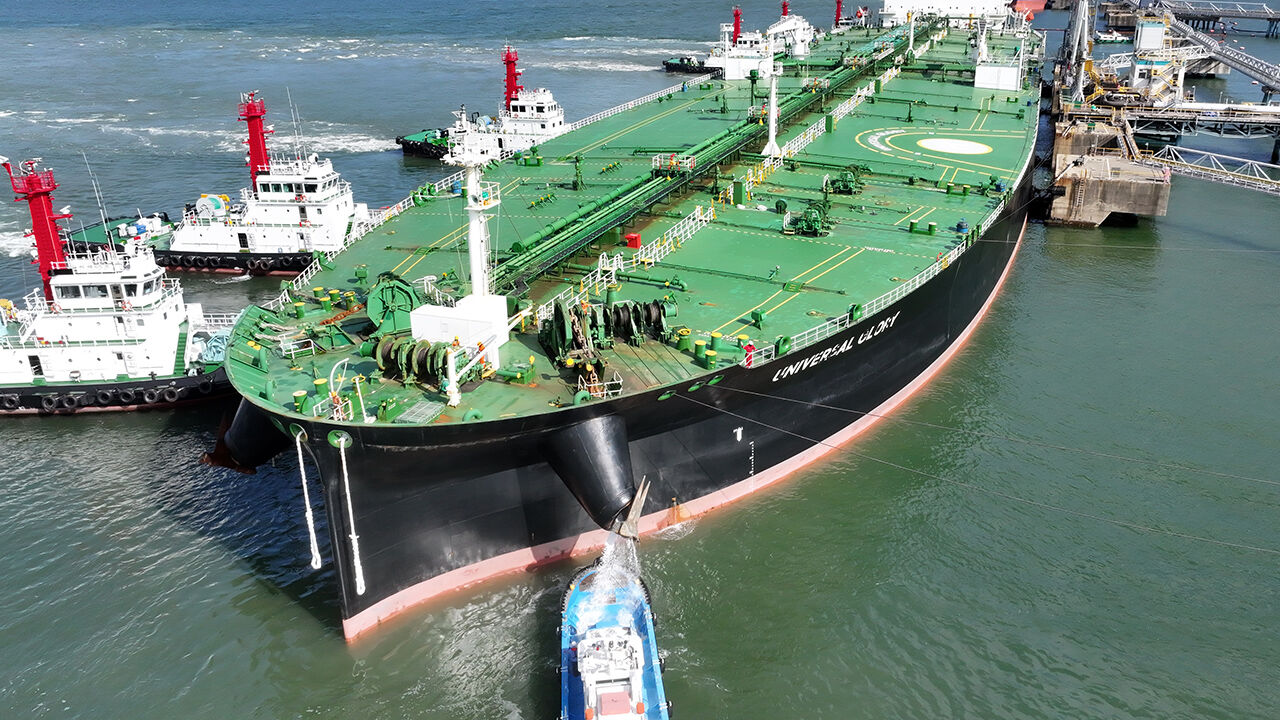
▲ The oil tanker HMM Universal Glory, which exited the Strait of Hormuz, enters the GS Caltex crude oil pier in Nakpo-dong, Yeosu, Jeonnam Gwangju Integrated Special City, on the afternoon of June 22.
South Korea's import share of U.S. crude oil exceeded 20% of the total in the first half of this year for the first time ever.
In contrast, Saudi Arabian crude, the traditional top supplier, barely maintained a 30% share, highlighting a clear trend toward diversifying crude import sources amid conflicts in the Middle East.
Export performance improved significantly, with petroleum product exports in the first half reaching nearly 70% of the total crude import value.
According to the Korea Petroleum Association and the Korea National Oil Corporation, South Korea's crude oil imports in the first half dropped 8% year-on-year to 467.12 million barrels.
Driven by surging international oil prices, the total value of crude imports rose 8.1% from the previous year to $41.367 billion (approximately 58.4 trillion won).
This means the country bought less oil but paid more.
Broken down by country, imports of Saudi crude were the highest at 142.47 million barrels, accounting for 30.5% of the total.
The figure marked a 2.6 percentage point decline from 33.1% in the same period last year, barely keeping the share above the 30% threshold.
Saudi Arabia experienced disruptions in crude supply and exports as the Strait of Hormuz was blockaded due to Middle East conflicts and its oil facilities came under attack.
U.S. crude imports followed at 95.87 million barrels, accounting for 20.5% of the total.
The import share for U.S. crude rose 4 percentage points from 16.5% a year earlier, surpassing the 20% mark for a half-year period for the first time.
The United Arab Emirates (UAE) ranked third with 15.1%, followed by Iraq at 7.4% and Kuwait at 4.9%.
The UAE, which houses the Port of Fujairah as an alternative route bypassing the Strait of Hormuz, saw its share increase by 3.2 percentage points from 11.9%, whereas the shares of Iraq and Kuwait fell by 2.6 percentage points and 3 percentage points, respectively, due to the impact of the strait blockade.
By continent, the import share of Middle Eastern crude dropped 6.4 percentage points from 68.7% in the first half of last year to 62.3% in the first half of this year.
Conversely, the shares of oil from the Americas increased from 23.4% to 26.5%, African crude from 2.0% to 5.6%, and Asian crude from 5.1% to 5.5%.
Domestic petroleum product exports in the first half showed a trend opposite to that of crude imports.
Petroleum product export volume fell 7.5% year-on-year to 226.23 million barrels, affected by export restrictions on major items.
However, as soaring product prices continued—with export unit prices in June alone jumping 54.0% compared to the previous year—the export value climbed 36.5% to $28.174 billion (approximately 40 trillion won).
This means the country sold less volume but generated more revenue.
This marks the third-highest half-year record in history, following the first and second halves of 2022 when the Ukraine war broke out.
The ratio of petroleum product export value to crude import value in the first half stood at 68.1%, significantly outpacing 54% in the first half of last year and 60.7% in the second half, setting a new all-time high for a half-year period.
By item, export values for naphtha, asphalt, and other products fell by 38.6%, 0.9%, and 1.5%, respectively, while exports of remaining products surged.
Aviation fuel recorded the largest increase at 85.2%, followed by lubricants at 54.1%, diesel at 48.3%, and gasoline at 4.1%.
Australia was the top destination for South Korea's petroleum product exports, with first-half exports surging 100.6% year-on-year to $6.211 billion.
It was followed by the United States at $3.171 billion (up 25.2%), Singapore at $2.92 billion (up 2.2%), and Japan at $2.907 billion (up 21.1%).
(Photo: Yonhap News)
※ Please note: This article was translated by AI and may contain errors.



 Video News


 Video News