
 KOR
KOR
▲ Arrested call center members in Thailand
A criminal organization that impersonated prosecutors and financial regulators to demand nude photos, produce sexually explicit materials, and extort billions of won from victims under the guise of "court deposits" has been busted by police, authorities said.
The Financial Crime Investigation Unit of the Seoul Metropolitan Police Agency announced today (Aug. 13) that it has apprehended and transferred 11 members of the syndicate, including a 29-year-old South Korean ringleader surnamed A, to the Seoul Central District Prosecutors' Office on charges of violating the Act on the Prevention of and Compensation for Damage Caused by Telecommunications-based Financial Fraud, the Act on Special Cases Concerning the Punishment, etc. of Sexual Crimes, and for forming and joining a criminal organization.
Among them, nine individuals, including A, have been placed under arrest.
Police have also taken steps to freeze 157 million won in criminal proceeds amassed by the group prior to indictment.
The suspects, all in their 20s and 30s, are accused of impersonating investigators and prosecutors from the Seoul Central District Prosecutors' Office as well as officials from the Financial Supervisory Service between May and December of last year. They allegedly demanded and obtained nude photos from victims to produce sexually exploitative content, while extorting approximately 6.7 billion won under the pretext of deposit money.
The gang set up a call center in Bangkok, Thailand, assigning members into three tiers: Tier 1 acting as prosecutors' office investigators, Tier 2 as prosecutors, and Tier 3 as financial regulators before launching their crimes.
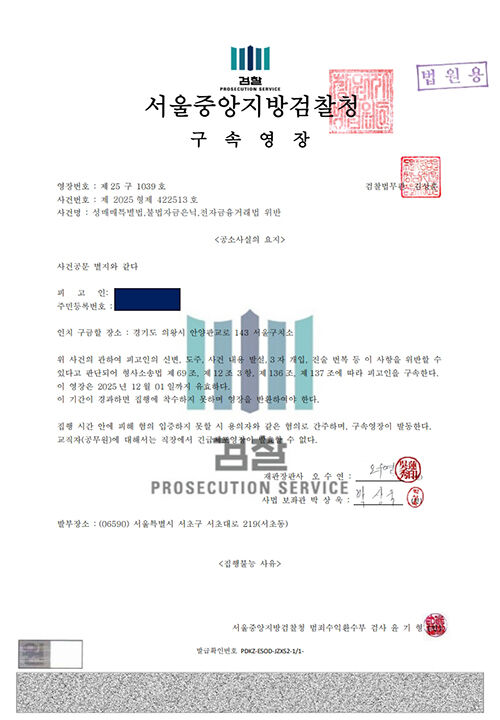
Tier 1 operatives, posing as prosecutors' office investigators, used pre-acquired information to target randomly selected victims, claiming that arrest warrants had been issued against them for involvement in money laundering or prostitution, and directed them to access a fabricated prosecution service website.
After victims viewed forged criminal fund crackdown notices and arrest warrants on the site, Tier 2 members called them and instructed them to check into a nearby motel for a summary investigation. Under the pretext of a physical examination, they had the victims transmit nude photos to produce sexually exploitative materials.
Finally, Tier 3 operatives pretended to sympathize with the victims and claimed that court deposits (money deposited with a court to signal an intent to settle with victims or opposing parties in civil and criminal trials) were necessary to resolve the case, tricking 68 victims into transferring a total of roughly 6.7 billion won.
Authorities found that one victim suffered the greatest loss by remitting 500 million won to the syndicate.
According to the investigation, the ring was formed around a Chinese national surnamed B last year, growing to a total of 24 members including 20 South Koreans—such as A, who was recruited through acquaintances and local networking—and four Chinese nationals.
The organization operated on a promotion system where members advanced from Tier 1 to Tier 2, and then to Tier 3, based on their criminal performance.
Profit distribution rates also varied by role, with Tier 1 receiving 4%, Tier 2 receiving 10%, and Tier 3 receiving 13% of the extorted funds as allowances.
Investigators revealed that the ringleader exercised coercive management, confiscating members' passports, beating them, and threatening to hand their passports over to the police if they violated work rules such as commuting hours.
Last November, through "Breaking Chains," a global cooperative operation meeting held in Seoul to counter transnational crime, South Korean police teamed up with Thai law enforcement to apprehend 13 members locally in Thailand on Dec. 4.
Nine of the detained South Koreans were repatriated to South Korea, while two other South Korean suspects who were not caught locally were arrested domestically.
It was revealed that the two additionally apprehended suspects had already been detained on charges including opening burner bank accounts.
Police have also placed red notices through Interpol for the remaining nine South Korean syndicate members who fled in Thailand and are tracking them down in cooperation with Thai police.
(Photo provided by Seoul Metropolitan Police Agency, Yonhap News)
※ Please note: This article was translated by AI and may contain errors.





![9천 찍고 6천 "내 돈 녹았다"…절박한 '2030' 레버리지 ETF로 [자막뉴스]](http://img.sbs.co.kr/newimg/news/20260813/202212041_300.jpg) Video News
Video News
