
 KOR
KOR
▲ The palm print and ink inscription on the back of Mangukgongbeop Bulyeodaepo (left)
"On October 26 in the 42nd year of Meiji, the Korean An Jung-geun assassinated Prince Ito in Harbin, and was executed the following year."
These eight characters are written in a large script across a piece of paper more than 1 meter long (from the ink inscription on the back of the calligraphy).
The writing appears to have been brushed down in a single, fluent breath: Mangukgongbeop Bulyeodaepo.
This translates to "International law is no match for heavy artillery."
These are the words left behind by activist An Jung-geun (1879–1910), who was sentenced to death in a prison in Lüshun, China, on charges of shooting Ito Hirobumi (1841–1909), the first Japanese Resident-General of Korea.
The calligraphy written by the activist while in prison has now returned.
It is a historical trace that preserves his life, embodying an unyielding spirit even as he felt the powerlessness of international law.
The Overseas Korean Cultural Heritage Foundation unveiled the calligraphy piece titled Mangukgongbeop Bulyeodaepo by activist An Jung-geun, which was recently repatriated from Japan.
The term yumuk refers to calligraphy or paintings left behind by a person during their lifetime.
Following the Harbinrighteous uprising, activist An was transferred to the local court of the Japanese Kwantung Government-General in Lüshun for trial, and is known to have left behind several pieces of calligraphy until his execution on March 26, 1910.
The calligraphy recently returned from Japan is believed to have been written in March 1910.
In the lower left corner of the piece, a palm print created by applying ink to the palm is clearly visible, accompanied by the inscription: "Written by Daehangukin An Jung-geun in the Lüshun Prison in March of Gyeongsul."
This means it was written by "Daehangukin" (Korean) An Jung-geun in March 1910, the year of Gyeongsul.
The writing combines regular script (haeseo) with semi-cursive script (haengseo), where the strokes flow slightly rather than being strictly upright, standing out with a powerful brushstroke.
The calligraphy holds significant meaning as vivid material documenting the reality surrounding activist An.
After shooting Ito Hirobumi, activist An argued that he was carrying out a legitimate act of war in his capacity as the chief of staff of the Korean Righteous Army, demanding a trial in accordance with international law.
However, the Japanese side reportedly indicted him on simple murder charges and sought the death penalty.
Derived from the words of 19th-century thinker Fukuzawa Yukichi (1835–1901), Mangukgongbeop Bulyeodaepo reflects a critique of the reality in which the international order was operated based on the logic of might.
The foundation explained, "These eight characters directly reflect his perception of reality, including a deep sense of skepticism regarding the powerlessness of international law."
Experts evaluated that this piece of calligraphy is highly likely to be an authentic work written by activist An.
Comparing the characters with Hwanggeum Baekmanning Bulyeo Ilgyoja and Ilcheong Hwongong, which were designated as treasures in 2022, revealed activist An's distinctive handwriting style, according to the foundation.
The foundation explained, "When compared to other works by activist An, there is a high degree of similarity across the overall calligraphic style, including brushstroke processing methods, character structure, and the sense of speed in brushwork, and the palm prints also match."
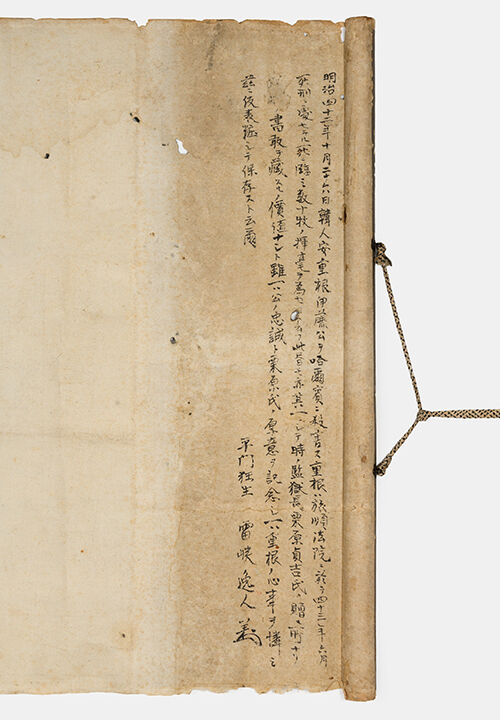
It is particularly notable that the records left on the back reveal the original owner and the transmission route.
The ink inscription on the back of the calligraphy explains that Kurihara Sadakichi (?–1941), the prison warden of Lüshun Prison, possessed the writing left by activist An.
Kurihara Sadakichi served as prison warden from 1907 to 1913 and is known to have requested a delay in activist An's execution so that he could complete On Peace in the East.
The inscription author, "Pyeongmun Gwangsaeng Ro-hyeop-ilin," is also presumed to be a former owner.
According to expert consultation, "Pyeongmun" refers to the Pyeong family clan, while "Gwangsaeng" is identified as a term for a scholar unconstrained by worldly ways or used as a humble self-referential pen name.
A foundation official stated, "Nothing is known about the individual named 'Pyeongmun Gwangsaeng Ro-hyeop-ilin,' including their birth and death years," adding, "No artifacts bearing such a name have been discovered."
The foundation confirmed the existence of the calligraphy through a local source in Japan in May of last year and succeeded in repatriating it in November.
The immediate previous owner reportedly purchased the calligraphy at an auction.
This indicates that the piece changed hands and circulated among at least three or more different owners.
Park Jung-hye, chairperson of the Overseas Korean Cultural Heritage Foundation, stated, "We will continue to systematically discover and repatriate our cultural heritage located overseas to share its value with the public."
According to the National Cultural Heritage Portal, a total of 31 pieces of activist An Jung-geun's calligraphy have been designated as treasures.
Among them are multiple works inscribed with phrases from classics such as the Analects and Records of the Grand Historian, alongside writings expressing inner thoughts or pointing out changes in the world.
Calligraphy pieces by activist An have also been steadily unveiled through auctions recently.
(Photo: Provided by Overseas Korean Cultural Heritage Foundation, Yonhap News)
※ Please note: This article was translated by AI and may contain errors.





![9천 찍고 6천 "내 돈 녹았다"…절박한 '2030' 레버리지 ETF로 [자막뉴스]](http://img.sbs.co.kr/newimg/news/20260813/202212041_300.jpg) Video News
Video News
