
 KOR
KOR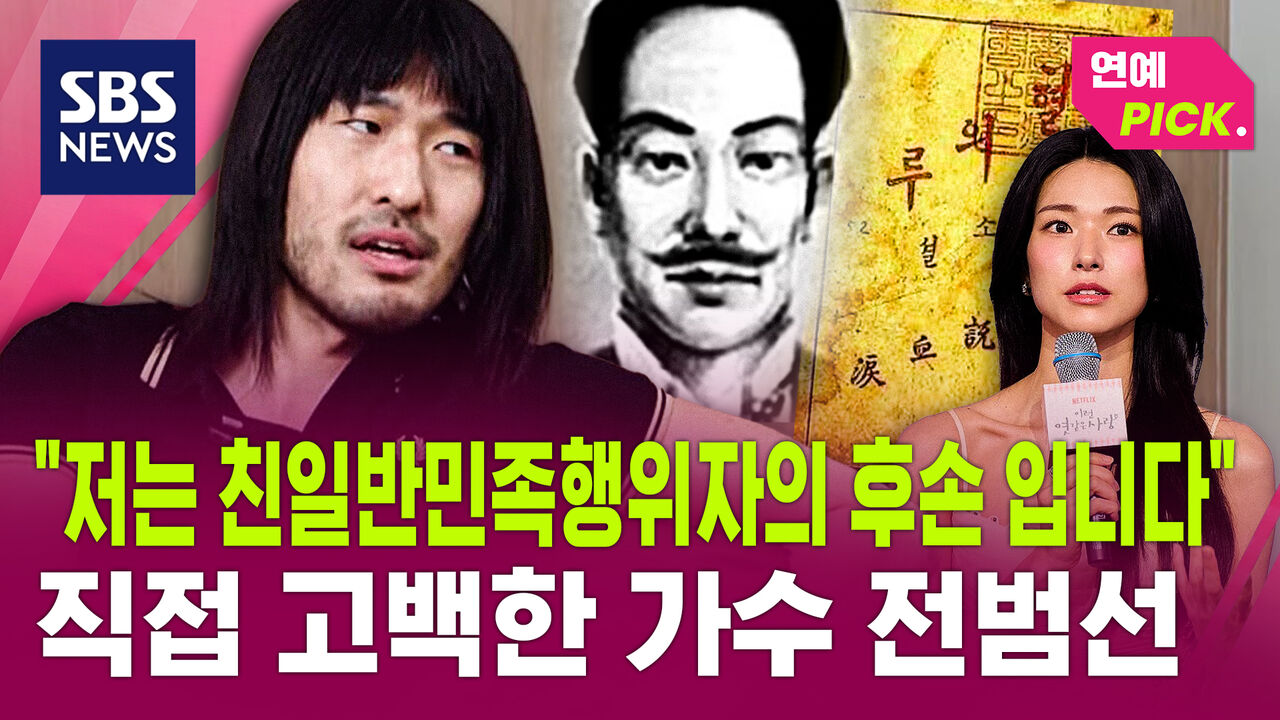
Jeon Beom-seon, the vocalist of the band Yangbanmdeul who majored in history at the University of Oxford graduate school.
Amid the recent pro-Japanese controversy surrounding actor Hayoung's great-grandfather, a family history confessed by Jeon Beom-seon on the YouTube podcast MP (Museum P) last April has resurfaced as a hot topic.
At the time, Jeon Beom-seon revealed that his great-great-great-grandfather was Lee In-jik, known in Korean language textbooks as the author of the "first modern Korean novel."
Lee In-jik served as an interpreter for Yi Wan-yong during the Eulsa Treaty and also worked as a Japanese military interpreter during the First Sino-Japanese War.
He is a figure whose name is listed in both the Dictionary of Pro-Japanese Collaborators and the Official List of Pro-Japanese Anti-Nationalist Activities.
Jeon Beom-seon said he did not know about this fact until he became an adult.
"I am a descendant of pro-Japanese figures, the ones I'd only heard about in stories... It was such a shock."
He subsequently searched for and read all of Lee In-jik's novels.
While he sympathized with critical issues such as the abolition of the traditional class system and women's liberation, he drew a clear line regarding Lee's pro-Japanese actions, stating they were "unmistakable."
"By dealing with my grandfather, I wanted to try healing myself from within."
Reactions praising his courage followed the video containing his candid confession, and Jeon even published a book titled "Jeon Beom-seon's Korean History Therapy" last March based on this experience.
On the other hand, actor Hayoung is facing heavy criticism for taking the exact opposite approach.
Controversy grew after records revealed that Hayoung's great-grandfather Ahn Sang-ho—whom she had proudly introduced on a recent variety show as possessing a "doctor's DNA"—was a council member of the Daejeong Chinmokhoe, a pro-Japanese organization during the Japanese colonial period, and that her family was even featured in the Government-General of Chōsen's official newspaper as a model case for assimilation policies.
Scheduled interviews were canceled, and video-on-demand services for her broadcasts were suspended.
The two figures faced the same family history, but their responses diverged completely.
Critics point out that the crucial difference was whether there was an effort to face the past of their ancestors as it is, rather than romanticizing it.
(Reported by Kang Kyung-youn | Video by Yonghee Jung | Graphics by Yang Hye-min | Produced by SBS Digital News | Video source: YouTube channel MP (Museum P))
※ Please note: This article was translated by AI and may contain errors.




![[현장영상] 9명 '정원 초과'로 탄 엘리베이터…바닥으로 꺼져버린 아찔한 '3초'](http://img.sbs.co.kr/newimg/news/20260812/202211700_300.jpg) Video News
Video News


