
 KOR
KOR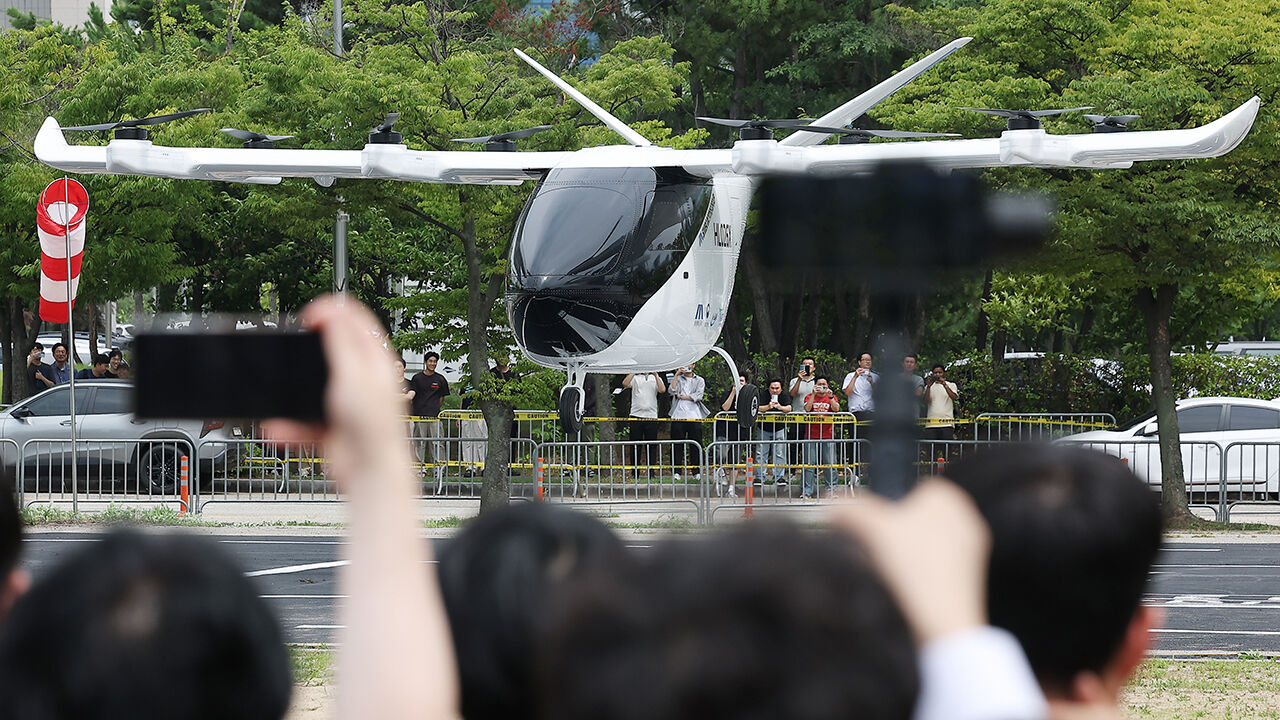
▲ Citizens take photos as an Urban Air Mobility (UAM) aircraft performs a flight demonstration during the 2026 Korea Drone & UAM Expo and UAM Flight Showcase held at Incheon National University's INU Innovation Center on the 16th of last month.
The Ministry of Land, Infrastructure and Transport is designating "pilot operation zones" to achieve the initial commercialization of Urban Air Mobility (UAM) by 2028.
The Ministry of Land, Infrastructure and Transport announced today (the 12th) that it will accept preliminary applications for UAM pilot operation zones from local governments starting from the 24th until September 4.
The ministry will hold an information session on the designation of pilot operation zones for local governments and public institutions in Seoul tomorrow.
Pilot operation zones are areas designated to prepare for and verify actual services for the early commercialization of UAM.
Local governments and public institutions pursuing initial commercialization must be designated as pilot operation zones to operate UAM services tailored to local characteristics.
The Ministry of Land, Infrastructure and Transport has previously verified core technologies, including traffic management systems, in testbed business areas such as the Goheung test complex and the Ara Waterway. Moving forward, the ministry plans to newly operate the pilot operation zone system to prepare services that the general public can actually use.
In the pilot operation zones, actual operational environments will be established by building infrastructure such as vertiports (vertical takeoff and landing sites) and by designing and coordinating routes and airspaces.
Based on this, various UAM services such as passenger and cargo transportation and tourism will be operated.
In particular, regulatory exceptions under the Urban Air Mobility Act will be applied to accumulate actual flight experience and step-by-step verify safety and institutional operation methods.
The ministry has prepared guidelines for the operation plan of pilot operation zones to help applicant institutions smoothly prepare their projects.
The guidelines contain detailed criteria necessary for operating pilot operation zones, including UAM service models, vertiport configurations, operation methods, and flight frequencies.
Kim Gi-hun, head of the Urban Air Mobility Policy Division at the Ministry of Land, Infrastructure and Transport, said, "Pilot operation zones are the first step in moving beyond UAM technology demonstrations to actual services, serving as a core foundation for initial commercialization in 2028."
(Photo: Yonhap News)
※ Please note: This article was translated by AI and may contain errors.




 Video News
 Video News

![[현장영상] 9명 '정원 초과'로 탄 엘리베이터…바닥으로 꺼져버린 아찔한 '3초'](http://img.sbs.co.kr/newimg/news/20260812/202211700_300.jpg) Video News
Video News