
 KOR
KOR
"That's a difficult question to answer." However, saying this does not mean he avoids answering. Rather, he seemed to be the kind of person who wants to clarify that it is not an easy question for him. He told me twice that my last question was hard to answer. I will tell you later what that question was.
*
Director Nolan usually wears a suit with a dress shirt, even on rough location film sets. When it is cold, he slips an overcoat over it. This is the opposite of Meta head Mark Zuckerberg. Another famous film director who preferred wearing suits on set was Alfred Hitchcock. Both share the commonality of being British. A true 'British gentleman,' perhaps?
To interview Director Nolan, I also wore a suit—despite this heat. However, Nolan was dressed in a black polo shirt and a dark brown jacket. That attire might actually have helped ease the tension a bit. Although I have interviewed many directors and actors, I was still slightly nervous because he is, after all, the world's most influential director (according to a New York Magazine survey). But as the interview progressed, I felt he was not stiff or pretentious, but rather prudent and conscientious. In terms of listening attentively to questions and striving to answer as accurately and thoroughly as possible, I was reminded of Director Park Chan-wook. Of course, because the interview time was so short, some answers felt like textbook responses.
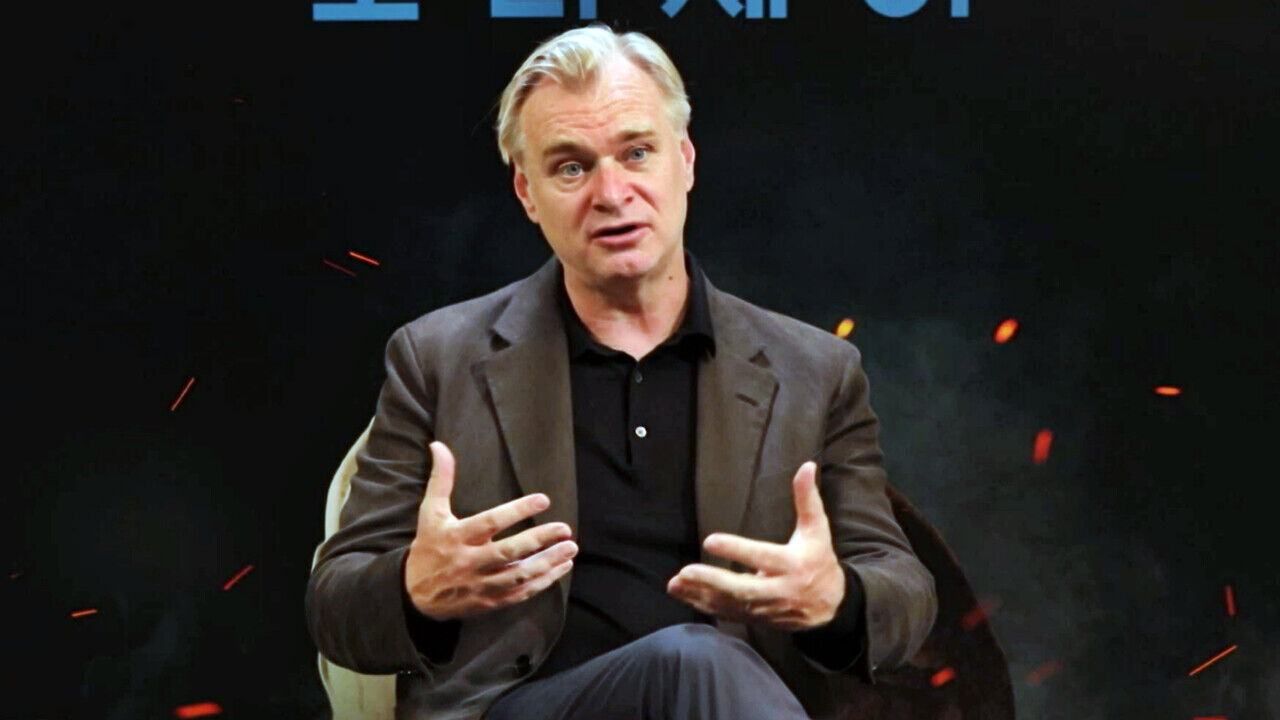
I have always thought of Director Nolan as a diligent 'ambitious man.' Looking at his films, that is evident. He unleashes cinematic imagination across past and future, time and space. His filmography includes Batman as well as Oppenheimer. He crosses between the far future of 'Interstellar' and the distant past of 'The Odyssey.' I wonder if the agonizing human beings in his films might be Nolan's own cinematic alter ego. That is why my first question was as follows:
- What cinematic ambition of yours as a director and filmmaker does 'The Odyssey' fulfill?
To me, 'The Odyssey' is a foundational text of Western literature. Above all, it is one of the greatest adventure stories in history, and a tale that has fascinated people across generations for nearly 3,000 years. As a film director, I look for gaps in film culture—something new that I can bring to audiences. The fact that the world of Greek mythology had never been properly addressed in a modern cinematic sense struck me as remarkable. (In fact, films based on The Odyssey include 'Ulysses' in 1954 starring Kirk Douglas and 'The Return' in 1997 starring Ralph Fiennes and Juliette Binoche. Director Nolan's standards must have been different.)
That was precisely the opportunity I was looking for as a director. So I jumped in with the specific ambition to deliver one of the great adventure stories to a modern audience in a way that allows them to feel genuinely connected and part of the story. I always try to do something I haven't done before. The Bronze Age storytelling world was something I had never touched, and I felt it could be presented on screen in a fresh way.
Director Nolan majored in English literature at university. In other words, he likely had time to ponder 'The Odyssey' deeply long ago. Nolan mentioned that studying English literature in college cultivated his eye for broad worlds spanning time and shifts in storytelling methods. As you know, 'The Odyssey' is an orally transmitted epic poem.
When I read the poem from the perspective of adapting 'The Odyssey' into a film, so much of it resonated with me. This poem is visceral and accessible. I wanted to tell it in a very realistic way that brings that out for the audience. When dealing with literature of the past, we too often tend to put it on a pedestal and treat it with excessive reverence. The real challenge and joy of this adaptation was to give audiences the experience of reading this poem inside a movie, encountering it as a fresh story for the first time.
One of the things I was most curious about before watching the movie 'The Odyssey' was how the fact that 'The Odyssey' was originally a poem would be reflected in the film.
- 'The Odyssey' was originally an oral epic poem, and the opening adaptation consisting of short words was impressive. When and how did you come up with the specific idea to reflect this in the screenplay?
When I decided to make this movie, one of the earliest decisions I made was to introduce the bard character played by Travis Scott. Introducing the concept of the act of storytelling itself was very important to me, because 'The Odyssey' is a poem about storytelling. I wanted to pay homage to the concept that it was a story passed down orally from bard to bard before it was written down. Most scholars believe 'The Odyssey' was eventually recorded in that manner.
This poem has been handed down through various eras and cultures through oral repetition. So I felt it was important to start with that, and it was one of the decisions I made earliest. Especially for Telemachus, what's important is that he is receiving stories about his father—the concept of a father he doesn't even remember—through songs and poetry.
'The Odyssey' is, above all, the origin of adventure stories. Director Nolan said that 'The Odyssey' is an adventure story, but at the same time a love story, a coming-of-age story, and a tale of homecoming. He added that these were crucial themes for people back when the poem was written as well.
I think the reason this poem has sustained interest over thousands of years is that the themes it deals with are universal truths. They are just as valid and important to us today as they were 3,000 years ago.
Meanwhile, heated debate has erupted in the English-speaking world over Nolan's adaptation of 'The Odyssey', becoming a hot topic. Director Nolan revealed that he consulted various translations of 'The Odyssey' while making the film, but Emily Wilson, the translator of a major translation (2017), criticized Nolan's adaptation in the London Review of Books after watching the movie, calling it exaggerated and superficial. Emily Wilson, chair of the Department of Classical Studies at the University of Pennsylvania, translated the opening line of 'The Odyssey' as "Tell me about a complicated man," and her column was titled "An uncomplicated man"—making it quite a sharp satire. Other scholars countered that Nolan's adaptation is Nolan's artistic freedom, drawing attention to the debate, but since that is not the main topic of this article, I will stop here.
Where were we? Ah yes, around this point, pressed for time, I had no choice but to skip a few prepared questions and move on to IMAX. The IMAX format was invented a year before Director Nolan was born in 1970, and Nolan reportedly harbored a long-standing dream of making movies in IMAX after watching an IMAX film at the Museum of Science and Industry in Chicago around age 16.
- You have been on an IMAX journey for nearly 20 years since 'The Dark Knight'. Shooting the entire film in IMAX this time must have given you special emotions.
Since 'The Dark Knight', I tried to use IMAX cameras as much as possible, but it was mostly limited to action sequences. (Starting with 28 minutes in 'The Dark Knight', he shot about an hour's worth in IMAX for 'The Dark Knight Rises', 'Interstellar', 'Dunkirk', 'Tenet', and 'Oppenheimer'.) As I embarked on this project, I went to IMAX and said, "If there is any movie that should be shot entirely in IMAX, it is this one." I asked if they could make the cameras quieter, and thanks to the blimp system they developed—an advanced box that blocks camera noise—we were able to shoot dialogue scenes as well. At that point, I realized we could shoot the entire movie in IMAX.
The biggest advantage of shooting on large-format film is that it is the format closest to the way the human eye sees. For me, as someone interested in drawing the audience into the story, it is the optimal format. I really loved being able to do that across the entire film rather than just in certain sections by switching formats.
- In a way, this feels like a culmination of your IMAX journey. Did you feel a sense of achievement, like 'we finally did it,' after finishing the shoot?
When we finished IMAX shooting, there was definitely a feeling of having fulfilled an ambition held for a very long time. But film production happens in stages, so after shooting, we had to edit the negative film. Each stage brought its own sense of completion, but right now, when the film is being shown to audiences around the world, I think that is the true completion. It opens in Korea on Wednesday, and the audience completes the film. The audience's reaction tells what the film is, and only then does the journey feel truly complete.
If it's a Nolan movie, we cannot skip this question: Why stick to location shooting and analog production methods over VFX in the age of A.I.? (Using VFX is not bad. Shooting in an analog way like Nolan requires that much capital. Currently, Director Nolan is practically the only director in the world who can negotiate on equal footing with major Hollywood studios.) I gained conviction from Nolan's answer.
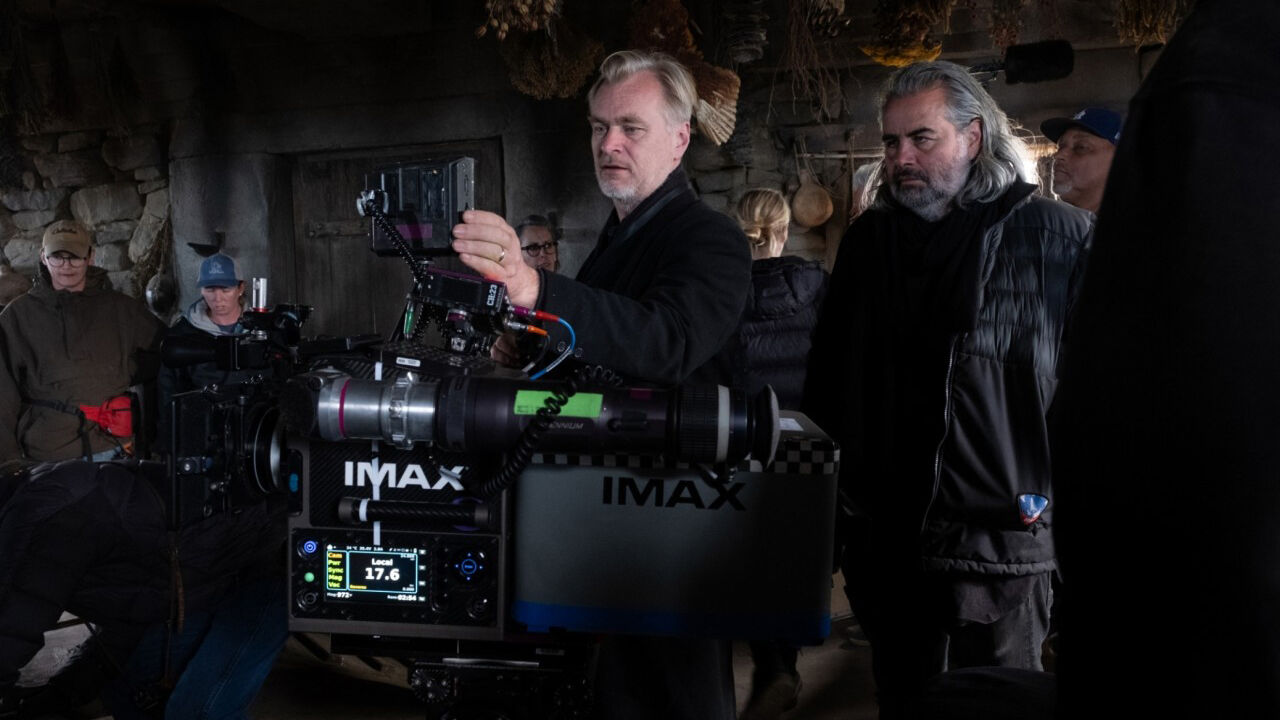
Technology has various uses and forms, and we also utilize all kinds of technology and cutting-edge techniques. But what I always try to maintain in filmmaking is an obsession with tonality. Because we shoot in real places and actual locations, when we need to implement fantasy elements that cannot be captured with a camera, we collaborate with the visual effects team while trying to shoot as much as possible for real. This stems from my desire to maintain the film's tone.
Audiences are very sensitive to tone—the feeling of "Are we really somewhere in reality? Are the actors standing in a real space, or in an animated world?" Making a more artificial, animated-feeling movie is also a completely valid and viable approach. I simply choose a more realistic tone, and the challenge is finding a way to continue that tone even in sequences where visual effects must be used.
In 'The Odyssey' as well, Nolan shot as much as possible in analog, even for scenes like battles against the Cyclops or giants, and sea whirlpools, to the extent that one might wonder, 'How did they shoot that in live-action?' Also, as Nolan says, even movies that seem filled with VFX actually need to be shot as live-action as much as possible first and have VFX built on top of that to reduce production time and costs. Nolan provides audiences with realism and immersion through physical, tangible shooting for scenes that are hard to implement in live-action (like crashing an actual Boeing 747 in 'Tenet' or physically shooting the atomic bomb explosion scene with practical special effects in 'Oppenheimer'). Nolan's answer brings to mind the saying, "The devil is in the details."
*
Listening to his answers up to this point, I had already reached the final leg of my short interview odyssey with Director Nolan. The final question I added—after obtaining permission from the Universal Pictures headquarters representative who was monitoring, or rather supervising, the interview site—was this very question: the one Nolan said was difficult to answer.
- As a film director, where do you think you are currently in your own Odyssey? And what ultimate goal do you hope to achieve when you reach your Ithaca?
That's a difficult question to answer. My principle is always to focus on one thing at a time. I try not to look at each movie as part of a broader body of work or as a step in a journey I'm taking. I try to see just the film itself. That's how the audience receives a movie as well. Of course, there are fans who know my previous works, and film critics who write from that perspective. But fundamentally, I have to make movies for audiences who don't care who the director is. They are simply interested in the story. So viewing my work on a continuum with other films is very difficult for me. It's really hard to answer.
✻ This interview took place for about 15 minutes from 11:30 a.m. to 11:45 a.m. on August 3 at the Four Seasons Hotel in Seoul and was partially edited—much like the non-linear storytelling style Director Nolan favors—while keeping the order of questions and answers and the original interview text as faithful as possible.
※ Please note: This article was translated by AI and may contain errors.





 Video News