
 KOR
KORFollowing yesterday's report on temple stay budget realities, today we focused our reporting on the "religious cultural facility construction" project. This is a project where meditation halls and cultural centers are built inside temples, with more than 300 billion won in taxes poured into it over the past 10 years alone.
Reporters Jang Min-seong and Lee Hyun-jung investigated whether these facilities, funded by massive budgets, are serving their proper roles.
[Reporter: Jang Min-seong]
Neungin Jeongsa in Cheongju, North Chungcheong Province.
Construction of a two-story "MZ Complex Cultural Center" is currently in full swing across the courtyard.
Under the pretext of relieving stress for the younger generation, it received 900 million won combining national and local government funds.
However, another building right across from it has its lights turned off.
It is a traditional culture experience center built 6 years ago with 500 million won in taxes, but it is practically out of business this year.
The temple side explained that it is not operating due to construction safety reasons, but people on the scene voiced difficulties regarding a lack of demand.
[Temple Official: There are practically no children coming in groups. It cannot be done with just one or two people coming; at least 10 or more people need to come for it to operate now.]
The temple's stance is that the new MZ center will differentiate itself from the existing experience center through youth programs.
Cheongju City Hall, the competent local government, stated that it has not received demand surveys or specific operation plans, and announced it will inspect whether it is being operated properly.
Inchwisa Temple in Asan, South Chungcheong Province, received 800 million won in tax support early this year to build a meditation training center.
Inside, multiple desks and chairs are arranged, but actual meditation programs are not being operated.
[Temple Official: Currently, we are studying Buddhist college doctrines and praying the Diamond Sutra, and there are currently no meditation classes.]
They explained that regular meditation programs are difficult unless group visitors come steadily.
The competent Asan City Hall stated that it does not know the temple's operation status in detail and will look into whether it is being used according to the purpose of construction.
Like this, apart from temple stays, large and small buildings are being constructed at various temples nationwide through a project called "religious cultural facility construction."
Reflecting trends, it is expanding to cultural experiences and recently to healing and mental health purposes such as meditation and Seon (Zen) practice.
As a result of our analysis of the entire project details, national funds that went into 48 temples nationwide over the past 10 years amounted to 303.5 billion won.
Although there is self-funding, a significant portion of the new construction costs is supported by taxes.
Among these, there is also an ultra-large facility where more than 20 billion won in taxes alone was poured.
However, when actually visiting the site, there were places where construction was carried out differently from the original plan.
(Video Reporting: Seol Min-hwan, Video Editing: Park Na-young, Lee Hong-myeong, VJ: Kim Jun-ho)
---
[Reporter: Lee Hyun-jung]
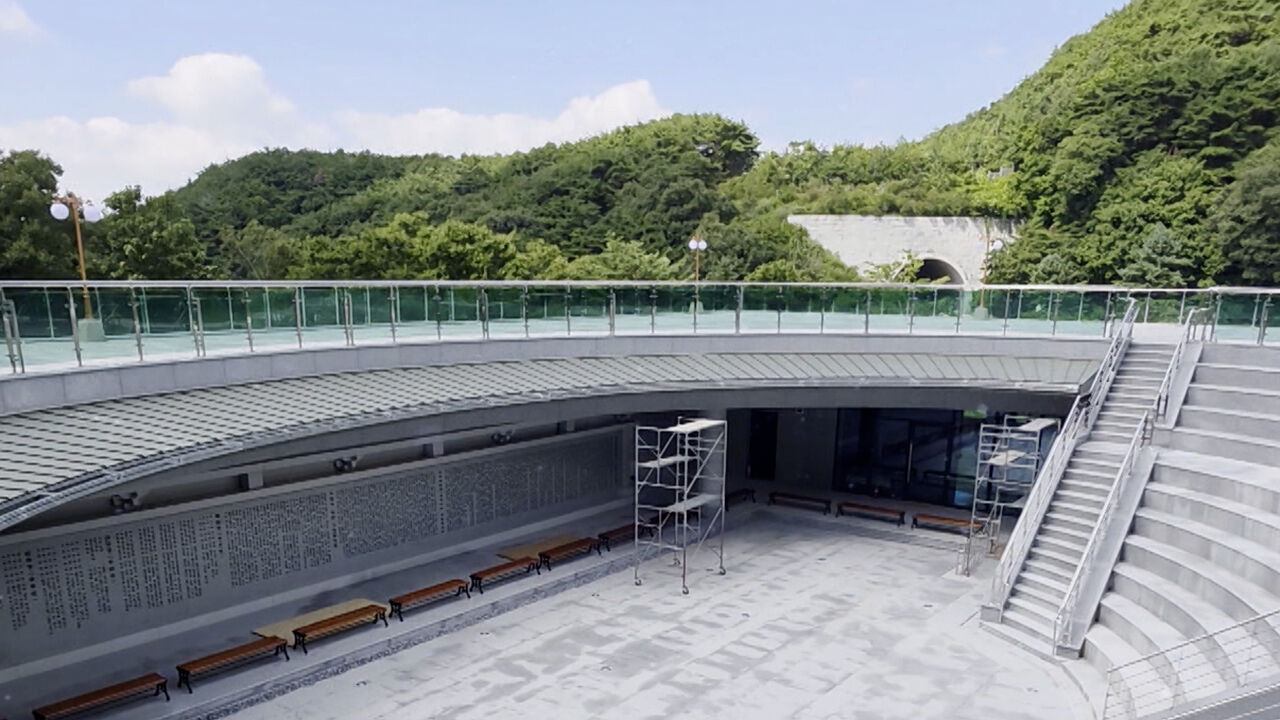
This is the General Samyungdae Experience Center at Donghwasa Temple in Daegu.
Construction was recently completed at a cost of 22 billion won in taxes, but most spaces, including the exhibition hall and museum, are completely empty.
Only a projector and a sofa are placed in the projection room.
Contents originally planned, such as a video of General Samyungdae's life or an ultra-large digital Buddhist painting exhibition, are nowhere to be found.
[Construction Company Official A: (Was there ever a request to produce separate contents related to General Samyungdae?) There wasn't.]
The subsidy allocated for "VR and exhibition construction" alone was 10.6 billion won, but the actual execution cost was shockingly small.
[Construction Company Official B: (For the entire building) internal finishing work was budgeted at 2.62 billion won. Among that, video equipment accounts for about 300 million won out of the 2.62 billion won.]
Where did all those subsidies go?
Construction officials confessed that most of the exhibition budget was spent on increased construction costs as the design was changed under the instructions of the "Senior Monk."
The subsidy, which was initially 10 billion won, was increased twice at the request of Donghwasa Temple, and every time, instead of VR and exhibition construction, the money was used to raise the building from one basement floor and one ground floor to two ground floors, and to replace walls and courtyard surfaces with expensive stone finishes.
[Construction Company Official C: Because (the Senior Monk) now had no money to do the building construction, [he said] 'spend even the money to do the exhibition construction entirely on building.' That's why they made the second floor and did this.]
[Former Donghwasa Official: They attached stone slabs to the entire wall, and I know that the stone cost alone is well over 5 billion won.]
Phrases praising the Senior Monk were even engraved on the walls of the building.
The reporting team went to visit the "Senior Monk" who moved his residence after leading this project, but could not hear his stance.
The Jogye Order stated, "We changed part of the project details to maximize the experiential effect for visitors, and the exterior wall phrases do not fit the purpose of the project, so they are scheduled to be removed."
The Ministry of Culture, Sports and Tourism and local governments stated that since the design changes went through approval, using the budget differently is not a problem, but they have conveyed concerns regarding the operational readiness state.
In addition, they stated that if major defects or regulatory violations are confirmed, they will proceed with the recovery of subsidies.
[Song Jin-ho, Visiting Research Fellow at Korea Tax Research Institute: They simply brought a really justifiable and declarative plan to the extent of 'we will put in VR, we will do this or that.' I think we need to see whether the expected effect commensurate with the 22 billion won spent is actually generated.]
Such subsidy issues are not unique to Donghwasa Temple.
In the National Assembly, pointing out that the scale of support is excessive is repeated every budget season, but rather than being cut due to reasons such as allocation by religious denomination, the budget invariably increases.
[1st Vice Minister of Culture, Sports and Tourism (from the minutes of the Budget and Accounts Settlement Subcommittee of the Culture, Sports and Tourism Committee): We are supporting the construction of one cultural experience center for each religious denomination, and Bomunjong is next...]
In fact, the budget for the construction of religious cultural facilities last year was increased by nearly 8 billion won and passed the National Assembly.
(PD: Kim Do-gyun, Han Seung-ho, XR: Lee Jun-ho, Jeon Yu-geun, Choi Jae-young, Design: Kang Yun-jeong, Kim Min-young, Cho Su-in, Kim Han-gil, Hwang Se-yeon, Data Provided by: Office of Representative Lee Jae-jung)
---
[Anchor]
Let's talk in more detail with Reporter Noh Yu-jin of the investigative team who covered this issue.
Q. How did you come to look into this project in the first place?
[Reporter Noh Yu-jin: It is certainly true that temple stays and religious cultural projects have positive aspects of giving people rest and promoting our culture. However, what we paid attention to was whether the taxes we paid were being used properly. When we exhaustively analyzed the budget plans early this year, we found that several billion won were increased without any special deliberation, and we tried to verify this. However, most of the National Assembly member offices we contacted waved their hands, saying it would be a bit difficult to request data from the religious circles, so we ended up filing more than 10 information disclosure requests. But even with these, local governments refused to disclose even the subsidy amounts, claiming it was an infringement on corporate trade secrets, and although we finally received them after going through an objection, it took more than two months.]
Q. As seen in the previous report, there are one or two buildings that are practically neglected, so why do they hand out budgets?
[Reporter Noh Yu-jin: Because when applying for subsidies, they write plans very plausibly. They take national money saying citizens will have meditation experiences and introduce our traditional culture well to foreigners, but when you actually go to the site, there were really many cases where it was completely different from the plan. There are cases where an experience center is left standing in a place with no floating population without even a minimum demand survey. Nevertheless, supervisory agencies were just handing out subsidies, saying that it was procedurally fine and that the plan was just a draft. One public official I met during the reporting frankly confessed, would you spend it like this if it were your own money?]
Q. Ultimately, there are loopholes in management and supervision, so what is the biggest problem?
[Reporter Noh Yu-jin: When building temple stay religious cultural facilities, the Ministry of Culture, Sports and Tourism and local governments hand out subsidies separately. Because multiple agencies are entangled in a single project, the subject of management and supervision is unclear, and it is a structure where no one takes ultimate responsibility. In fact, when we pointed out the problems of the project, they were busy blaming each other. Since these are taxpayers' money poured for the culture and rest of citizens, it seems urgent to improve the system to clarify the locus of responsibility from budget support to management.]
※ Please note: This article was translated by AI and may contain errors.



 Video News
 Video News
 Video News
 Video News
 Video News