
 KOR
KOR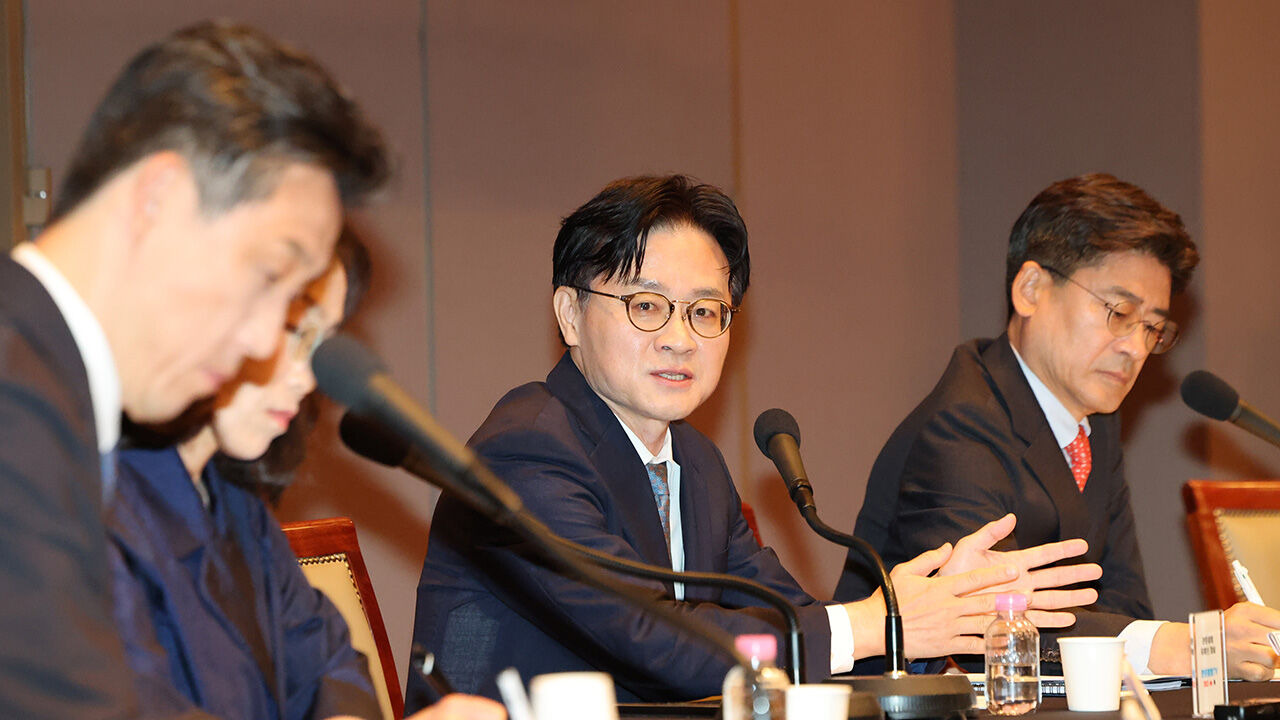
▲ Minister of Trade, Industry and Energy Kim Jeong-gwan answers a panelist's question during a Kwanhun Club debate held at the Press Center in Jung-gu, Seoul, on the 6th.
The stances of relevant cabinet ministers have sharply diverged over the "52-hour workweek exemption" clause, which is one of the key controversial issues in the mega-special zone special act currently being pushed by the government.
Attending a Kwanhun Club debate held at the Seoul Press Center today (the 6th), Minister of Trade, Industry and Energy Kim Jeong-gwan emphasized the necessity of applying exceptions to the 52-hour workweek system within mega-special zones, stating, "The system must not forcibly block the will of young people who want to work."
"The 52-hour workweek issue should be compared with China, our biggest competitor," Minister Kim said, sharing an anecdote he heard during a business trip to China while working at a private company.
Minister Kim said, "I was shocked to hear from an official at an IT company in Chongqing, China, that when they tried to introduce the '996' system (working from 9 a.m. to 9 p.m., 6 days a week), the employees protested, asking, 'How can we compete with other companies if we work like that?' which ultimately led them to change to a system where they work until midnight."
Minister Kim pointed out, "Internal competition in China is truly fierce," adding, "Chinese workers also believe that the company must grow for them to take home a salary, so they worry about companies reducing working hours."
Minister Kim then emphasized, "The system should not crush the motivation and will of people who want to work hard and achieve results," and stated, "There is a need to overhaul the working hours system across cutting-edge industries, including startups as well as the research and development sector."
Minister Kim Jeong-gwan's remarks contrast significantly with the stance of Minister of Employment and Labor Kim Young-hoon.
During a meeting with reporters the previous day, Minister Kim Young-hoon noted that major domestic semiconductor companies are currently subject to the 52-hour workweek system, saying, "They are generating massive profits even without exceptions."
Minister Kim stated, "It's not like we are being caught up and overtaken by overseas competitors," adding, "(Allowing exemptions to the 52-hour workweek) has become so exaggerated as if it's something we cannot do without, making healthy debate difficult."
Minister Kim also stated, "While we cannot eliminate the differences in positions (between labor and management), we can find rational alternatives based on facts," and added, "Since the two major umbrella labor unions have proposed a meeting with the president and social dialogue regarding this, we will proceed with sufficient communication with the labor sector."
(Photo: Yonhap News)
※ Please note: This article was translated by AI and may contain errors.



 Video News
 Video News


