
 KOR
KOR
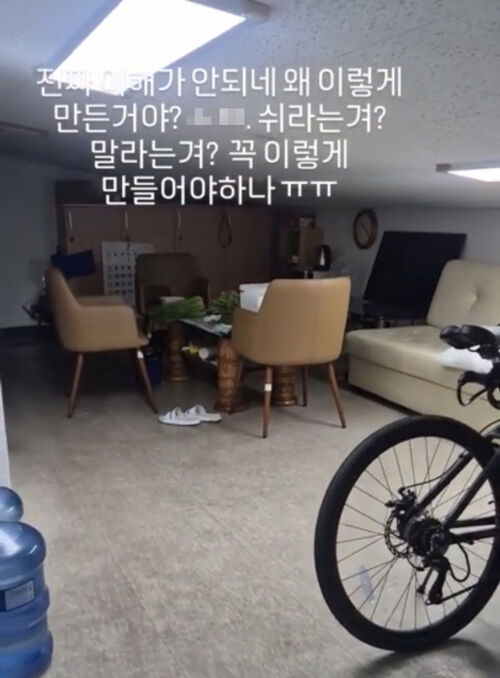
▲ A poorly equipped rest area for sanitation workers.
A ceiling so low that an adult can barely stand upright, and a cramped, makeshift interior hastily cobbled together from an awkward leftover space in a building.
A facility featured in a video recently posted on an online community has sparked controversy.
This is because it was captured under circumstances indicating the space is being used as a breakroom for sanitation workers.
According to press reports compiled on August 6, netizens posted critical comments on August 4, such as, "If you straighten your back the wrong way, the ceiling is going to break," "It looks like they forcibly remodeled a place that used to be a storage room," and "Please tell me this is AI-generated."
The video from an online community post titled "Controversial Sanitation Worker Waiting Room" shows a narrow entrance beneath a sign reading "Sanitation Worker Waiting Room" that requires people to stoop deeply just to enter.
Although equipped with chairs and a refrigerator inside, the low and cramped ceiling height makes it difficult to even stand upright, making genuine rest appear impossible.
The creator of the video expressed frustration with captions reading, "I don't get it. Are they telling us to rest or not? Do they really have to make it like this?"
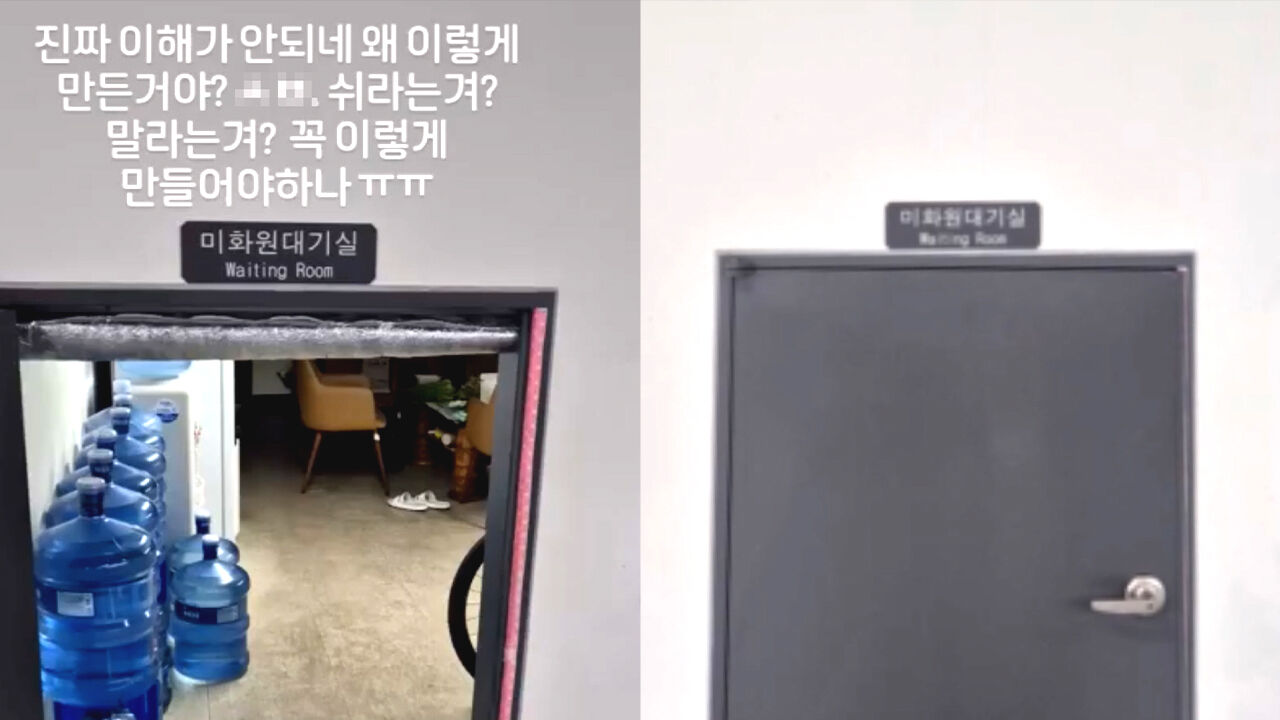
Critics point out that it only formally satisfies the legal minimum standards without taking actual working conditions and movement paths into consideration.
According to the Occupational Safety and Health Act (Article 128-2), employers are legally obligated to install rest facilities for workers.
Starting with workplaces with 50 or more employees in August 2022, the system was expanded in August of the following year to workplaces with 20 or more regular employees, as well as workplaces with 10 or more employees that have two or more workers in vulnerable occupations such as cleaners and sanitation workers.
Under the current enforcement rules, rest facilities must secure a minimum floor area of 6 square meters and a ceiling height of at least 2.1 meters.
In addition, regulations require facilities to be equipped with basic fixtures such as chairs, drinking water, and equipment capable of maintaining appropriate temperatures (18–28°C / 64–82°F), humidity (50–55%), and lighting (100–200 lux).
Although the system is entering its fourth year of implementation, the tangible effect in the field remains minimal.
Analysts point out that practicality is low because employers are only required to install a single rest room that barely meets the legal minimum standards, regardless of the number of workers.
Kang Seok-hwa, 52, secretary-general of the Federation of Korean National Trade Unions, said, "Even though rest facilities have become mandatory, it is disconnected from reality because you only need to build one small rest room that meets the standards regardless of the number of workers on site." He added, "Most sanitation workers work out in the field, but the rest rooms are installed in remote locations, leading some workers to say, 'It's better to just rest inside a car parked in a nearby public parking lot.'"
Yoo Young-beom, 64, chairperson of the National Sanitation Workers' Union, stated, "In the case of subway cleaning workers, there are rest rooms without showers or sinks," adding, "There are still many cases where improvements to rest facilities are not made under the pretext of space shortages or budget issues."
Experts emphasize that for sanitation workers who endure monsoons, heatwaves, and cold snaps outdoors with their bodies, a rest facility should not merely be a waiting room, but a space to recover physical strength.
They point out that effective management and budgetary support from the government and local authorities are urgently needed to achieve this.
Kim Sung-hee, a professor at Korea University Graduate School of Labor, pointed out, "If there is no space separated from the workplace where they can rest, giving break times is meaningless, which is why the mandate for rest spaces was initiated." He noted, "Because rest spaces were not considered from the initial building design stage and employers try to cut costs, they often make do with basements, windowless enclosed spaces, or cramped makeshift facilities."
Professor Kim advised, "Effectiveness can only be achieved when local government facility cost support and government labor supervision go hand in hand," adding, "Sanctions must accompany the policies so that employers do not just take the subsidies and delay making choices."
(Photo: Captured from online community 'Ruliweb', Yonhap News)
※ Please note: This article was translated by AI and may contain errors.





 Video News