Group 1 Carcinogens Leached from Bottled Water in Sweltering Heatwave... Crackdowns Delayed by 2 Years?
Jang Se-manSeoul
Published2026.08.05 15:53ViewView Count
Drank Bottled Water Today Too, But Group 1 Carcinogens Found?
The weather is blistering hot. Expressions like "kiln" or "steam sauna" do not sound like exaggerations at all. Yet even under such intense sunlight, if you look closely while walking down the street, you will often spot stacks of bottled water left outside convenience stores and supermarkets. Store owners place them outdoors due to a lack of storage space inside.
Convenience Store Employee "(Bottled water) takes up a lot of space and can interfere with customer foot traffic (inside the store), so as a rule, we usually put it all outside...."
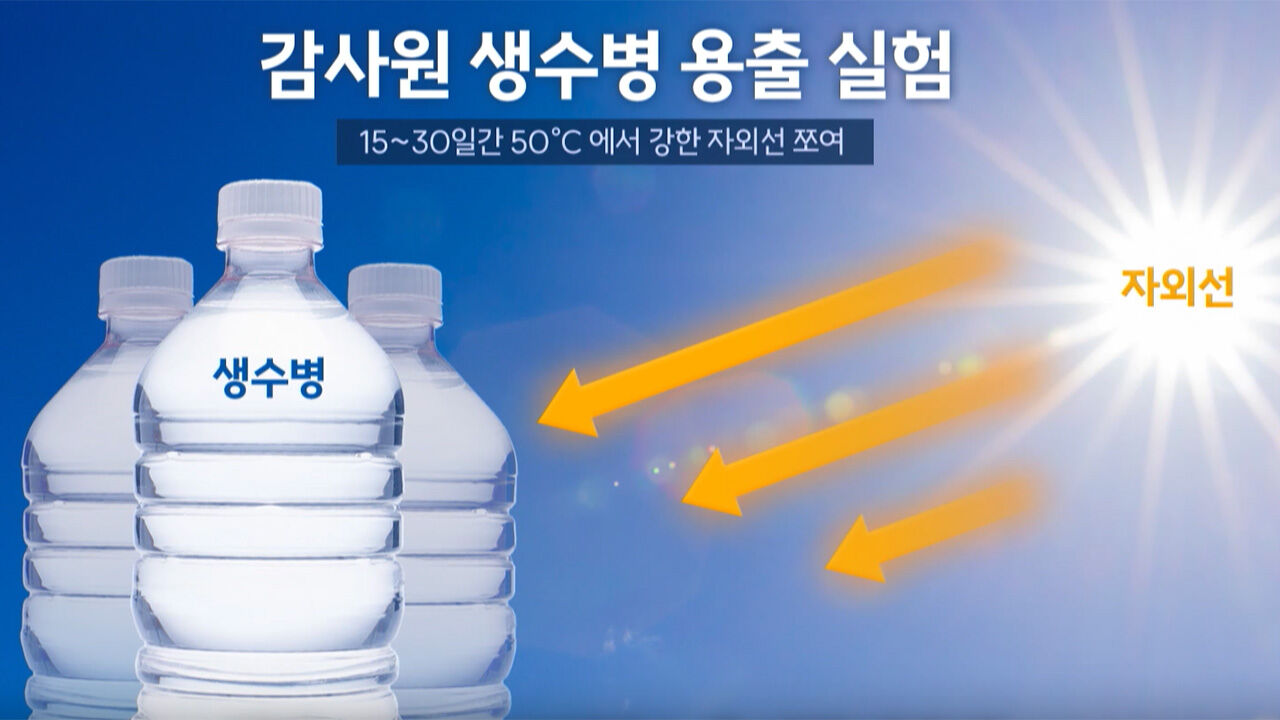
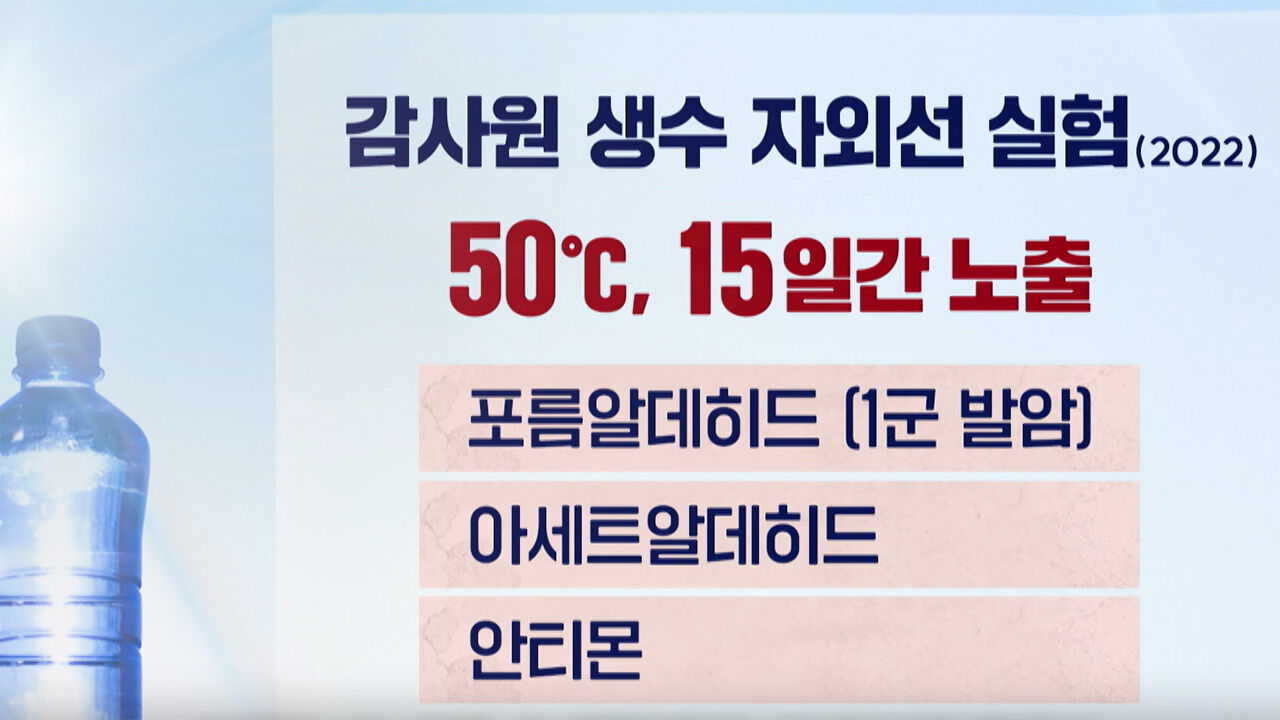
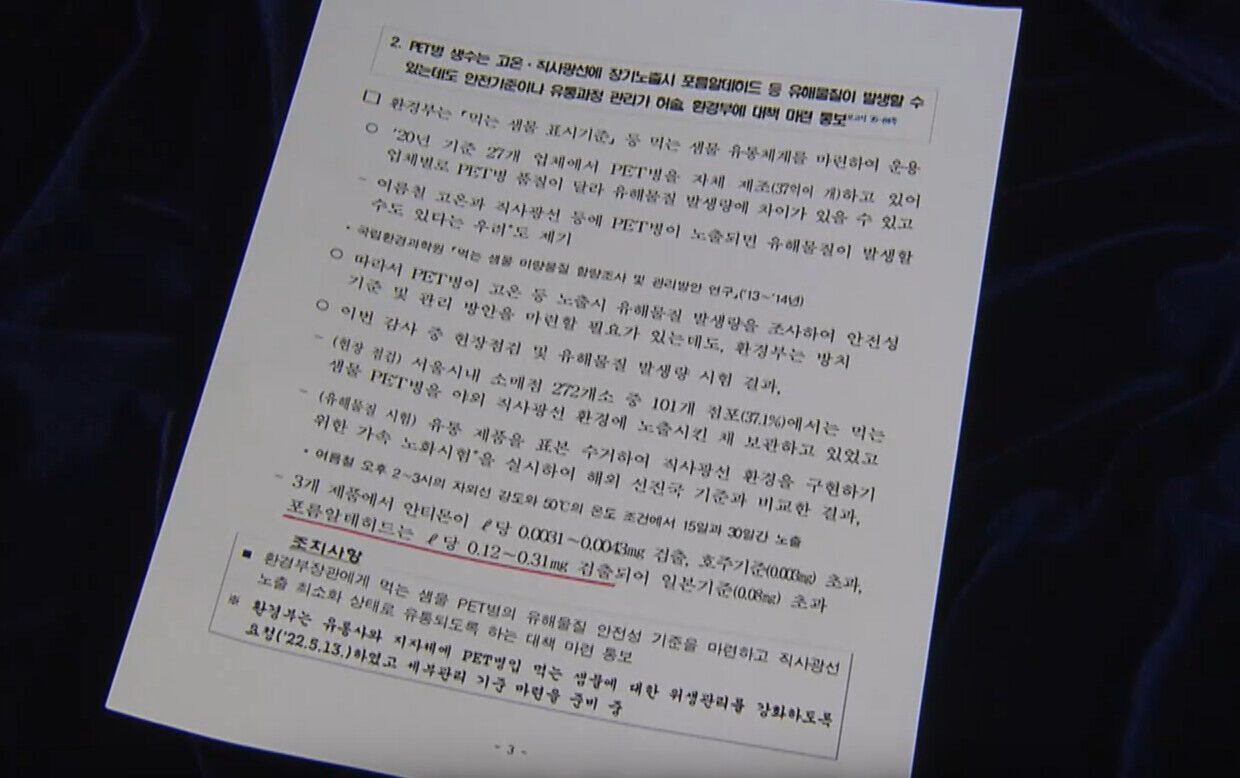
Is bottled water safe when exposed to extreme heat and intense sunlight like today? Regarding the issue of "PET bottled water exposed to direct sunlight," the Board of Audit and Inspection (BAI) conducted a direct investigation and experiment four years ago during its audit on the management of drinking water quality. They collected four products of PET bottled water—three domestic brands and one imported brand. They built a testing chamber with harsh conditions, setting the temperature to 50°C (122°F) and replicating the strong ultraviolet (UV) radiation intensity typically seen around 2 to 3 p.m. in the summer. They exposed the water bottles inside for 15 days and 30 days, respectively, and then sampled the water to test its quality. The BAI explained that 15 days of exposure in the chamber corresponds to roughly 3.9 months under natural conditions, while 30 days of exposure corresponds to about 7.8 months. When tested this way, formaldehyde—a Group 1 carcinogen—along with acetaldehyde, another toxic substance, and the heavy metal antimony were detected in some of the products.
Kang Sang-wook / Professor, Department of Chemical and Energy Engineering, Sangmyung University "When PET molecules are continuously exposed to ultraviolet light, their molecular chains break down. The chemicals produced as a result are aldehydes."
Formaldehyde is a Group 1 carcinogen classified by the International Agency for Research on Cancer (IARC) and is known to cause sick building syndrome and atopic dermatitis. Antimony is a toxic heavy metal used in plating or pigment processing; if poisoning occurs, it can cause gastrointestinal disorders, and it is also suspected of being carcinogenic.
How Harmful Is It?
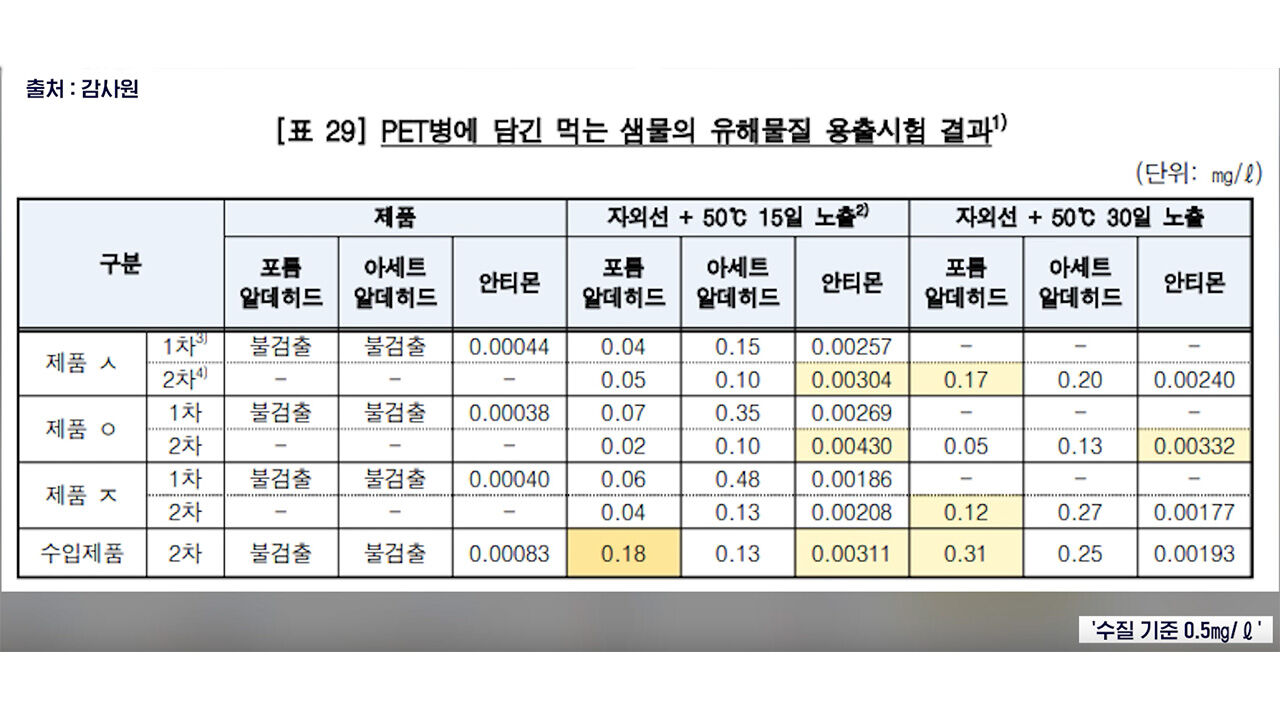
While it is clear that harmful substances are released, the crucial factor is the amount leached. Looking first at formaldehyde, the detected levels were below South Korea's safety threshold for drinking water quality. South Korea's current water quality standard for formaldehyde is 0.5 milligrams per liter, and 0.18 milligrams leached from the imported product during the 15-day exposure test. In the 30-day exposure test, 0.31 milligrams leached from the imported product, while the highest level among the three domestic products was 0.17 milligrams. Although these results met domestic standards, the picture changes when compared against countries with stricter drinking water standards. In Japan, for instance, the threshold is 0.08 milligrams per liter, meaning three out of the four tested products exceeded Japan's limit. What about the leaching of the heavy metal antimony? In the 15-day exposure test, amounts ranged from 0.003–0.004 milligrams, while the 30-day exposure test showed 0.001–0.003 milligrams. Although South Korea lacks drinking water standards for antimony and acetaldehyde, several overseas countries do have permissible limits for antimony. Australia sets its limit at 0.003 mg/L, the United States at 0.006 mg/L, and Japan at 0.015 mg/L, with Australia having the strictest standard. Measured against these international standards, no products exceeded the U.S. or Japanese limits. However, under Australian standards, four out of eight total test samples from the 15-day and 30-day tests exceeded the threshold.
What these figures signify is not necessarily that one must immediately stop drinking bottled water that has been exposed to sunlight, but rather that
it has been proven as a fact that harmful substances inside PET bottles do leach out when exposed to high temperatures and strong ultraviolet radiation over prolonged periods. Formaldehyde and acetaldehyde, which were undetectable prior to the exposure tests, were clearly shown to have leached out after the experiment. In the case of antimony, trace amounts were present even before the experiment, but after 15 to 30 days of UV exposure, the levels increased substantially.
In Effect Since July 31, But a 2-Year Grace Period?
Based on the test results, the Board of Audit and Inspection requested corrective measures from the Ministry of Environment—now the Ministry of Climate, Energy and Environment. The request called for establishing management standards through detailed reviews, such as testing the leaching of harmful substances under various conditions in the manufacturing and distribution processes of PET bottled water, as well as devising measures to distribute bottled water while minimizing exposure to direct sunlight.
It took four years for the Climate Ministry to revise and enact the regulations. The revised public notice on labeling standards for bottled natural mineral water came into force last week, on July 31. Previously, there was only a general guideline to store bottled water hygienically in a cool, dark place. Going forward, it is mandatory to store water indoors away from windows exposed to direct sunlight and, if windows are present, to install light-blocking devices. Furthermore, if outdoor storage is unavoidable, covers must be used. However, the problem is that although this regulation took effect on July 31, a two-year grace period has been granted. What does a grace period mean in this context? It means that while the policy itself is officially in effect, there will be no enforcement or crackdowns, leaving it up to businesses to comply voluntarily.
Of course, considering the circumstances of convenience stores and supermarkets, finding extra indoor space is not easy due to limited room. When the BAI inspected the distribution state of bottled water across 270 randomly selected retail shops and convenience stores in Seoul, over 100 stores—or 37 percent—were storing PET bottled water outdoors, directly exposed to sunlight. In that case, even if securing indoor space immediately is difficult, requiring covers for outdoor storage is a measure that could have been enforced right away. Given that ultraviolet radiation in direct sunlight plays a major role alongside high temperatures, simply covering the water bottles can yield significant effects, making the grace period a disappointing decision.
While the BAI's experiment took place four years ago in 2022, that was not the first time the issue was raised. Experts had raised concerns about this problem more than a decade earlier. In 2013, the National Institute of Environmental Research conducted tests and confirmed that acetaldehyde leached above sensory threshold levels—meaning at levels detectable by human smell—concluding that exposure to high summer temperatures should be avoided. Counting from that point, it took 13 years of raising issues and conducting scientific experiments to finally revise the public notice. Adding another two-year grace period leaves a strong impression of an overly passive response. One can only hope that the industry will take voluntary action.
※ Please note: This article was translated by AI and may contain errors.

 KOR
KOR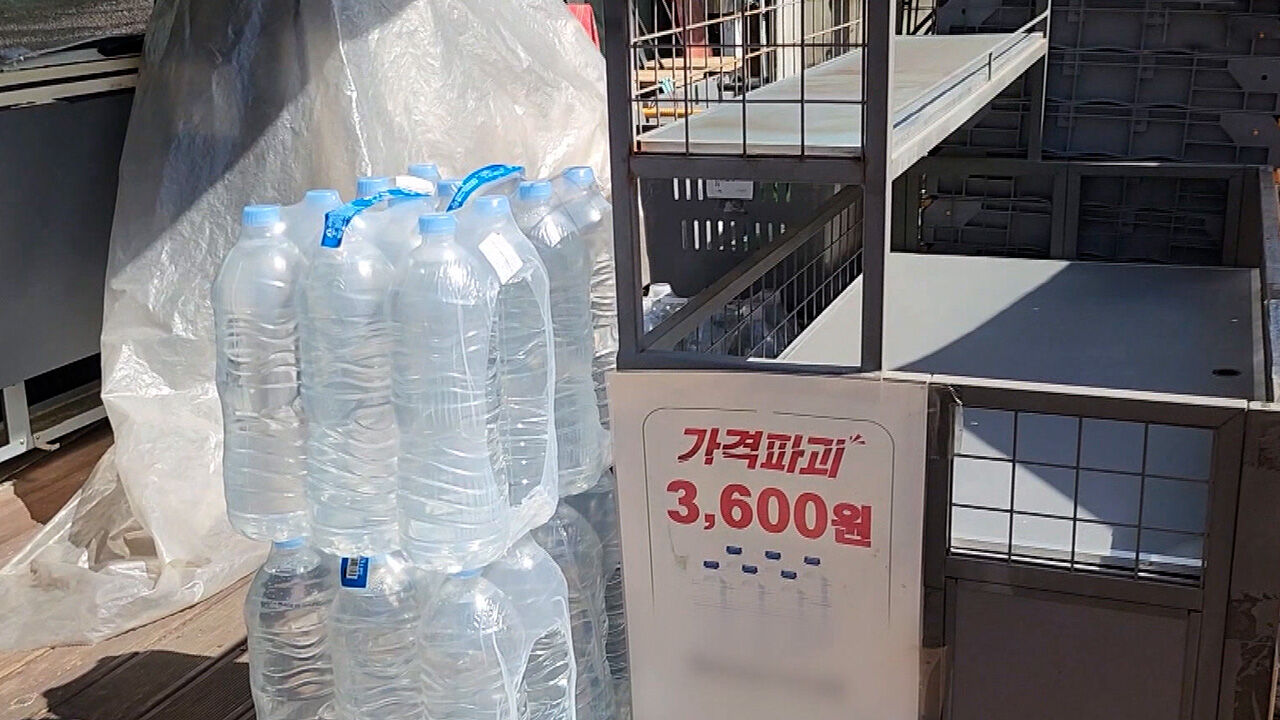





 Video News
 Video News