
 KOR
KOR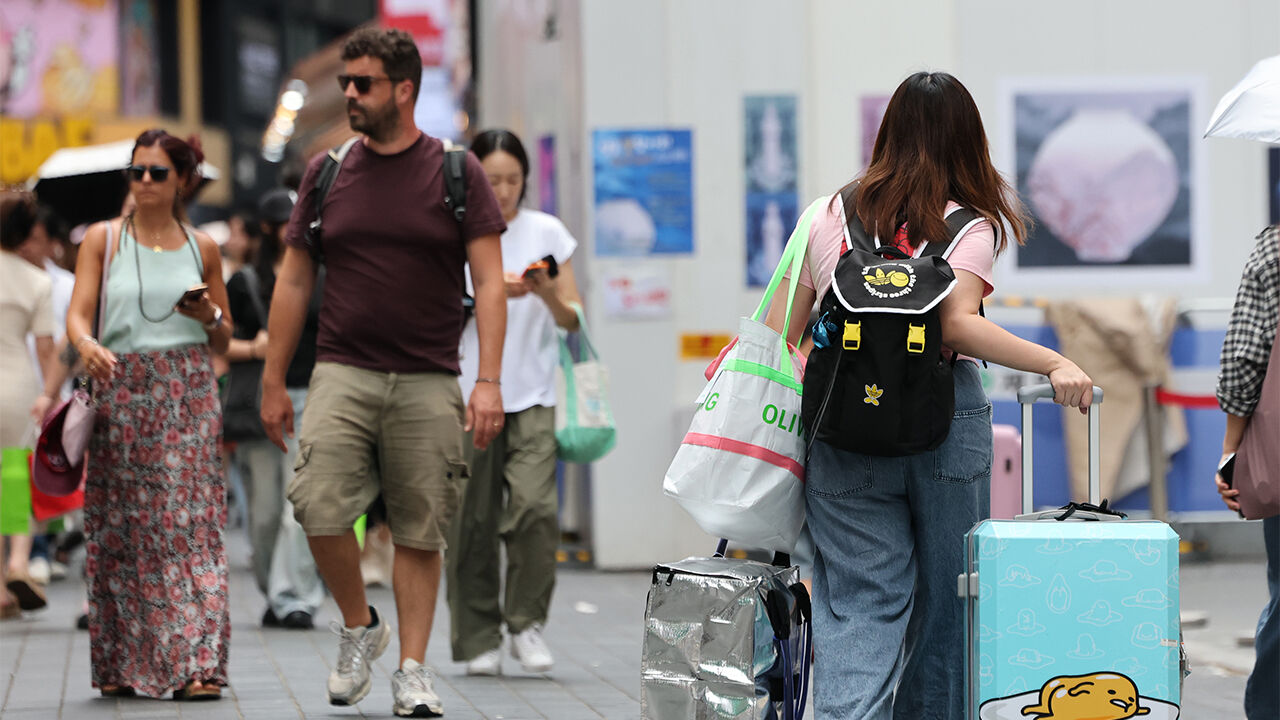
▲ Tourists
The Bank of Korea (BOK) suggested that to enhance the economic performance of South Korea's tourism, efforts should go beyond merely increasing the number of inbound visitors to also lengthen their stays, expand spending, and raise added value.
In a report titled "Growth Effects and Policy Directions of the Tourism Industry from the Perspective of Service Exports" released today, the BOK emphasized that "the true economic benefits of tourism can only be fully realized when not only attracting visitors, but also expanding their stays and spending, which in turn converts into domestic industrial production and added value."
This research focused on presenting development directions for South Korea's tourism industry through a comparison with Japan, a successful case of fostering the tourism sector.
After rolling out its tourism-oriented nation policy in earnest in 2003, Japan succeeded in both quantitative expansion and qualitative upgrading of its tourism industry, pushing its ratio of tourism exports to Gross Domestic Product (GDP) to 1.45% as of last year.
South Korea's ratio lingers at 1.17%, and reaching Japan's level would require expanding tourism exports by more than 25%.
To achieve this, the BOK calculates that South Korea would need to drastically increase the number of inbound tourists from 18.94 million last year to 23.75 million, raise average daily spending per visitor from $177.8 to $223.0, or extend the average length of stay from 6.5 days to 8.2 days.
Accordingly, the BOK stressed that simultaneously boosting multiple policy variables would be more effective.
For instance, even if the average length of stay is maintained at 6.5 days, increasing the number of visitors by 2.26 million and raising average daily spending by just $21.3 would enable South Korea to reach Japan's level in terms of the ratio of tourism exports to GDP.
The BOK also highlighted that domestic added value could be further increased by improving the spending structure of inbound tourists and the value-added ratio of core tourism industries.
If the share of spending in high value-added sectors such as medical services and beauty is raised from 17.2% to 35.0%, and the value-added ratios of the lodging, aviation, and restaurant industries are improved by 10 percentage points, 5 percentage points, and 8 percentage points respectively, the induced domestic added value would increase by approximately 420.4 billion won.
This would yield an effect equivalent to attracting an additional 320,000 inbound tourists.
Jeong Seon-young, head of the BOK's Asia-Pacific Economy Team, said, "Achieving policy goals through the number of visitors alone would require an influx of tourists equivalent to half of South Korea's population," adding that "this could create physical burdens, such as concerns over 'overtourism'."
She further emphasized, "There is a need to ex-post evaluate how current policies contribute to expanding tourism exports and enhancing domestic added value," and noted that "individual policies should be organically linked to raise the consistency and effectiveness of tourism policies."
(Photo: Yonhap News)
※ Please note: This article was translated by AI and may contain errors.





 Video News
 Video News