
 KOR
KORSBS has obtained a document that police leadership reported to the presidential office one month before the Jang Yoon-gi incident occurred. The document stated that upon receiving reports of stalking crimes, police would immediately file the cases and actively secure custody of the perpetrators. However, these measures were not implemented when the Jang Yoon-gi incident broke out. Prosecutors are now investigating whether the National Office of Investigation under the Korean National Police Agency ordered the downsizing of the case to cover up such operational failures.
Reporter Kim Deok-hyeon has our exclusive report.
[Reporter Kim Deok-hyeon]
On March 14, Kim Hoon, the perpetrator of the stalking murder in Namyangju, killed a woman in her 20s with whom he had previously been in a relationship.
[President Lee Jae-myung: Wasn't it a lax response that failed to prevent this horrific crime? Please swiftly supplement our systems without any loopholes.]
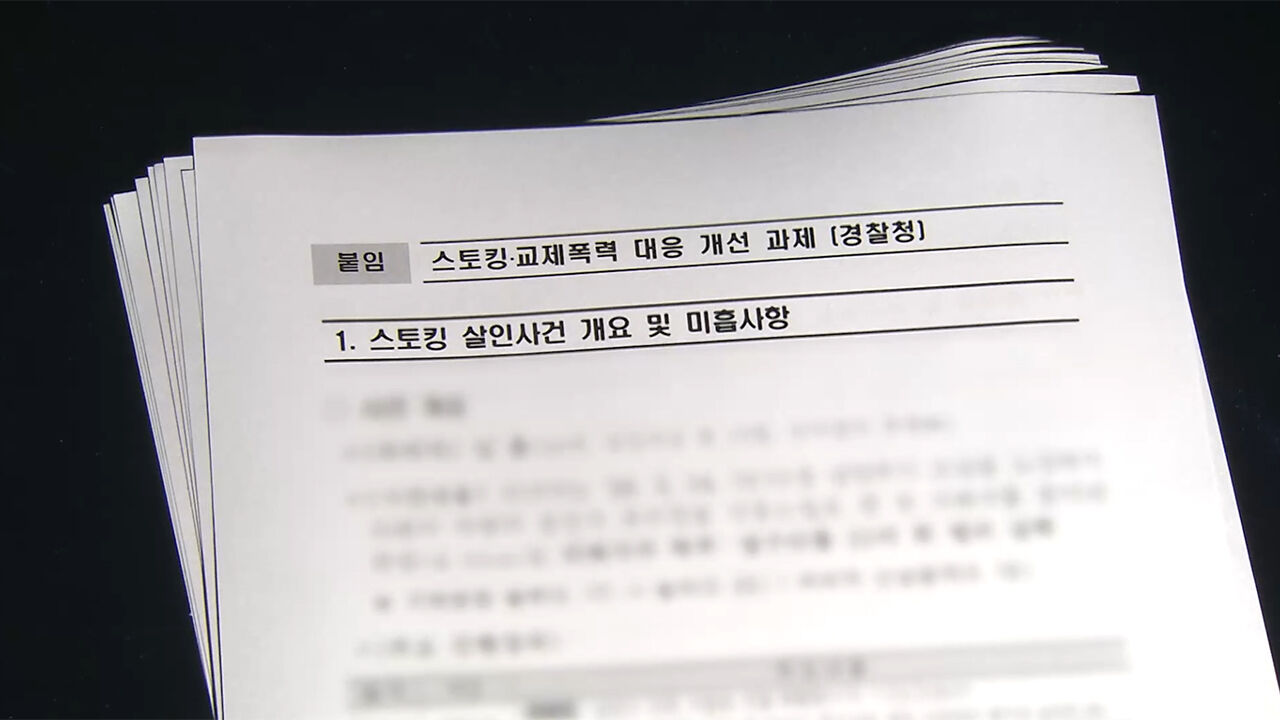
Two weeks later, on March 27, a related countermeasures meeting was held at the presidential office, and SBS obtained the document that the National Police Agency reported to the presidential office at the time through a lawmaker's office.
The police pointed out cases where reports from victims of relational crimes, including stalking, were closed internally without officially filing the cases as problematic.
To improve this, they reported that whenever relevant reports came in regardless of police station jurisdiction, they would immediately file the cases, and also presented plans to conduct preliminary investigations to secure custody for high-risk groups.
However, these points reported by the National Police Agency to the presidential office were not implemented during the response to Jang Yoon-gi's stalking crime that occurred about a month later.
On May 3, a Vietnamese woman, A, reported to the police when Jang Yoon-gi, who had sexually assaulted her, appeared near her home again.
Jang Yoon-gi's offense appeared to fall under the "high-risk group" mentioned in the presidential report document, but the dispatched police officers did not officially file the case and closed it on-site after merely "sending a warning text message."
Having received only a warning text message, Jang Yoon-gi discarded his mobile phone, freely roamed around the neighborhood, and murdered the late Lee Chae-won about 28 hours after the stalking report.
Had the police immediately filed the case upon receiving the stalking report as mentioned in the presidential report document and classified him as a high-risk group to secure his custody, Jang Yoon-gi's murder could have been prevented.
Recently, the prosecution, having secured the document, suspects that the National Office of Investigation ordered the downsizing of the Jang Yoon-gi case to conceal the fact that the investigation was not conducted according to the presidential report.
Park Sung-joo, the head of the National Office of Investigation at the time, explained to SBS that the order for "separate allocation" was "intended to ensure that the responsible department thoroughly investigates whether there were additional stalking victims."
(Video reporting: Yoon Hyung, Video editing: Shin Se-eun, Design: Seo Hyun-jung, Lee Ga-jin, Data provided by the office of lawmaker Park Soo-min)
---
[Anchor]
SBS reporting has confirmed that just one day before Jang Yoon-gi murdered the late Lee Chae-won, the police missed even their final chance to prevent the crime. There is a guideline known as the "post-incident callback," which mandates that police must call the reporter the very next day after receiving a stalking victim report, but the police failed to follow this protocol. The prosecution views this omission as another reason why police leadership ordered the downsizing of the case.
This is an exclusive report by reporter Shin Yong-il.
[Reporter Shin Yong-il]
In October 2021, ahead of the enforcement of the Stalking Punishment Act, the National Police Agency distributed "Measures to Strengthen Responses to Stalking Crimes" to frontline police stations.
This plan stipulated that whenever a report of a stalking crime is received, a phone call must be made to the reporter unconditionally on the "very next day."
The purpose of this so-called "post-incident callback" is to check the victim's current status, assess the possibility of additional harm, and guide them through support measures.
However, SBS reporting confirmed that the police, who received a stalking report from a Vietnamese woman two days before Jang Yoon-gi murdered the late Lee Chae-won, not only failed to file the case immediately but also neglected to perform the mandatory "post-incident callback" the next day.
The critical issue is that the victim, the Vietnamese woman, submitted a complaint to a different police station on May 4, the day after the report, stating she had been sexually assaulted by Jang Yoon-gi.
Had the police conducted the "post-incident callback" the next day according to the manual, they would have easily grasped the fact that sexual assault had been committed alongside stalking. This likely would have triggered efforts to secure Jang Yoon-gi's custody, thereby preventing further crimes.
The police, having missed the final opportunity to stop Jang Yoon-gi's murderous crime, reportedly contacted the Vietnamese victim only on May 5, after the late Lee Chae-won had already died.
The Gwangsan Police Station explained, "At the time, there were an overwhelming number of stalking reports," and added, "As we were processing the 'post-incident callbacks' sequentially, it appears to have been delayed by a day."
Having confirmed through interviews with relevant personnel that the "post-incident callback" measure was delayed at the time, the prosecution reportedly views this as another reason why the police leadership ordered the downsizing of the Jang Yoon-gi case.
(Video reporting: Yang Hyun-chul, Video editing: Lee So-young, Design: Hwang Se-yeon)
---
[Anchor]
Legal affairs team reporter Kim Deok-hyeon is with us in the studio.
Q. What is the significance of the "March 27 Presidential Report Document"?
[Reporter Kim Deok-hyeon: This document contains what the National Police Agency reported to the presidential office after President Lee Jae-myung strongly reprimanded the police for their inadequate response to the Namyangju stalking crime. It was a report conducted under gravely serious circumstances. When the core contents mentioned in the report document were not implemented in the "Jang Yoon-gi case" about a month later, the police leadership inevitably had to feel immense pressure. The prosecution suspects that the National Office of Investigation's order for "separate allocation" during the handling of the Jang Yoon-gi case—aimed at preventing sexual crimes from coming to light—was driven by concerns that their initial response failures in the stalking case would be exposed.]
Q. Regarding the final opportunity, the "post-incident callback"… what if it had been properly executed?
[Reporter Kim Deok-hyeon: Yes, exactly. This is especially regrettable because looking back at the entire sequence of the Jang Yoon-gi case, it was the final opportunity that could have prevented the tragic death of the late Lee Chae-won. Jang Yoon-gi's murder took place at 12:08 AM on May 5. The Vietnamese woman who reported the stalking damage on the night of May 3 filed a complaint regarding sexual assault at a different police station the next day, May 4. If the Gwangsan Police Station had simply called the victim back on May 4, the day of the complaint, they could have easily grasped the sexual assault and launched a full-scale pursuit. Given that Jang Yoon-gi was wandering around his usual haunts on the night of the 4th, it leaves a bitter sense of what could have been—he might have been apprehended, or at the very least, the murder could have been prevented.]
Q. Is the prosecution's investigation heading toward the "police leadership"?
[Reporter Kim Deok-hyeon: The prosecution is targeting the leadership of the National Office of Investigation as the higher-ups behind the abuse of power. Officials at the Gwangsan Police Station claim they merely followed and executed the separate allocation order, and that the National Office of Investigation spearheaded the case downsizing. In particular, the prosecution believes that the fact that the National Office of Investigation ordered separate allocation has been objectively verified through messaging data from officials at the National Office. However, to apply charges of abuse of power to the National Office of Investigation, it is necessary to establish whether there was an "improper motive" behind the order—in other words, the "motive" must be clarified. The prosecution considers the details reported by our network today (August 4) as evidence that raises suspicions of an improper motive.]
(Video editing: Lee So-young, Design: Seo Hyun-jung)
※ Please note: This article was translated by AI and may contain errors.



 Video News
 Video News
 Video News
 Video News
 Video News