
 KOR
KOR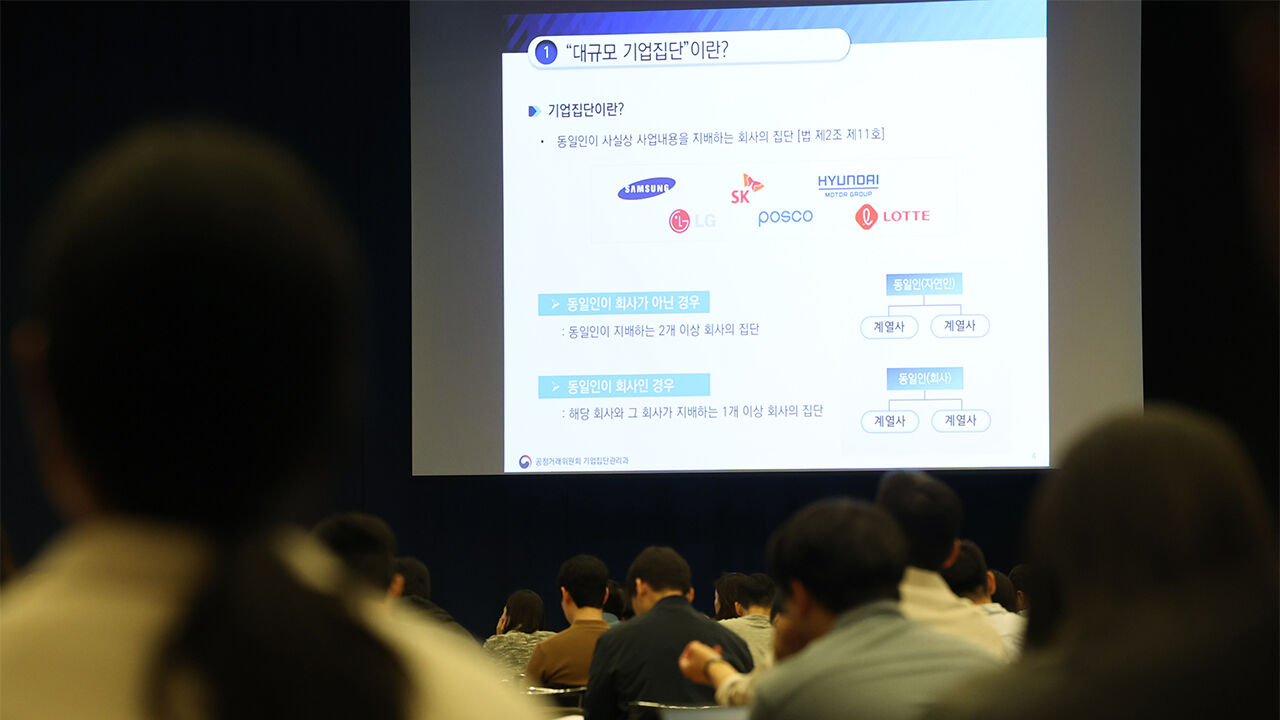
▲ A briefing session for business groups subject to disclosure is being held at the Korea Chamber of Commerce and Industry in Jung-gu, Seoul, on May 11. (Photo: Yonhap News)
The Fair Trade Commission (FTC) is reforming its system to impose fines directly on the heads of large business conglomerates if they omit affiliate companies when submitting designation data to the antitrust agency.
The agency plans to actively file criminal complaints for serious or repeated omissions.
In addition, the FTC will conduct in-depth fact-finding surveys on three major platform sectors prone to frequent complaints—open markets, delivery services, and accommodations—and reform the exclusive right to file complaints system by granting the right to directly file complaints regarding the Monopoly Regulation and Fair Trade Act (Fair Trade Act) to a certain number or more of citizens, central administrative agencies, and metropolitan local governments.
The FTC announced these measures today (August 4) at the Yeongbinmun of the Blue House as part of its "Second Half 2026 Key Policy Implementation Plan."
The FTC is strengthening sanctions for violations of the obligation to submit designation data, which serves as the starting point for large business group policies.
The law will be revised so that fines can be imposed directly on the head of a conglomerate if affiliate companies are left out.
The maximum limit for the fine is being reviewed at up to 10 percent of the larger amount between the total sum of assets and the total annual average sales of the omitted affiliate companies.
The current Fair Trade Act stipulates that submitting false designation data is punishable by up to two years in prison or a fine of up to 150 million won.
However, the FTC has concluded that criminal punishment alone is insufficient to prevent law violations.
The agency's policy is to strengthen criminal referrals for major and repeated omissions of affiliate companies.
When calculating shareholding ratios for companies subject to regulations on private interest-gaining (unfair support), treasury stock will be excluded from the total number of issued shares.
Currently, regulations against private interest-gaining apply to affiliates in which the conglomerate head's family holds a 20 percent or greater stake, as well as subsidiaries in which such affiliates hold more than a 50 percent stake.
When treasury stocks are excluded from the total number of issued shares—which serves as the denominator in calculating shareholding ratios—the ownership percentage rises, potentially bringing affiliates that were previously outside the regulatory scope into the net of private interest-gaining regulations.
The FTC decided to revise the law so that private interest-gaining regulations can be applied retroactively to the period of non-designation if a company was not designated as a disclosure group due to omitted affiliates.
The surcharge rates for heavier penalties will also be raised if disclosure obligations are repeatedly violated.
To encourage large business groups to voluntarily improve their ownership and governance structures, the FTC will present standards and develop metrics to measure them quantitatively.
The FTC will also step up monitoring against unfair internal support within livelihood-sensitive sectors such as food, logistics, and pharmaceuticals; small and medium-sized enterprise-dominated sectors such as building management, security, and construction material procurement; and livelihood finance sectors including the loan industry.
The FTC is also overhauling the exclusive right to file complaints system, which was established when the Fair Trade Act was enacted in 1980.
The agency decided to reform the system to eliminate the FTC's monopoly on filing complaints by granting direct complaint-filing rights to a certain number or more of citizens, central administrative agencies, and metropolitan local governments.
Currently, prosecutors can only indict Fair Trade Act violations if the FTC files a complaint, but discussions on reform gained rapid momentum after President Lee Jae-myung raised issues with the system during a Cabinet meeting in February.
The specific number of citizens required to qualify for filing a complaint will be decided through societal discussions.
To prevent indiscriminate complaints, a tentative body called the "Complaint Review Committee" will be operated within each respective national agency.
To sufficiently deter law violations, the upper limit of fines will be significantly raised, and the fine imposition system will be completely overhauled so that larger corporate entities bear heavier fines.
Under the plan, metropolitan local governments will also be granted investigative and disposition powers for clear-cut violations in subcontracting, franchising, agency businesses, and labeling and advertising sectors.
This will allow metropolitan local governments to directly investigate unfair practices such as abuses of power by prime contractors against subcontractors and franchisees, as well as false or exaggerated advertising, and issue fines or corrective recommendations.
Although the FTC's organization was expanded following President Lee Jae-myung's directive, it has yet to fill all authorized positions, prompting a rush to secure personnel.
Unfilled positions out of the 167 added in March will be filled by next month, and additional staff will be recruited in October in line with a second workforce expansion (+237 personnel).
To foster an innovative ecosystem in the digital market, the FTC will closely examine the actual conditions regarding commissions, payment settlement periods, and damages to tenant merchants across three major platform sectors experiencing a surge in complaints and disputes: open markets, delivery services, and accommodations.
The findings will be utilized in establishing future platform policies.
The agency also plans to conduct fact-finding surveys on the competitive landscape and transaction conditions of artificial intelligence (AI) service markets, such as ChatGPT, to identify areas for institutional improvement.
Efforts will be made to ensure the swift passage in the National Assembly of the Platform Fairness Act and the Delivery Platform Act, which aim to establish fair trading order in the platform sector and alleviate the burden of high commissions on tenant businesses.
In addition, the FTC plans to improve regulations to review anti-competitive concerns in the AI sector, even in cases of indirect business combinations where companies absorb core talent en masse without corporate mergers and acquisitions (M&As).
In business combinations within innovative fields such as big data and blockchain, the agency will closely examine the likelihood of monopoly formation and the potential to support market innovation.
The FTC will also launch intensive inspections into dark patterns (online deceptive user interfaces) utilized in paid AI subscription services.
To block the distribution of hazardous products, the FTC will expand the AI-monitored platforms from 8—including Naver, Coupang, AliExpress, and Temu—by adding 3 more, including Danggeun, Junggonara, and Lightning Bazar, bringing the total to 11.
(Photo: Yonhap News)
※ Please note: This article was translated by AI and may contain errors.



 Video News

 Video News
 Video News
 Video News