
 KOR
KOR
▲ Fair Trade Commission
The Fair Trade Commission (FTC) has raised the baseline surcharge rates for unfair trade practices in subcontracting, franchising, and agency businesses, while increasing surcharges by up to 100 percent based on the frequency of law violations over the past five years.
The FTC announced today (August 4) that it is implementing revised notices on surcharges for acts including the Fair Subcontract Transactions Act, the Fairness in Franchise Transactions Act, and the Fairness in Agency Transactions Act.
Under the revised notices, the FTC has raised the baseline surcharge rates and standard surcharge amounts, while sub-dividing the degree of severity into a four-tier surcharge system, replacing the previous three-tier system.
Surcharges are calculated primarily by multiplying the standard amount determined by each law by the baseline surcharge rate corresponding to the nature and severity of the violation.
In cases where it is difficult to calculate the standard amount, a fixed standard surcharge amount serves as the basis for the penalty.
However, criticisms have been raised that because the baseline surcharge rates themselves were set low, the level of penalties imposed was relatively mild compared to the severity of the law violations.
According to the revised notices, under the Subcontract Act and the Agency Act, the baseline surcharge rate for the most severe category of violations—"very serious violations"—will be raised from the previous 60 to 80 percent to 90 to 100 percent.
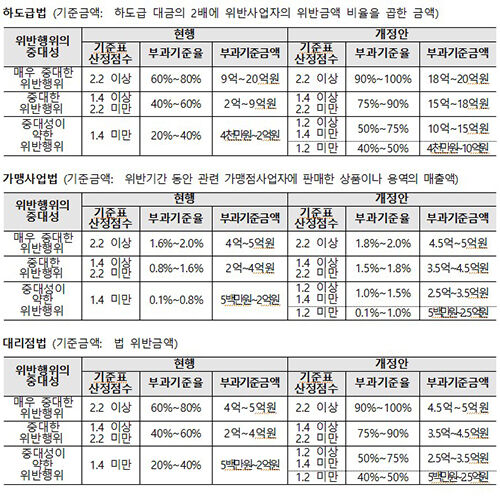
The maximum baseline surcharge rate under the Franchise Business Act will rise from 1.6 to 2.0 percent to 1.8 to 2.0 percent.
The maximum baseline surcharge amounts will be adjusted upward from 900 million to 2 billion won to 1.8 billion to 2 billion won under the Subcontract Act, and from 400 to 500 million won to 450 to 500 million won under the Franchise Business Act and the Agency Act.
Along with these changes, the "detailed evaluation criteria tables" (attached tables of the surcharge notices), which form the basis for determining the severity of law violations in the franchising and agency sectors, have also been partially improved.
For the franchise sector, the benchmark timing for reflecting the size of the franchisor in terms of sales revenue has been changed from "immediately prior to the violation" to the business year "immediately prior to the end of the violation."
For the agency sector, "types of violation" and "size of the supplier" have been added as factors to be taken into consideration.
This adjustment aims to allow a more thorough assessment of the severity of violations.
Surcharge increases related to repeated law violations have also been tightened.
If a business has a record of one violation in the past five years and the combined weighted score is 2 points, the surcharge amount was previously increased by 10 to 20 percent, but it can now surge up to 40 to 50 percent.
When a business has violated the law four or more times over the past five years and the combined weighted score is 7 points or higher, the surcharge amount will be increased from 60 to 80 percent up to 90 to 100 percent.
In addition, for businesses in the agency sector engaging in "unfair practices" that take retaliatory actions against others for filing reports with the FTC or applying for dispute mediation, the upper limit for surcharge increases will be raised from 20 percent to 30 percent.
This is to align with the surcharge increase limits already applied in the fair trade and distribution sectors (30 percent).
A 30 percent surcharge increase limit has also been newly established for the franchise sector, which previously lacked specific provisions for increasing surcharges regarding retaliatory actions.
Grounds for reducing surcharges will be curtailed.
Previously, if a business cooperated with FTC investigations and deliberations, it could receive reductions of 10 percent for each, up to a total of 20 percent; moving forward, surcharges can be reduced by up to 10 percent only if the business cooperates with both investigations and deliberations.
In the franchise sector, a provision allowing surcharges to be reduced by up to 10 percent for law violations caused by minor negligence has been eliminated.
The FTC stated, "Through this revision, we expect to deter incentives for law violations among businesses in the subcontracting, franchising, and agency sectors, thereby establishing a fair trading order."
(Photo provided by FTC, Yonhap News)
※ Please note: This article was translated by AI and may contain errors.



 Video News


 Video News
