
 KOR
KOR
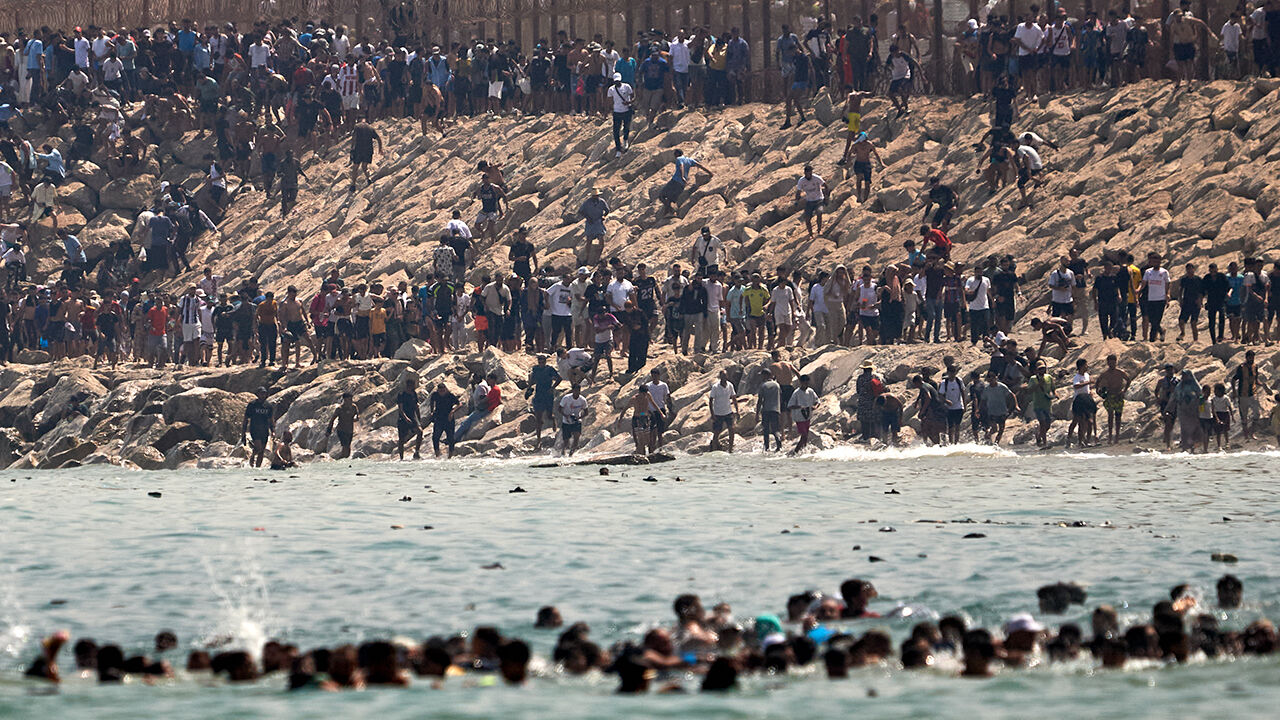
▲ Migrants attempting to enter Ceuta from Morocco
The Spanish government has deployed military personnel and tightened border controls after thousands of migrants swarmed into Ceuta, a Spanish autonomous city bordering Morocco in North Africa, foreign media outlets including Reuters reported on July 30 (local time).
According to the reports, migrants in Morocco breached the fences surrounding Ceuta or swam across the sea to enter the city that day.
The crowd reportedly included not only young adults but also families with small children, unaccompanied minors, and the elderly.
While a significant number entered the border area on foot or by swimming, others arrived on motorcycles or in cars.
Hundreds of migrants broke through the fences within minutes just past midnight.
Some migrants were heard shouting "Viva Spain" as they entered Ceuta.
Moroccan police attempted to block them, but were overwhelmed by the large crowd and lost control.
A spokesperson for Spain's Guardia Civil border guard stated that the scale of the migrant influx was too large for police forces to handle.
Spanish state broadcaster TVE reported that 2,000 to 3,000 people crossed the border over the course of a few days.
Casualties also mounted amid the heavy chaos.
Local authorities announced that nine bodies, presumed to be migrants who attempted to cross into Ceuta, were found along the coastline and other areas that day.
The death toll of migrants who died while attempting to enter Ceuta over the past few months has reached around 60, including these latest fatalities.
The Spanish government sent 200 police officers and 60 military personnel from the mainland to Ceuta to reinforce local security forces.
As the situation on the ground became extremely chaotic, many shops in downtown Ceuta shut their doors.
Enrique Serrano, who runs a women's clothing store in the city center, said, "The situation is extremely tense, so we will not open the shop this afternoon," adding, "My priority is to protect my business and my family."
Ceuta is a Spanish territory in North Africa with a population of 85,000.
Reuters noted that this situation is reminiscent of 2021, when about 10,000 migrants from Morocco and sub-Saharan Africa entered Ceuta over the course of a few days.
Because Ceuta shares a land border with the African continent, mass border-crossing attempts by migrants aiming to enter Europe occur periodically.
The Socialist-led government of Spanish Prime Minister Pedro Sánchez has pursued relatively migrant-friendly policies in Europe.
Recently, it launched a program granting legal residency status to about 500,000 undocumented migrants.
The opposition criticized the Sánchez government for the crisis in Ceuta.
Alberto Núñez Feijóo, leader of the main opposition Popular Party, wrote on X (formerly Twitter) that the situation in Ceuta is desperate, stating that the government must not turn a blind eye and that they are facing a national security crisis.
Juan Jesús Vivas, the mayor of Ceuta, also urged the central government that day to declare a state of emergency in response to the mass influx.
In a TV interview, he appealed that they are in a complete humanitarian and social emergency and no longer have the space to accommodate migrants.
The crisis also appears to be spilling over into a diplomatic conflict between Spain and Italy.
Italian Foreign Minister Antonio Tajani claimed on X that the scenes from Ceuta demonstrate that the migration policy of the Sánchez government is flawed.
Referring to the Schengen Agreement—a pact among 29 European countries abolishing border checks to ensure free movement—he said he would be in favor of suspending the Schengen arrangement with Spain, drawing backlash from Spain.
The Spanish government criticized Tajani's remarks as "provocative statements" and summoned the Italian ambassador in Madrid to lodge a protest, AFP reported.
Spain's Ministry of the Interior stated that it has blocked the illegal entry of thousands of people over the past few days and is cooperating closely with Moroccan authorities.
The Ministry of the Interior ruled out the possibility of declaring a state of emergency, reporting that it had agreed with the Moroccan government to return those who crossed into Ceuta as quickly as possible.
Prime Minister Sánchez wrote on X that the central government is mobilizing all necessary resources, cooperating with Morocco and international relations authorities, and preparing measures to return to normalcy as soon as possible.
(Photo: AP, Yonhap News)
※ Please note: This article was translated by AI and may contain errors.





 Video News
 Video News