
 KOR
KOR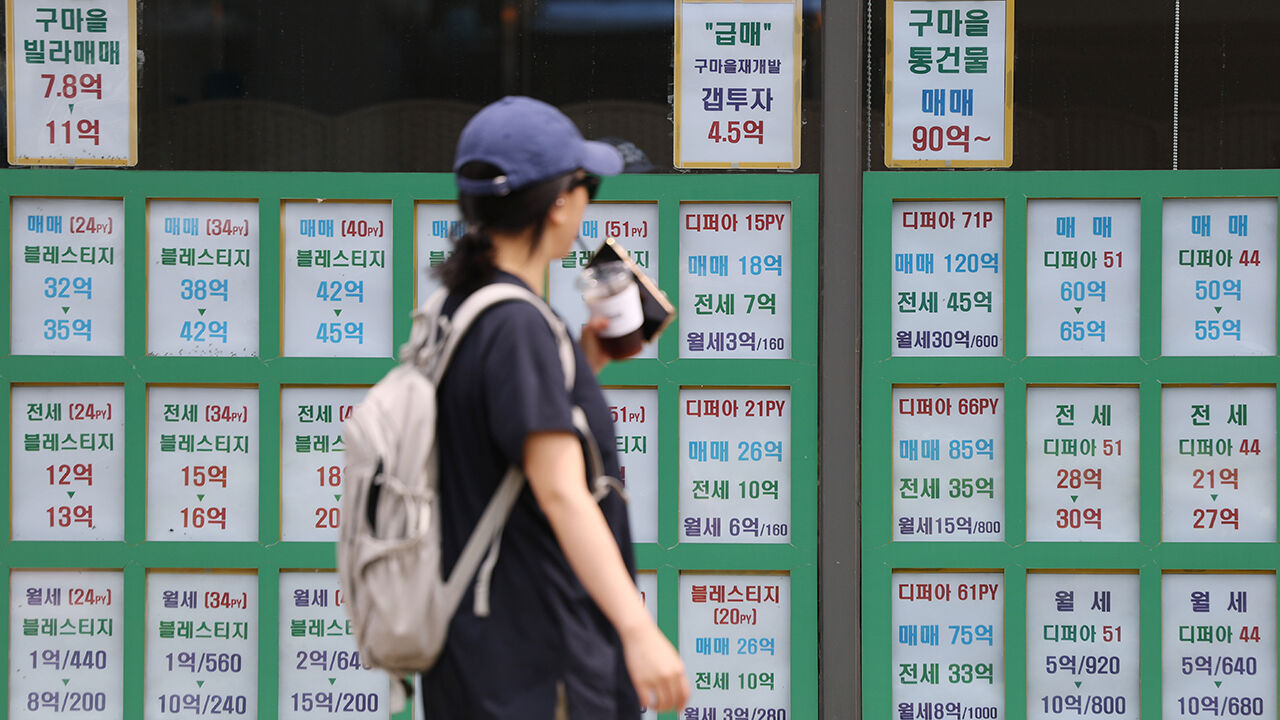
▲ Real estate listing information posted at a real estate agency in Gangnam-gu, Seoul
While the government pushes to raise taxes on ultra-high-end homes in its tax revision bill to be announced early next month, property taxes on some expensive apartments in areas like Gangnam and Yongsan-gu have surpassed 2021 levels to reach all-time highs this year, even without tax rate adjustments.
Amid this trend, projections suggest that if a "triple hike"—involving adjustments to comprehensive real estate holding tax rates, the fair market value ratio, and the public price realization rate—is implemented going forward, the tax burden on owners of high-end homes could grow exponentially.
According to simulations conducted today (July 29) by Woo Byeong-tak, a senior specialist at Shinhan Premier Pathfinder, calculations of this year's property taxes for nine housing types in complexes with public prices exceeding 3 billion won in the three Gangnam districts and Yongsan-gu showed that more than half, or five housing types, recorded the highest property taxes ever based on current standards without any tax rate increases.
Property taxes as of June 1 of this year have been levied starting this month based on public prices calculated at the beginning of the year, with comprehensive real estate holding taxes scheduled to be levied this December. For a single-home owner of an 84㎡ exclusive-area unit at Banpo Xi in Banpo-dong, Seocho-gu, the estimated property tax for this year is 18.1 million won, excluding comprehensive real estate holding tax deductions for the elderly or long-term owners.
This is an increase of over 40% compared to last year (12.74 million won), surpassing the previous record of 16.53 million won set in 2021.
In 2021, near the end of the Moon Jae-in administration, the public price realization rate for apartment units with market prices exceeding 15 billion won stood at 78.3%, and fair market value ratios of 95% for the comprehensive real estate holding tax and 60% for property taxes were applied, making it the period with the highest property tax burden ever.
However, even though this year's realization rate is lower than in 2021 at 69%, and the fair market value ratios were lowered to 60% for the comprehensive real estate holding tax and 43% to 45% for property taxes, the largest tax amounts in history were calculated.
The cause is the sharp surge in public prices driven by rising apartment prices.
This year's public price for this apartment is 3.491 billion won, up 55.5% from 2021 (2.245 billion won).
Property taxes for this year also reached all-time highs for other simulated complexes: the 84.97㎡ exclusive-area unit (22.27 million won) and the 112.96㎡ exclusive-area unit (38.16 million won) at Acrew River Park in Banpo-dong, Seocho-gu; the 84.93㎡ unit (19.05 million won) at Raemian Firstige in Banpo-dong, Seocho-gu; the 82.6㎡ unit (12.58 million won) at Jamsil Jugong Complex 5 in Songpa-gu; and the 235.3㎡ unit (76.33 million won) at Hannam The Hill in Yongsan-gu.
Specialist Woo Byeong-tak said, "Despite the freeze in this year's public price realization rate, apartment prices in Seoul rose sharply last year, leading to record-high public prices in many areas," adding, "Even with a low fair market value ratio of 60%, quite a few places hit record highs in property taxes."
Meanwhile, as the government reviews ways to increase the tax burden on ultra-high-end homes to advanced-economy levels in order to curb the preference for owning a single "competent" home, a record-level property tax burden is imminent.
During a real estate town hall meeting presided over by the president on the 23rd, opinions were presented that the effective property tax rate for ultra-high-end homes should be raised to 1%, matching advanced-economy levels.
This suggests levying a 50 million won property tax on a home with a market price of 5 billion won, in which case the property tax on an 84㎡ apartment in Gangnam could increase by two to three times compared to the current level.
While the criteria for ultra-high-end homes have not yet been disclosed, many in the market project it will likely be set around the public price mark of 3 billion won.
According to the Ministry of Land, Infrastructure and Transport, apartment complexes with public prices of 3 billion won or more number around 50,869 this year, accounting for 0.32% of all apartment complexes (15,851,336 units).
Among them, an absolute majority of 50,519 units (99.3%) are located in Seoul.
Considering the current apartment realization rate (averaging 69%), apartments with market prices of 4.3 billion won or higher effectively serve as candidates for ultra-high-end homes.
Representative examples include expensive complexes such as Nine One Hannam and Hannam The Hill in Hannam-dong, Yongsan-gu; units with exclusive areas of 84㎡ or larger around Gangnam and Seocho-gu; large apartments in Songpa-gu; and ultra-large mixed-use residential complexes in Seongsu-dong.
The currently discussed methods for raising property taxes on ultra-high-end homes vary.
One approach is to create a separate tax bracket for the comprehensive real estate holding tax to raise tax rates on ultra-high-end homes.
For a home with a public price of 3 billion won, the tax base for the comprehensive real estate holding tax is 1.08 billion won when applying a 60% fair market value ratio, and 1.44 billion won when applying an 80% ratio. The current bracket of over 1.2 billion won to 25 billion won, which is subject to a 1.3% tax rate, could be split to create a separate bracket starting from over 1.4 billion won or 1.5 billion won, raising tax rates two- to threefold through a progressive step structure.
Another method being discussed is raising comprehensive real estate holding taxes by differentially applying the fair market value ratio from 60% to 90% by price tier without creating a separate bracket.
This would allow tax increases solely through enforcement decree amendments, bypassing parliamentary hurdles.
How to apply the basic deduction is also a variable.
While the government is reportedly considering raising the deduction for single-home owners from the current 1.2 billion won to the 1.3 billion to 1.5 billion won range, it remains uncertain whether the same deduction will be applied to ultra-high-end homes.
A tax expert who spoke on condition of anonymity said, "The current comprehensive real estate holding tax rate tops out at 2.7% for single-home owners, but for ultra-high-end homes, it could be raised to 5.0%, the maximum rate currently applied to those owning three or more homes," adding, "Looking ahead, tax credits for the elderly or long-term owners are also expected to be scaled back for ultra-high-end and non-resident single-home owners, meaning the perceived tax burden will feel much heavier the moment a property is classified as ultra-high-end."
Tax experts expect that the property tax burden cap, currently set at 150%, will also be raised to enhance tax-increase effects.
This is because major apartments in the Gangnam area, prime candidates for the ultra-high-end category, saw their public prices soar this year, meaning many complexes have already reached the tax burden cap, and their perceived tax burden remains low.
Market projections suggest the tax burden cap could be raised to 200% to 300%, levels previously applied to owners of two or more homes during the Moon Jae-in administration.
Another variable is the public price realization rate.
The government plans to establish a five-year realization rate roadmap, which is currently undergoing research and is scheduled to be announced as early as October or November.
As the public price realization rate rises, public prices will increase even at the same market value, inevitably expanding the category of ultra-high-end homes.
The government has set the final target for the public price realization rate at 90% of market value. Even if the realization rate is raised to just 80% immediately, homes with market prices of 3.75 billion won or more would be classified as ultra-high-end (assuming a public price of 3 billion won).
An appraiser said, "Raising the public price realization rate risks reversing market prices in a highly volatile market and will inevitably expand the category of ultra-high-end homes to areas like the Han River belt," adding, "Such points must be taken into consideration when establishing the realization rate roadmap."
Tax experts believe that once criteria for ultra-high-end homes are established, the "threshold effect" will also intensify.
They point out that preference could shift more noticeably toward apartments along the Han River belt instead of the Gangnam area, where tax burdens are spiking.
Last year's rise in Seoul apartment prices was led by areas along the Han River belt.
A real estate agent in Mapo-gu, Seoul, said, "After seeing opinions expressed at presidential town hall meetings and elsewhere, homeowners of regular apartments in Seongdong, Mapo, and Gwangjin-gu seem relieved, believing they will be excluded from being 'ultra-high-end,'" and added, "While multi-home owners remain on edge either way, single-home owners might see their property tax burden decrease, prompting real demand buyers who originally aimed for Gangnam to move toward the Han River belt instead."
(Photo: Yonhap News)
※ Please note: This article was translated by AI and may contain errors.



 Video News
 Video News
 Video News
 Video News