
 KOR
KOR
▲ A worker uses a parasol while farming in a field in Gyeongsan, Gyeongsangbuk-do, where a heavy heatwave warning was issued on the 27th. (Photo: Yonhap News)
"If you work in the field in this kind of heatwave, you could collapse."
As heavy heatwave warnings have been issued for Daegu, Gyeongsan, Pohang, and Gyeongju, daily lives of citizens are changing.
Farmers have stopped working during midday, and pedestrian traffic in downtown areas has dried up.
People have sought out cooler places such as valleys, parks, and shade to escape the heat.
On the morning of the 27th, at a community garden complex in Jinnyang-eup, Gyeongsan.
Without a single spot of shade, heat rose from the ground to the point where it was difficult even to stand for a moment.
Although the area was surrounded by rice paddies and fields, no farmers were seen working.
Agricultural sprinklers continuously sprayed water to prevent crops from drying up.
Farmer A, whom we met at a storage shed next to the garden, clicked their tongue and said, "We come out early in the morning to work for a few hours and stop working once the sun comes up. Because the heatwave is severe, people can collapse."
After walking around the endless fields for about 10 minutes, we met foreign worker B, who was working with a parasol as shade.
"I come out at 5 a.m., when it is somewhat less hot, and finish work before lunch," B said.
Wearing a vest that blows cool air, B continuously drank cold water and resumed work.
For vulnerable groups worried about electricity bills, finding shade or cool spaces in the downtown area has become an important daily routine.
Daegu also showed scorching weather from early in the morning.
Elderly residents gathered in the shade along the Sincheon stream banks beneath Suseonggyo bridge, continuously fanning themselves or playing janggi (Korean chess) to cool off.
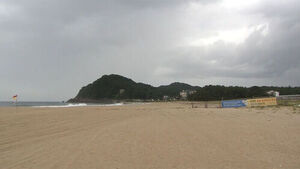
As the heatwave continues, the number of vacationers visiting eastern coast beaches in Gyeongsangbuk-do, including Gyeongju and Pohang, has also been relatively sparse.
Vacationers who visited the sea were also seen sitting on mats spread out in the shade under windbreak trees amidst the hot weather, catching a breeze.
Vacationers who had visited expecting a cool sea gave up entering the water as the sandy beach became too hot to step on from the morning, sitting in the shade to forget the heat.
The majority of residents stayed indoors where air conditioning was installed or spent time in valleys and parks with tree shade.
Hhwangseong Park, known as the lungs of downtown Gyeongju, had relatively lush forests where citizens could be seen taking walks, but pedestrians on the pathways were sparse.
Hwangridan-gil and the area around Cheomseongdae, which usually bustle with outsiders during the holiday season, also saw a noticeable decrease in passersby.
Several camping vehicles escaping the heat were spotted on roads leading to Pohang's Hawok Valley and Sangok-ri.
A Pohang citizen in their 40s, surnamed Seo, said, "Because tropical nights and heatwaves continue these days, I live with the air conditioner running all day."
As the heatwave persists, livestock farms have also become busy.
At livestock farms clustered in Angang-eup, Gyeongju, workers sprayed water on the roofs of barns and operated large fans to prevent cows' body temperatures from rising, struggling with all their might to keep the animals from suffering from the heat.
"To prevent deaths caused by the heatwave, we must reduce the stress cows experience from the heat, so we are mobilizing all means to lower the temperature inside the barns," said one farmer.
According to the Korea Meteorological Administration, as of 3 p.m. that day, the highest daytime temperature in Gyeongju, Gyeongsangbuk-do, was 39.1°C (102°F), the highest nationwide.
Based on measurements from Automatic Weather Stations (AWS), which are unofficial records, Sinam in Daegu recorded 39.2°C (103°F).
※ Please note: This article was translated by AI and may contain errors.


 Video News
 Video News
 Video News
 Video News
