
 KOR
KOR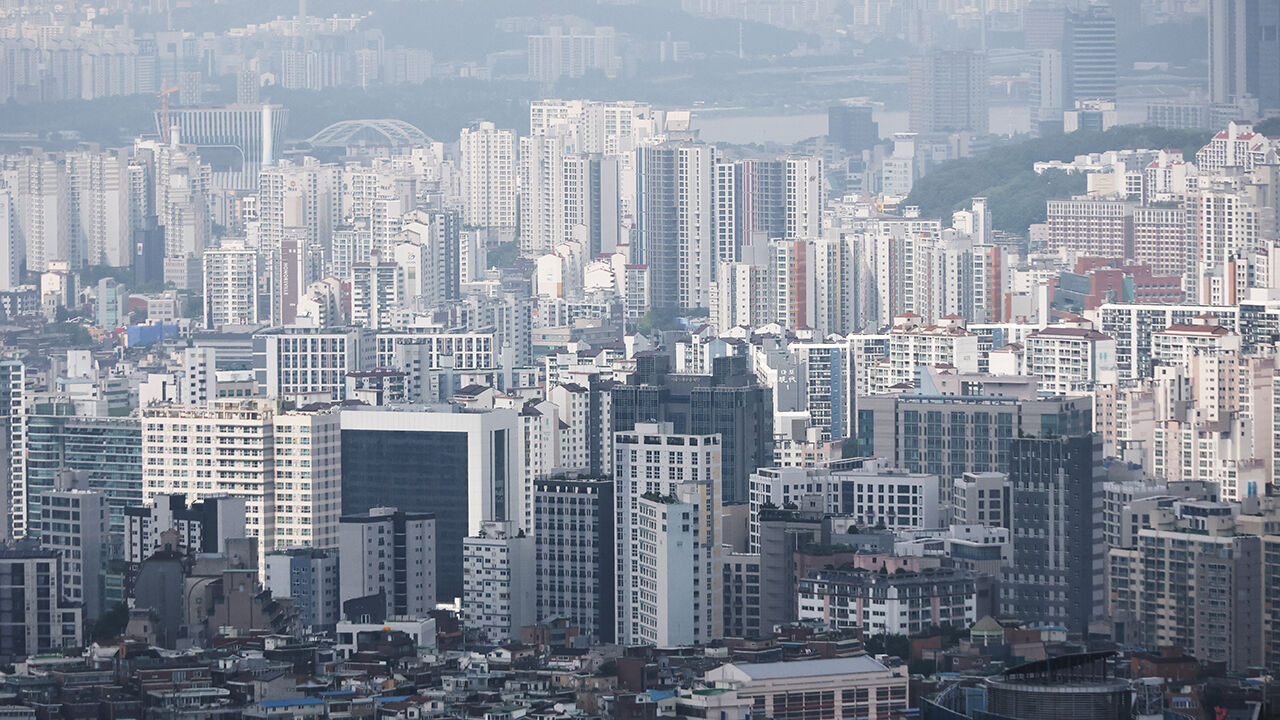
▲ An apartment complex in Seoul viewed from Namsan Mountain
Comprehensive real estate holding tax deductions applied to ultra-expensive single-home owners with a taxable base exceeding 2 billion won hit a four-year high, data showed.
Amid rising housing prices, the statistics confirmed that the current comprehensive real estate holding tax system tends to reduce taxes more significantly for expensive homes.
The government is preparing tax revisions aimed at increasing the holding tax burden on ultra-expensive homes.
According to an analysis of National Tax Service statistics released today (the 26th), the total comprehensive real estate holding tax deductions for individuals applied to homes with a taxable base exceeding 2 billion won for the 2025 tax year reached approximately 46.1 billion won, an increase of about 27.9 billion won (153.2%) from the previous year (18.2 billion won).
After peaking at 68.1 billion won in 2021, tax deductions for homes with a taxable base exceeding 2 billion won plummeted before reaching a four-year high last year.
The scale and rate of the increase also marked the highest levels since 2021 (48.8 billion won and 220.7%).
Recent increases in housing prices are believed to have driven the growth in tax deductions for ultra-expensive homes.
Comprehensive real estate holding tax deductions are granted to single-home owners who have held their property for five years or longer, or are aged 60 or older.
The deduction rate based on the holding period ranges from 20% to 50%, while the rate based on age ranges from 20% to 40%.
Both deductions can be applied concurrently up to a cap of 80%, regardless of whether the owner actually resides in the property.
The basic deduction for single-home owners under the comprehensive real estate holding tax is 1.2 billion won, with a fair market value ratio of 60%.
Working backward, a single-home with a taxable base of 2 billion won is estimated to have a market value of around 6.57 billion won if it is an apartment (based on a 69% public appraisal value realization rate).
For a detached house (with a market reflection rate of 53.6%), the estimated value is around 8.46 billion won.
Regardless of the number of homes owned, the total number of individuals and corporations subject to the comprehensive real estate holding tax last year stood at 538,439.
Among them, only 1.6%, or 8,399 individuals, had a taxable base exceeding 2 billion won. Some of these individuals who met requirements such as single-home ownership enjoyed 22.2% of the total tax deductions (approximately 207.1 billion won).
Geographically, 87.9% of the total comprehensive real estate holding tax deductions for housing were applied to properties in Seoul.
It is estimated that individuals or seniors who long held a single prized property, including ultra-expensive Gangnam apartments, substantially reduced their tax burdens.
Ultra-expensive homes with a taxable base exceeding 2 billion won accounted for 13.1% of the total comprehensive real estate holding tax deductions in 2024, but rose by 9.1 percentage points in a single year.
The determined comprehensive real estate holding tax per capita (average combining individuals and corporations) for owners of homes with a taxable base exceeding 2 billion won stood at 55.7 million won last year, down 16.81 million won (23.2%) from the previous year.
This contrasted with owners of homes with a taxable base of 2 billion won or less, whose average determined tax was 1.59 million won, an increase of about 10,000 won from the previous year, showing virtually no change.
Based on homes with a taxable base exceeding 1.4 billion won, the total tax deductions for 2025 amounted to roughly 74.9 billion won, up 32.7 billion won (77.6%) from the previous year.
Converted to market value, this group is estimated to exceed 5.1 billion won for apartments and 65 billion won for detached houses.
Tax deductions for homes with a taxable base exceeding 1.4 billion won also expanded by the largest margin and at the highest rate in four years.
While basic deductions and tax rates are applied differentially according to the number of homes owned, data showed that owners of three or more homes bore a heavier comprehensive real estate holding tax burden than single-home owners even with a similar taxable base.
Last year, the determined tax per individual subject to the comprehensive real estate holding tax with a taxable base exceeding 1.2 billion won up to 1.4 billion won was 9.38 million won for owners of three or more homes, which is 5.65 million won more than that for single-home owners.
A taxable base of 1.2 billion won serves as the turning point where tax rates diverge by 0.7 percentage points, set at 1.3% for owners of one to two homes and 2.0% for those with three or more homes.
The tax rate gaps gradually widen to 1.5 percentage points and 2.0 percentage points when taxable bases exceed 2.5 billion won and 5 billion won, respectively, stretching up to 2.3 percentage points in the highest bracket exceeding 9.4 billion won.
Consequently, the difference in per capita determined comprehensive real estate holding tax between single-home individuals and those owning three or more homes last year widened as the taxable base grew: 10.64 million won in the bracket exceeding 1.4 billion won up to 2 billion won; 21.2 million won in the bracket exceeding 2 billion won up to 3 billion won; and 41.94 million won in the bracket exceeding 3 billion won up to 5 billion won.
Aside from tax rate differentials based on the taxable base, basic deduction amounts are set differently at 1.2 billion won for single-home owners and 900 million won for owners of two or more homes.
In addition, tax deductions of up to 80% are granted exclusively to single-home owners.
The current comprehensive real estate holding tax system itself is structured so that ultra-expensive single-home owners pay less than owners of three homes of equivalent value, structurally inducing a preference for a single prized property.
The government is discussing system revisions to eliminate differentiation based on the number of homes when calculating the comprehensive real estate holding tax and base it instead on value.
It is reported that the government is also reviewing plans to increase the holding tax on ultra-expensive single-home owners compared to current levels while reducing or eliminating deductions based on the holding period.
Following a debate presided over by Prime Minister Han Duck-soo scheduled for the 27th, the tax revision plan will be finalized and announced early next month.
(Photo: Yonhap News)
※ Please note: This article was translated by AI and may contain errors.



 Video News


 Video News