
 KOR
KOR
Growth requires strength. Strength to remain unshaken, strength to reach higher. "Take Care of Culture," the knowledge news that makes you smarter as you listen, provides you with the power to become a growing cultured person alongside top SBS Premium contributors.
Contributor Hong Choon-wook
CEO of Prism Investment Advisory
Former Head of Investment Management Team at National Pension Service
CEO of Prism Investment Advisory
Former Head of Investment Management Team at National Pension Service
Caution over the burden of AI investments grew following Google's earnings announcement. However, the presence of South Korean semiconductors is becoming even clearer. With Intel's surprise earnings added to the mix, expectations surrounding semiconductors are heating up again.
However, the market does not always move on expectations alone. What are global investors looking at right now?
Behind the market, three danger signals are appearing simultaneously. First, profit-taking in semiconductors. Second, excessive margin debt. Third, valuations driven by "dreams" rather than profits. In a highly volatile market like today's, these are crucial points to check. Let us take a look at them one by one.
The Real Reason Behind Semiconductor Selling
In countries like South Korea with high economic volatility, there is an investment principle: "Buy when the price-to-earnings ratio is high, and sell when profits are generated and the price-to-earnings ratio drops to a low level." This is an ironclad rule for investing in cyclical stocks. From the perspective of global investors, South Korea's semiconductor industry, which suffered from losses for a long time, is now generating massive profits, driving the PER (price-to-earnings ratio) down to 10 or even 5 times. In times like this, many investors desire to lock in profits.
After all, the top investment masters in the South Korean stock market are foreign investors. From 2007 to 2025, South Korea has been stuck in a range-bound market ("Boxpi") for 17 to 18 years, with stock prices failing to rise overall. In such a market, foreign investors bought vast amounts of stocks, owning over 50% of shares in Samsung Electronics and SK Hynix. They bought during bleeding periods and sold when profits came in.

The blue line is Oracle, and the yellow line is SoftBank. They are heading toward stock price levels seen when the war in Iran broke out in March. Why? Market trust in Oracle has plunged drastically. While data center investments are surging exponentially, S&P downgraded Oracle's credit rating to BBB-. BBB- is right above speculative grade. One notch down is BB (junk bond). In other words, the market views it as a bond with a very high risk of default.
Liquidity Pushing Up Semiconductor Stock Prices... The Shadow of "Margin Debt" Built on Expectations
Q. What signal do you think is being sent between the timing of increasing margin debt—leveraged investment—and the timing when the market rally loses momentum?

The red line is the Nasdaq 100 Index. Going from around 800 in 1997 to over 10,000 now, seeing it trend upward despite going through about three market corrections along the way shows that technological innovation continues and the term hyperscaler is not an exaggeration. Everyone agrees that "they are truly achieving technological innovation while stimulating consumer demand related to IT, enabling consumers to easily use the results of the IT revolution based on lower prices, and making big money in the process," but the question remains: "Why is stock price volatility so high?"

In 2000, 5,000 dropped to 800, which means it plummeted to one-fifth or one-sixth of its value. "Why is stock price volatility so severe?"
Reason for High Volatility ① Many IT companies wait for demand to increase
Except for companies like Apple, a large number of IT companies operate like a buffet restaurant. They set up massive facilities through huge investments and wait for demand to increase, or wait for liquidity to unlock, or wait for innovative products to come along so people buy their products.
Amazon is a prime example. Before turning a profit, Amazon built Amazon Prime and set up fulfillment centers across the United States. Even during recessions when labor costs are not expensive, they use hundreds of thousands or millions of logistics robots. They are a buffet restaurant that grew by jumping forward when the right market arrived for them.
Reason for High Volatility ② Many IT companies wait for liquidity
So whether the economy is good or bad is important, and the second factor is whether the high tide comes in. The high tide refers to liquidity—the sentiment and mood of the market saying "I want to buy this company's stock."

The blue line is an indicator that illustrates this well, showing changes in margin debt balances. The yellow line measures periods when it increased by more than 50% compared to the same period last year. The right axis shows 50, meaning stock margin debt increased by 50% compared to last year.
As the stock market grows in size, it is natural for margin debt to grow as well. So it fluctuates in positive territory. However, once every few years, margin debt increases severely. Why? When making money looks easy, people think, "Why put money in bank deposits when it's so hard? Buying Tesla just duplicates money; in 1990, buying Dell Computer duplicated money; recently, buying SpaceX duplicates money."
When the future looks obvious to anyone—when overconfidence becomes prominent—people do not fear leveraged debt investing or stock margin loans. When people think, "I'll just use it briefly. I need to ride the trend. Why hesitate?", this blue line spikes.
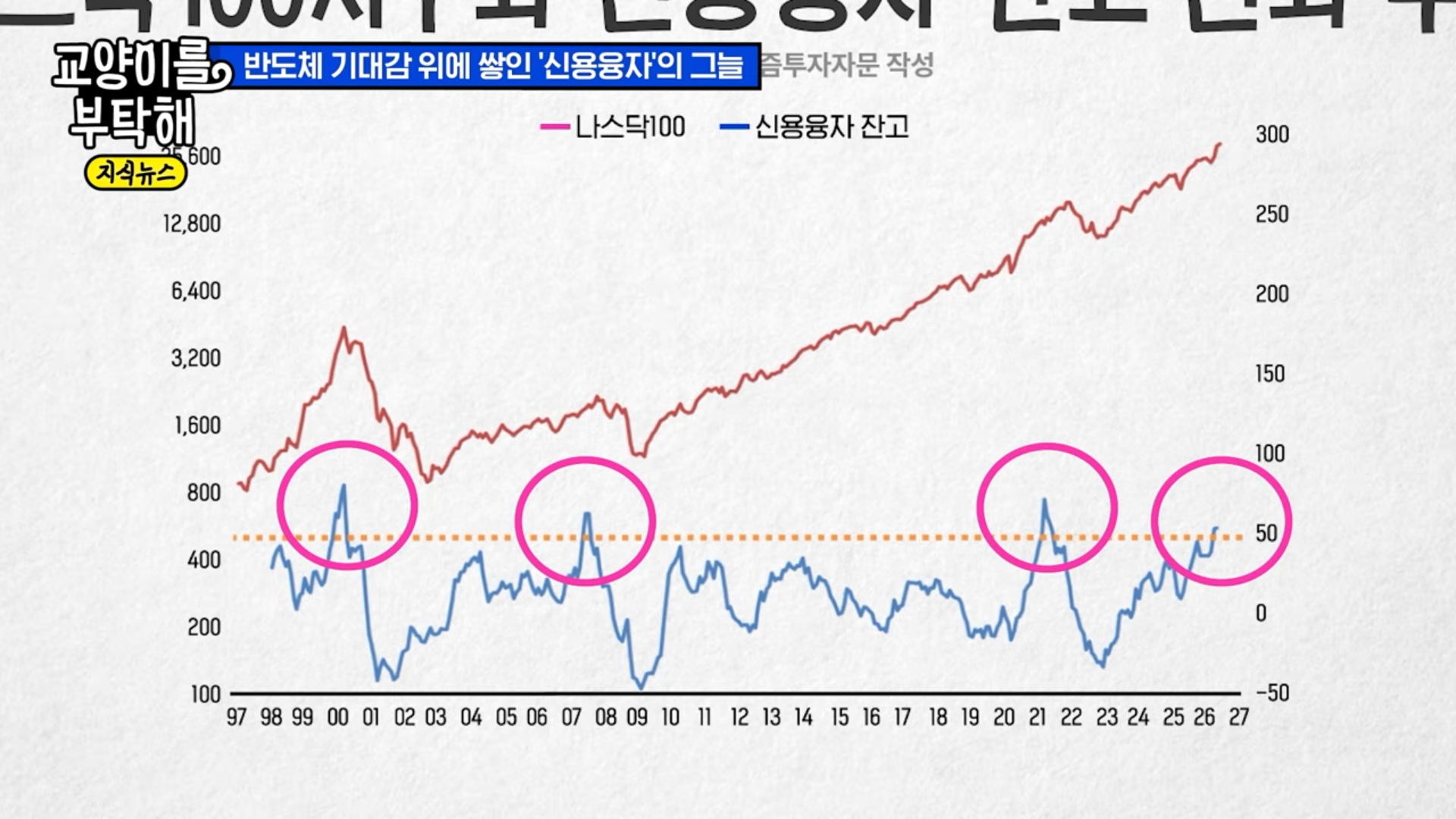
In 1999, 2007, 2020, and this time. Historically, this has happened four times. The previous three times ended with maximum drop rates of minus 40%, but this time, nobody knows.
Q. South Korea also faced serious issues with leverage, leading to rule changes, but it seems we were not the only ones overheating—Nasdaq was following the same trend.
Since the spread of the internet in the mid-1990s, with exceptions like closed markets such as China, South Korea is a market where mutual exchange occurs between stocks open to foreigners and those open to locals, where people can buy and sell stocks freely and engage in short selling. Depending on the leading stocks at the time and regulatory differences, the intensity varies, but markets move together. So when the U.S. market rises, our market tends to rise as well. Our market was sluggish throughout 2023 and 2024 as the secondary battery theme fizzled out, but as the U.S. market kept rising, our market kept watching for an opportunity to rise, and the moment semiconductors arrived, it unleashed all the gains it had held back.
Kim Yong-beom | Presidential Chief of Staff for Policy
Delisting is actually difficult to consider. That product is currently formed at over 10 trillion won, and if it were to be delisted, that itself would cause a massive shock to the market.
*Source: KBS Sunday Diagnosis Live
Delisting is actually difficult to consider. That product is currently formed at over 10 trillion won, and if it were to be delisted, that itself would cause a massive shock to the market.
*Source: KBS Sunday Diagnosis Live
'Margin Call,' the Bell Toll from Hell... Will a Market Built on Debt Trigger a Cascade of Sell-offs?
If the recent drop in Oracle's stock price was the first worry, the second risk is that while liquidity flowing in and raising our stock prices was good, it feels like "a flood is coming." A massive amount of water came in, but when it flows back out, will the people who bought stocks on debt at the peak be okay? What happens if they are not okay? There is a movie called "Margin Call," right?
*Margin call: A demand by a broker for a client to deposit additional money or securities when losses exceed a certain level and maintenance margin falls short.
Because they took out stock-backed loans and margin financing, if the value of the underlying stock price drops even slightly, securities firms call them. "If you do not deposit additional collateral, forced liquidation will occur starting tomorrow morning." That is a margin call. It is also called the "hell bell." This might be approaching. Just as negative signals emerge, you look to the side and think, "When did it rise this much? When did people borrow this much money to invest?" Looking closely, it is $1.4 trillion. Money amounting to about 2% of U.S. GDP ($30 trillion) is in stock-backed loans. You can see how huge that amount is.
If that gets liquidated, it causes a chain reaction collapse. When someone tells a friend, "I have a margin call tomorrow, please lend me some money," the friend thinks, "If he got a margin call and dumps his stocks at market price, I'll get margin called too," and thinks, "Shouldn't I sell before my friend sells?" News that someone got margin called becomes a signal for surrounding people to sell. For hedge funds, it is a buying opportunity for put options*. A put option is an option where you profit when prices fall.
*Put option: A contract giving the owner the right to sell at a predetermined price at a specified future date, structured to generate profit when stock prices fall.
From a hedge fund's perspective, someone else's misfortune can become their profit. Hedge funds hold a neutral position toward the market. They are literally hedge funds.
Stock Prices Rising on "Dreams" Rather Than Profits... A Market Entering a Dangerous Phase
What is PDR*?
*PDR (Price to Dream Ratio): Evaluating current stock price relative to a company's future growth potential (dreams).
"There is a decent company, but recommending it is hard because it's in deficit and its stock price is 100 times revenue." This actually happens. When trying to advise people to buy this company, there is no solid rationale. So suddenly, they start sending the valuation to the moon. This is the story of SpaceX.
Elon Musk | CEO of SpaceX
We plan to launch solar-powered AI satellites within a few years. That's because in space, we can secure vast amounts of energy without spatial constraints.
We plan to launch solar-powered AI satellites within a few years. That's because in space, we can secure vast amounts of energy without spatial constraints.
It's a wonderful plan. Building data centers in space offers two advantages. First, the biggest problem when building data centers is cooling them down. Space is absolute zero (the lowest thermodynamically possible temperature). So it's minus 270°C (-454°F). There is no need for cooling at all.
Second, another problem with data centers is that they consume an unimaginable amount of electricity. The way to solve this power issue is solar energy, and you place them in equatorial orbit. Since you can float them where there is the most sunlight, operating them that way works well.
However, to load such heavy objects onto launch vehicles and send them up, no matter how reusable the rockets are, how many launches would it take to lift them into geostationary orbit above Earth's gravity, and how much energy would be consumed in that process? And no matter how reusable launch vehicles are, they can't be used a thousand or ten thousand times. What if even one breaks or explodes?
Considering these costs, SpaceX's dream of building data centers in equatorial space orbit is truly impressive, but people wonder, "When will it happen? Who will continue to bear those costs?" And sending data produced in space down to Earth via Starlink brings up issues of hacking, efficiency, and whether it is really more effective than running data centers on Earth, which needs to be tested.
Despite this, it raised $75 billion—the largest fundraising in history, equivalent to 100 trillion won—and went public with a market capitalization of $1.8 trillion at the time of listing, which equals South Korea's annual GDP. It went public while being valued at a market cap equivalent to the GDP of South Korea, one of the world's top 10 economies. Can this be rationalized? It cannot. Yet Goldman Sachs calls for $500 or $400. They baked the dream into it.
They say, "If this company happens to succeed, we won't need data centers on Earth, and SpaceX, which can launch them into space, will own everything. In that case, what do you think SpaceX's market value would be? Wouldn't $10 trillion be cheap? But since it's in the far distant future, discounting it by interest rates gives $5 trillion." The problem is that this logic worked.
Of course, 10 years from now, I in this video might be ridiculed. But from the standpoint of investing and managing stocks, one can certainly say, "Aren't there too many assumptions required for this dream to come true?"
Yet that storytelling worked completely. That is why it went public at that price. Companies like Aramco, Alibaba, Visa, and PetroChina were making massive profits. SpaceX has never made a profit, and its stock price was 100 times revenue, yet it went public successfully and almost doubled after that.
While no one knows the distant future in the market, when judging that the market has overheated or become dangerous, the benchmark is the moment when existing valuation methods fail to explain things, and people suddenly bring out bizarre methods saying, "This one is different. Everything done before was wrong. This is the real deal," introducing new techniques.
I cannot say whether right now is the peak or not. Because human greed, human dreams, and human expectations have no upper limit, even I do not know if right now is the top. However, one should be able to feel that it is similar to those times. One needs to possess at least this level of capability. I explained the Price to Dream Ratio as one of those signs.
Strategy for Surviving in the Market... 'Prepared Response' Matters More Than Predicting the Peak
The decline in Oracle's stock price and the accumulation of margin debt balances are not good news. It feels good right now because the tide is coming in. However, high tide cannot last forever, and we must prepare for when the tide goes out.
The market's leading sector has not changed, and the leading sector in this market is semiconductors. If semiconductor stocks brought large profits, let's also do some rebalancing. Humans cannot know the peak. That's because optimism has no upper ceiling. Because people dream while being optimistic about the future, they cannot sell. They can't sell because they think that if prices rise further, they will curse themselves for selling then.
However, let's respond by rebalancing: "If I use part of the profits to buy assets that are currently bleeding, I will profit from them later when the stock market bleeds." In other words, we give up on market prediction. Because even if you study this hard you cannot predict it, that is why you rebalance. Wise investing begins with acknowledging your own limits.
Diversifying into the U.S. market or our market or any other country yields almost no diversification effect. Buying both Korean and U.S. stocks does not solve everything. That is why you also need to buy bonds, REITs, gold, and hold cash. The characteristic of markets moving together is that while they rise separately in sequence, they fall together when they drop.
In this current market, the person who made large profits in semiconductors and then suffered losses is the second most painful person, and the most painful person is the one whose stocks didn't even rise but dropped along with the market. If you fill a large portion of your assets with stocks, you must leave dollar-denominated bonds or Korean won cash on the other side—money that allows you to buy at bargain prices in the off chance that the market collapses.
Rather than predicting the future, let's respond well. I have shared the criteria for that response.
Market Response Strategy ① Be cautious of companies that seem "cheap no matter how much they rise"
"This company is cheap, it's cheap no matter how much it rises"? You need to be cautious about this. That's when you must be careful with buffet-style companies.
Market Response Strategy ② Take a break when leverage builds up too much
When leverage accumulates too severely, it is better to take a break.
Market Response Strategy ③ Companies going public with absurd valuations
A massive company suddenly going public at an unbelievable valuation.
The market always moves dynamically, and no one knows when the market's down cycle will stop and turn into an up cycle. However, catching the bottom is relatively easy. If you know the absolute value and the company's strong moat, you can catch the bottom, but because selling at the peak is so difficult, I have shared three tips for selling appropriately even if it's not the exact top.
https://youtu.be/jBK9j9d1c2I
Subscribe to the "Take Care of Culture" YouTube channel to watch more content.
※ Please note: This article was translated by AI and may contain errors.


 Video News

 Video News
 Video News
 Video News