
 KOR
KOR![The President's 1.77 Billion Won Mortgage Lien [Evening Briefing]](https://img.sbs.co.kr/newimg/news/20260721/202204256_1280.jpg )
The President's Real Estate Transaction... Why Establish a Mortgage Lien?
At the President's private residence in Bundang, Seongnam, a jeonse (lump-sum deposit) tenant is currently living there with a deposit of 1.14 billion won. Subtracting this jeonse deposit from the sale price of 2.9 billion won leaves 1.76 billion won. Since the down payment is typically about 10% of the total transaction amount, which would be around 290 million won, the remaining amount—the balance—would be around 1.47 billion won. It appears that President Lee and his wife held this as a claim and established a mortgage lien. The reason for establishing the mortgage lien, i.e., the remaining balance credit transaction, is reportedly because the home where the buyer currently lives is scheduled to be sold in October.
Then, why didn't they just pay the remaining balance and transfer the title in October? Why did they go through the cumbersome process of establishing a mortgage lien to transfer ownership in July? The reason is reconstruction. The apartment complex in question is a reconstruction complex where the designation of the project implementer is scheduled to be officially announced at the end of this month. If the apartment is purchased before that, the reconstruction union membership status is succeeded, but if the ownership transfer takes place after that, the membership status is not succeeded. In professional jargon (?), it becomes a "mul-ttak-ji" (an invalid right to buy a new apartment). Instead of being able to receive a larger apartment later, it is liquidated in cash at an appropriate level (in some cases, this leads to lawsuits).
The apartment's market price of 3 billion won should be seen as including this reconstruction union membership status. If the membership status is not succeeded, there would be no reason to buy the apartment for that price. That does not mean the apartment price will plummet after July. Since buyers cannot obtain union membership, no one will want to purchase it, and the existing owner will eventually receive a larger new apartment after reconstruction anyway, so they will just wait a few years, causing transactions to disappear. The market would likely go without transactions in an asking-price vacuum, and then the proper market price for the apartment would be re-established after the reconstruction is complete.
In fact, this transaction is not advantageous to President Lee Jae-myung, but can be seen as a transaction that provided significant convenience to the buyer. The buyer received the transfer of ownership after paying only a 10% down payment. This can be described as a typical "gap investment". While it is difficult to make a definitive statement without knowing the specific interest rate on the mortgage lien, selling a house with the remaining balance on credit at a price lower than the market rate is a transaction that usually only happens when the seller is desperately in need of money. Whether it is called an expedient or a detour, it seems clear that it was a rushed transaction completed while accommodating the buyer.
Presumably, did President Lee Jae-myung not want to hear people say he owned a reconstruction apartment? In other words, he might have wanted to avoid getting caught up in disputes later, such as "You also invested in a reconstruction apartment." Therefore, he may have wanted to quickly dispose of the apartment, even if it meant accommodating the buyer through a sort of remaining balance credit transaction. A Blue House official said, "The transaction price of 2.9 billion won was lower than the market price. Although he was a single-home owner and had no obligation to dispose of it, he sold it to show his commitment to the policy of normalizing the real estate market". While this is explained as policy commitment, to me personally, it sounded like he wanted to appear as a "non-homeowner" at the upcoming public debate on real estate the day after tomorrow (July 23, 2026).
People Power Party: "Trick Transaction, 'Together' Mortgage Lien"
Representative Jeong Jeom-sik, the floor leader of the People Power Party, described the President's mortgage lien as "an incident that clearly shows how regulation-heavy real estate policies abnormally distort the market". He also said, "It is a contradictory situation where the President, after imposing heavy regulations on the public, is personally teaching them expedients and tricks to bypass those regulations". With financial institution loans in the area limited to just 200 million won due to loan regulations, the criticism is that while the President's mortgage lien cannot be called illegal, it is an expedient and a trick.
Representative Joo Jin-woo also pointed out, "Ordinary citizens cannot engage in such transactions because they have to sell their homes and receive the remaining balance to buy another house. This transaction is only possible for President Lee, who lives in the presidential residence and does not have to worry about moving to another home". This is a criticism that President Lee engaged in a sort of "presidential residence tech" (gwanjeo-tech). Spokesperson Park Sung-hoon also added to the criticism of a "trick transaction," saying, "A bizarre trick transaction, so-called seller financing, was carried out in the process of selling the President's house".
In summary, the core of the criticism is that while it may not be illegal, it is an "expedient and trick" to bypass loan restrictions. It is also accompanied by sarcasm about President Lee's "presidential residence tech," as he does not need to secure a home immediately.
Questions to Arise at the Public Debate on Real Estate
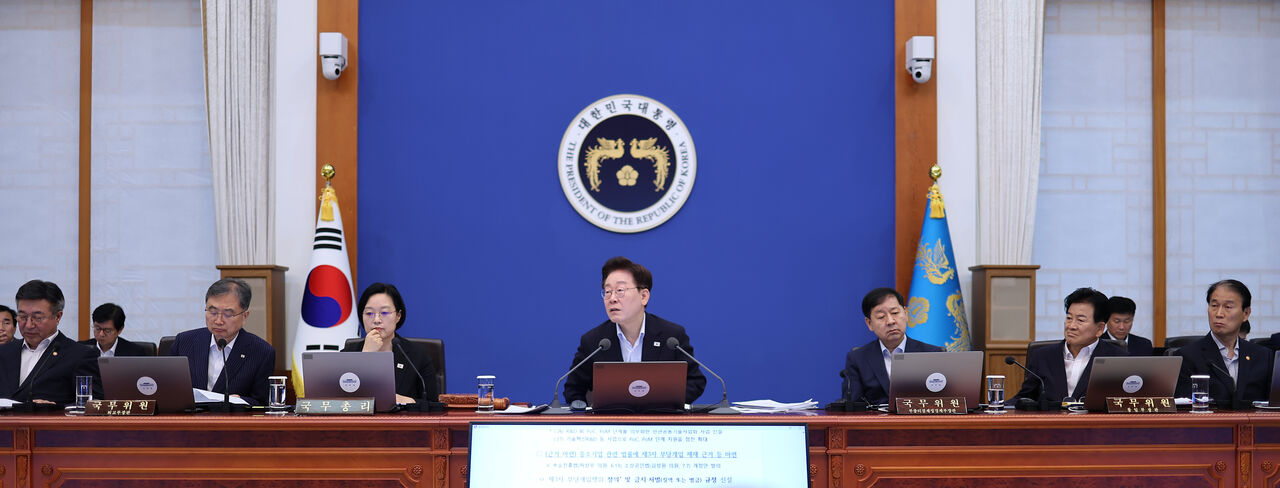
At today's Cabinet meeting, President Lee Jae-myung said, "Unearned real estate income, driven by illegal and expedient means, has become the biggest culprit in destroying fairness and common sense in our society and hindering national unity," adding, "Real estate is the most serious and difficult-to-solve problem in our society". He also diagnosed real estate issues as the root cause of wealth inequality, household debt, polarization, and the suffering and alienation of young people.
He then expressed high expectations for the public debate on real estate. He expressed his determination, saying, "To escape from the ruinous 'real estate republic' and move toward stable housing for the public and productive economic development, we will humbly listen to the voices of the people and create feasible alternatives."
As the President said, the real estate issue is an area where "illegality, expedients, and tricks" are most rampant. Having witnessed the long-standing myths of "invincible real estate" and "invincible Gangnam," it is a market where most of the economically active population has craved opportunities (?) as market participants. At the same time, it is an area where no administration has been able to provide a clear-cut solution, merely vacillating between expanding supply and suppressing demand, resulting in extremely low trust in government policies.
Many expect that one of the strongest demands to emerge from the real estate public debate will be complaints about or calls to revise loan regulations. The argument is that people without money need leverage (loans) to buy a house, but as loan regulations have been tightened under the pretext of market stabilization, only wealthy people are left with the opportunity to choose. There is a backlash that even for transactions aimed at actual residence by single-home owners, loan regulations ultimately act as "reverse discrimination, deprivation of opportunity, and kicking away the ladder" for those without money.
Therefore, I believe that President Lee needs to prepare an honest and persuasive explanation regarding this Seongnam real estate transaction at the public debate on real estate on July 23. Trust in him as a fair policymaker free from conflicts of interest will not come from the fact that he is a "non-homeowner," but from providing convincing answers to the concerns and longings of market participants. Trust, common sense, and fairness can only be established if he can break through the controversy over "tricks and expedients."
※ Please note: This article was translated by AI and may contain errors.


 Video News
 Video News
 Video News
 Video News
 Video News