
 KOR
KOR
We are currently in the midst of the hiring season. Our department also selected interns last week. Due to the high competition rate, we shortlisted three times the number of positions and conducted online interviews. An interesting investigative report regarding such online interviews was broadcast in 2021 by Bayerischer Rundfunk (BR)[1] in Germany. It was an experiment on an AI-based hiring system.
Better Evaluations with a Bookshelf Background and Brighter Lighting
Even though the interviewee's answers remained identical and only the background was changed, having a bookshelf as a background resulted in higher scores in conscientiousness, extraversion, openness, and agreeableness compared to having no background. It also had the effect of lowering scores in negative traits such as neuroticism.
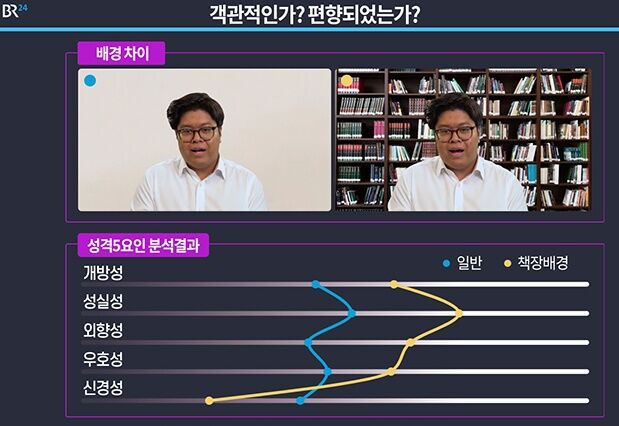
<Bayerischer Rundfunk's February 2021 investigative report, https://interaktiv.br.de/ki-bewerbung/en/>
Furthermore, simply making the lighting slightly brighter increased the scores for agreeableness, extraversion, conscientiousness, and openness.
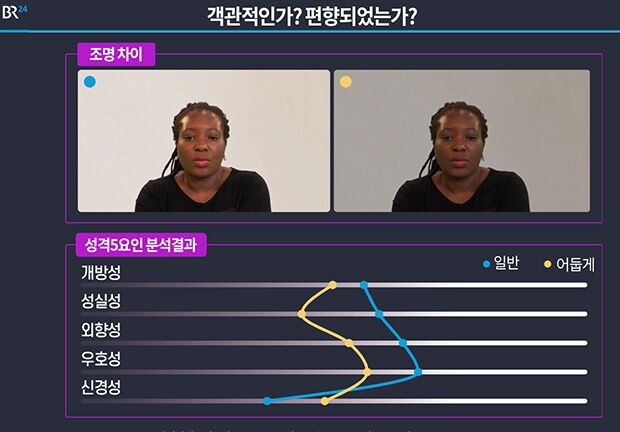
<Bayerischer Rundfunk's February 2021 investigative report, https://interaktiv.br.de/ki-bewerbung/en/>
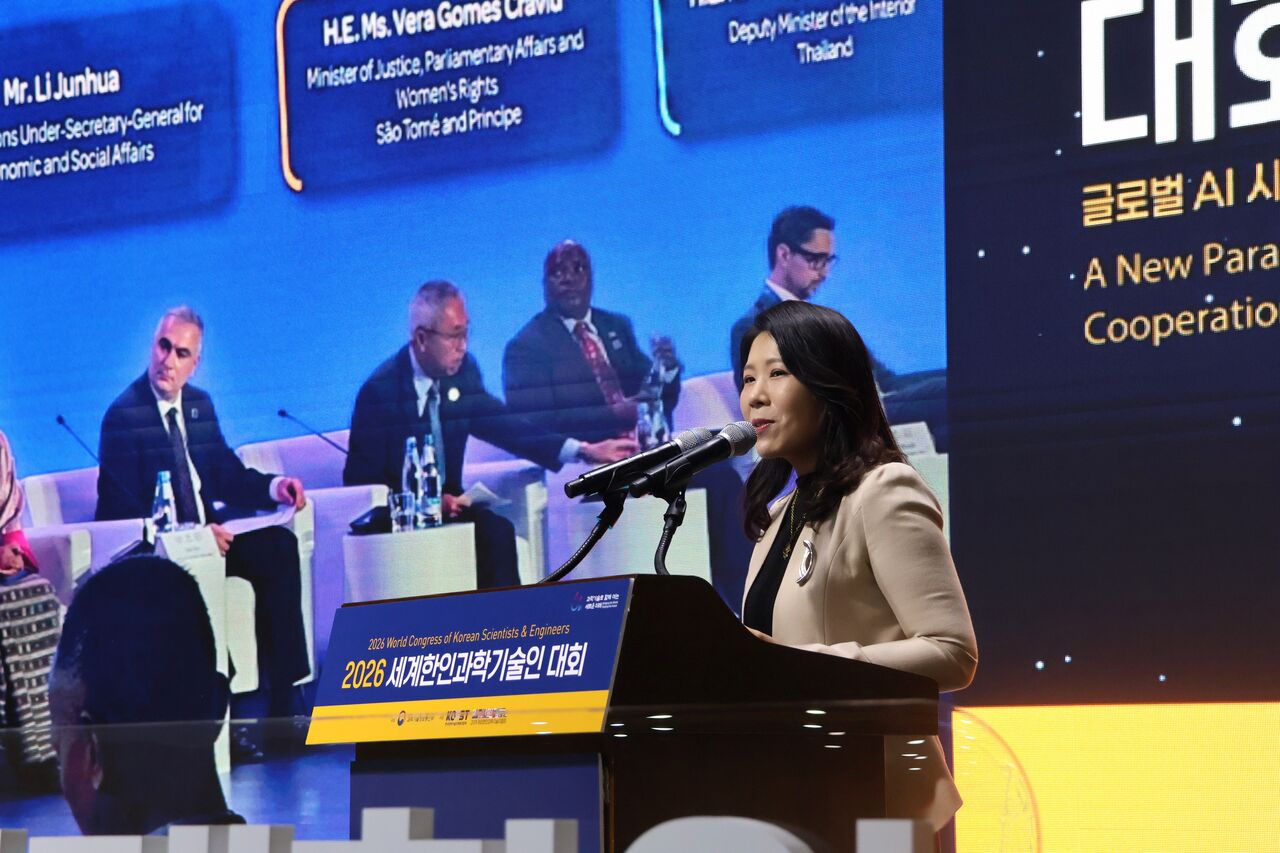
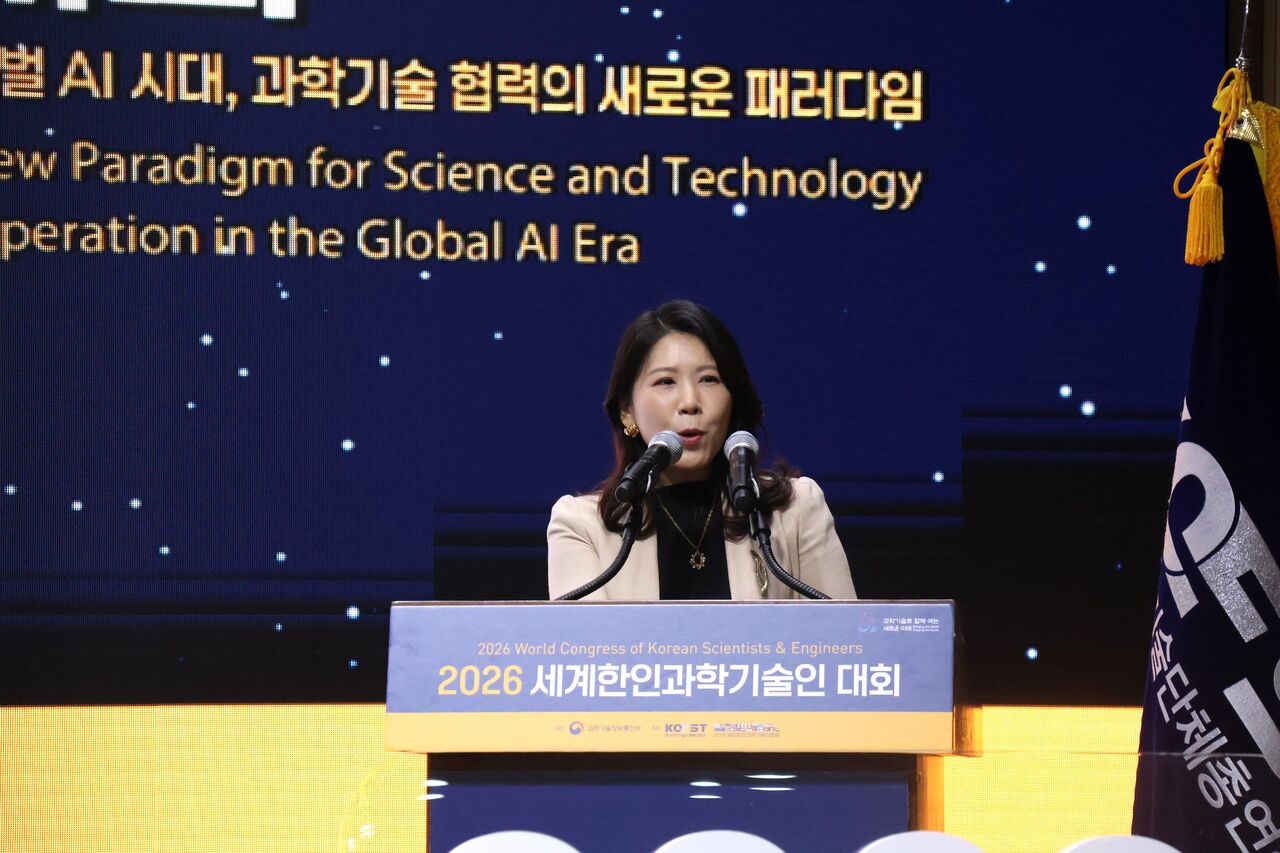
On July 7, Meeyoung Cha, Scientific Director at the Max Planck Institute for Security and Privacy in Germany, who took the stage as a keynote speaker at the "2026 World Congress of Korean Scientists and Engineers"—hosted by the Ministry of Science and ICT and organized by the Korean Federation of Science and Technology Societies (KOFST) and 20 associations of Korean scientists and engineers abroad—emphasized that we can cope with such AI hiring evaluation cases as long as we are aware of their blind spots. However, she noted that the more serious cases are those that are neither recognized nor visible.
We met with KAIST Professor Meeyoung Cha, who became the first Korean to be appointed as a scientific director at the Max Planck Institute two years ago, to hear more details.
[1] Bayerischer Rundfunk (BR) is a public broadcaster headquartered in Munich, Bavaria, located in southeastern Germany, which is the largest in area among Germany's 16 states. It is a member of ARD, Germany's national association of public broadcasters, and produces television, radio, news, and digital content centered on the Bavarian region. Although it has the character of a regional broadcaster, it is a large-scale public broadcaster that supplies major programs and investigative reports to the national network, such as the investigative program <report München> which began in 1962, produced by BR and broadcast on ARD's national channel Das Erste.


The Max Planck Society in Germany is an organization that combines around 80 research institutes across Germany, covering research in various fields ranging from science to humanities and social sciences. Its predecessor was the Kaiser Wilhelm Society, established in 1911. In 1948, following the reorganization of the institution after World War II, it was newly launched as the "Max Planck Society," named after Max Planck[2], the founder of quantum physics and a Nobel laureate in physics.
Q. I am curious about what kind of AI-related research is being conducted at the Max Planck Institutes in Germany.
There are several institutes dealing with AI-related research. First, there is the institute in Tübingen, where world-class figures in the AI field dealing with core AI modeling are located. Since our institute is the Institute for Security and Privacy, we naturally deal with the social impact and issues that can arise from AI. At the Institute for Software Systems, they find software bugs to ensure that code created in the AI era is safe and error-free. There is also the Institute for Informatics, which researches how to securely handle databases used in AI and how to process data efficiently while dealing with large amounts of data.
[2] Max Planck was a German theoretical physicist who, along with Albert Einstein, laid the foundation for modern physics. In particular, he received the Nobel Prize in Physics in 1918 for proposing the concept of "quanta," the minimum unit of energy.
© Korean Federation of Science and Technology Societies (President Kwon Oh-nam, Professor at Seoul National University)
The Most Attention-Grabbing Research in the AI Field Recently is "AI Mechanistic Interpretability Research"
In her keynote lecture, Director Cha stated that the most attention-grabbing research in the AI field these days is "AI mechanistic interpretability research," which looks inside the black box of large language models. Similar to fMRI, which indirectly identifies active areas of the brain through changes in blood flow and oxygen saturation, this research tracks the interior of artificial neural networks to see which concepts, information, and computational pathways are activated while a large language model processes questions and generates answers.
Q. During your keynote lecture, you mentioned that "mechanistic interpretability research," which is the study of the black box of large language models, is currently the most spotlighted research in relation to AI.
The purpose of "AI mechanistic interpretability research" started with looking inside AI, which is important these days but shrouded in mystery like a black box where we cannot understand how decisions are made. In neuroscience or brain science, an engram[3] refers to the physical or neurological trace left in the brain as memories are stored when we think, tracing how a memory flows through a neural network to make a decision. We apply the same principle to AI neural models. If we can accurately infer that "when a certain input is given among trillions of parameters, it must have passed through this area and performed this calculation," we can fix that part even if the calculation goes wrong. Therefore, "mechanistic interpretability research" is a tool that helps us look inside to see how AI makes decisions. This research has just begun, and various ideas are emerging from all over the world. We predict that a great deal of innovation will come from this area in the future.
[3] An engram refers to a physical or neurological trace left in the brain as an experience or information is stored as a memory, meaning a memory trace.
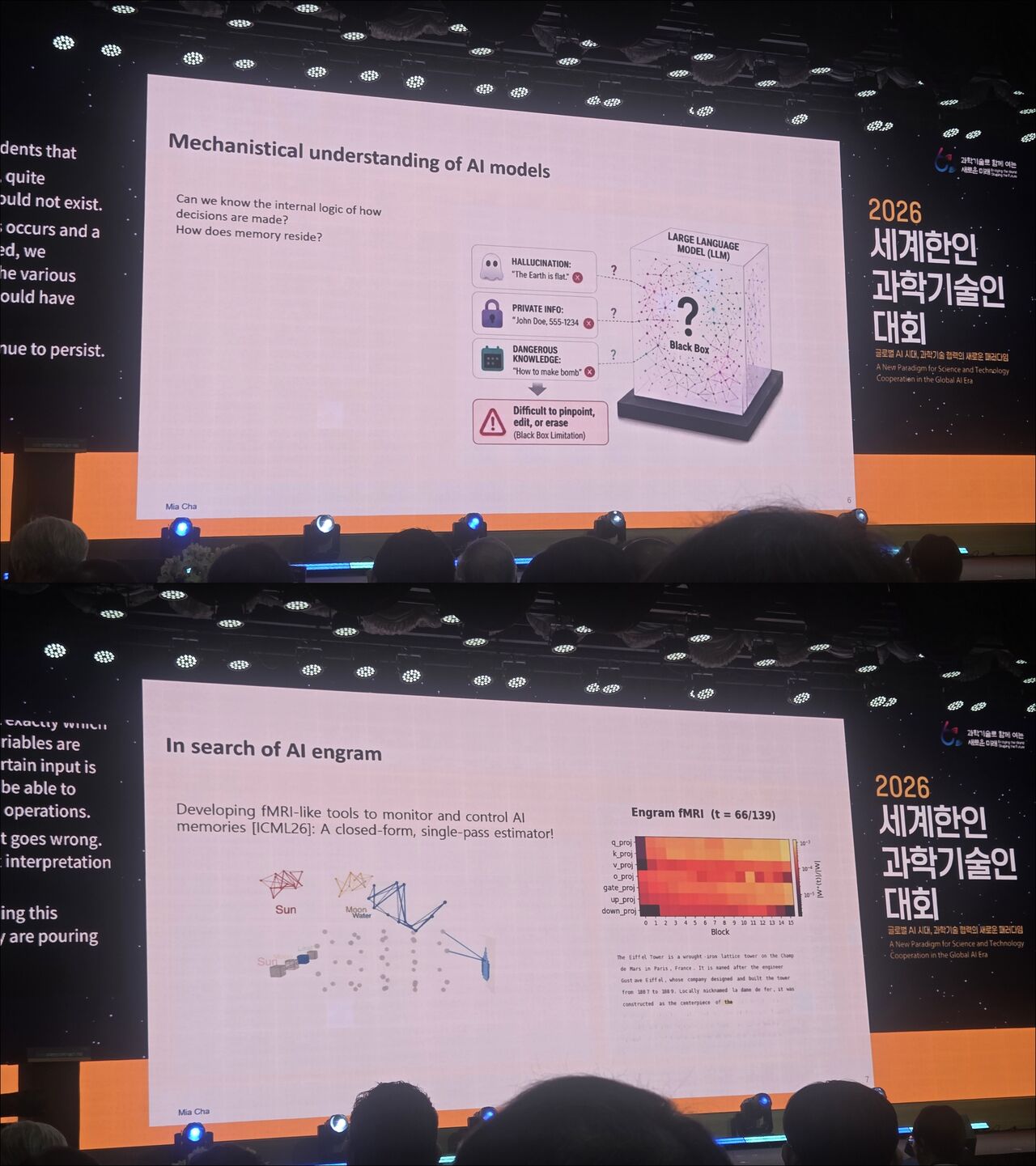
<Explanatory material on AI mechanistic interpretability research from Director Meeyoung Cha's keynote lecture at the 2026 World Congress of Korean Scientists and Engineers>
Evolution of Disinformation Technology
Concerns Over Networks Where "I Am the Only Human" Amidst a "Collective of AI Impersonating Users"
Particularly from a security perspective, she noted that as AI technology is incorporated, tracking disinformation is becoming more difficult and methods are becoming more sophisticated. For example, in the past, under the name of "botnets[4] and troll farms[5]," specific organizations manipulated public opinion by creating multiple accounts, whether by mobilizing people or utilizing automated accounts. Back then, the issue could be resolved if only the organization manipulating public opinion was tracked. At that stage, the patterns were relatively simple, as they showed identical sentences, similar posting times, and repetitive retweet structures.
[4] A botnet is translated as a malicious bot network and refers to a network of computers infected with malware and controlled by hackers.
[5] A troll farm, often translated as a "comment army," refers to a group or institution that systematically distributes fake news, malicious comments, and slanderous posts for specific political or commercial purposes.
Later, not only was simple misinformation distributed, but cognitive manipulation was also added. For instance, taking advantage of the fact that people spread information more when they are angry, methods to provoke anger were introduced, and they even began paying ordinary people to write advertisements.
However, the most concerning method in the AI era is a "collective of AI impersonating users." This is when multiple AI agents exchange information, divide roles, surround a user, and send out false information. If agents form a cluster within a network, strategize, and coordinate attacks, we might believe that the opinion of a fake majority is a consensus, in a situation where it is almost impossible to distinguish whether it is driven by AI or not. She said that if this actually happens, a situation could arrive where "I think I am talking to many people, but in fact, I might be the only human." Professor Cha warned in a joint paper published in "Science" early this year (2026) that if such collectives of AI impersonating real users systematically manipulate public opinion, democracy itself could collapse.
[4] A botnet is translated as a malicious bot network and refers to a network of computers infected with malware and controlled by hackers.
[5] A troll farm, often translated as a "comment army," refers to a group or institution that systematically distributes fake news, malicious comments, and slanderous posts for specific political or commercial purposes.
Later, not only was simple misinformation distributed, but cognitive manipulation was also added. For instance, taking advantage of the fact that people spread information more when they are angry, methods to provoke anger were introduced, and they even began paying ordinary people to write advertisements.
However, the most concerning method in the AI era is a "collective of AI impersonating users." This is when multiple AI agents exchange information, divide roles, surround a user, and send out false information. If agents form a cluster within a network, strategize, and coordinate attacks, we might believe that the opinion of a fake majority is a consensus, in a situation where it is almost impossible to distinguish whether it is driven by AI or not. She said that if this actually happens, a situation could arrive where "I think I am talking to many people, but in fact, I might be the only human." Professor Cha warned in a joint paper published in "Science" early this year (2026) that if such collectives of AI impersonating real users systematically manipulate public opinion, democracy itself could collapse.
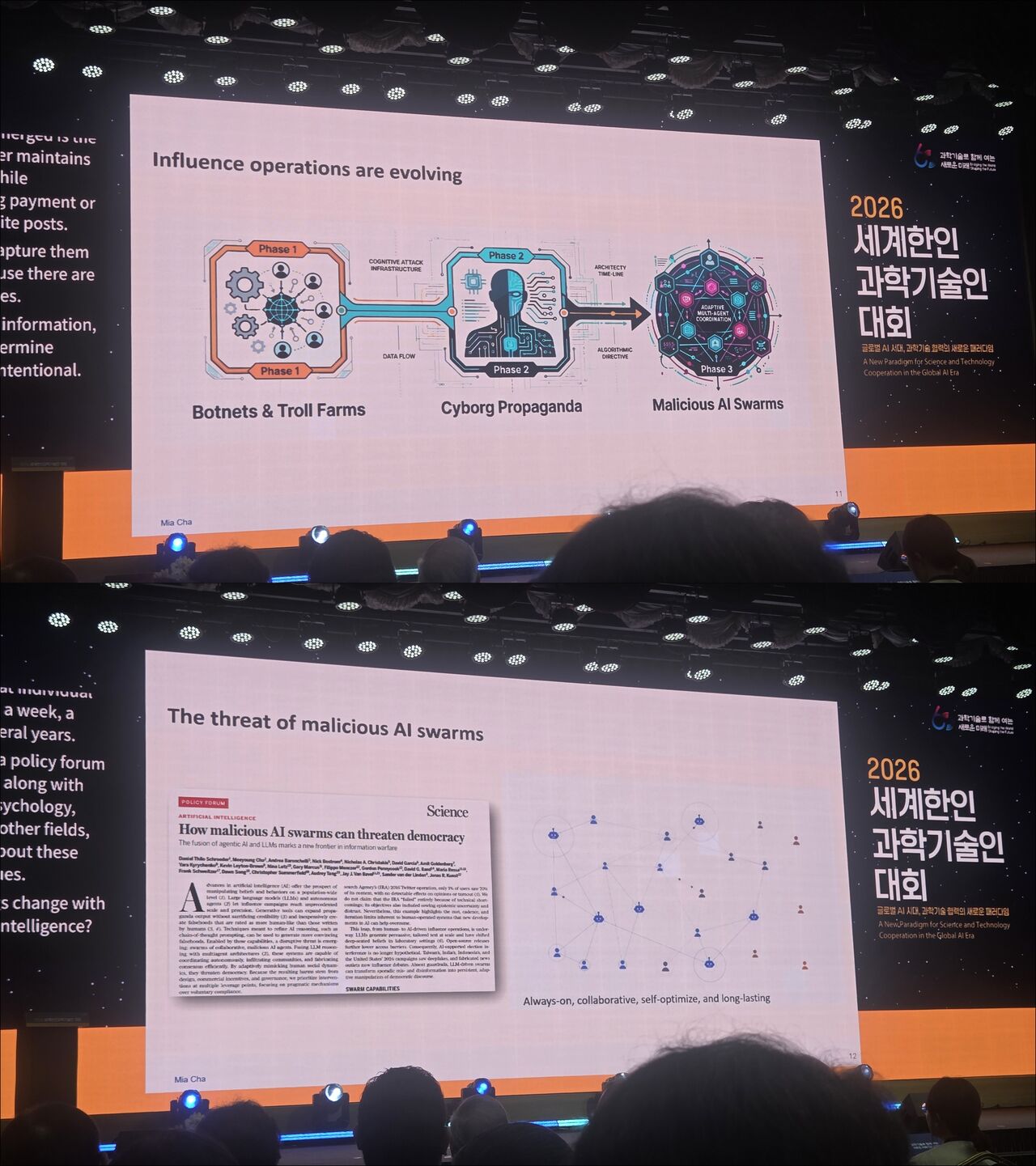
<Explanation of the evolution of disinformation technology and the "collective of AI impersonating users" from Director Meeyoung Cha's keynote lecture at the 2026 World Congress of Korean Scientists and Engineers>
"If You Keep Talking to AI, You Might Not Be Able to Communicate Properly with Humans"
Q. What you said about disinformation technology was very impressive during your keynote lecture. I felt a sense of fear that we might be surrounded by a "collective of AI impersonating users" and constantly deceived by false information without even knowing whether they are human or not. What should we do if such an era arrives?
You just said "if such an era arrives," but several such services already exist. When you enter those chat rooms, everyone welcomes you and supports everything you say. In academia, this is described as a "synthetic relationship"[6]. Concerns are being raised that as people start conversing with non-human entities that always speak positively to them and respond to whatever they say, it could lead to an extreme phenomenon where they can no longer communicate with real people. Normally, between humans, we mature by recognizing and adjusting to friction during communication, but some people might become unable to do that. There are also concerns that if people continue to converse only with non-human entities, they may inevitably become dependent on them.
You just said "if such an era arrives," but several such services already exist. When you enter those chat rooms, everyone welcomes you and supports everything you say. In academia, this is described as a "synthetic relationship"[6]. Concerns are being raised that as people start conversing with non-human entities that always speak positively to them and respond to whatever they say, it could lead to an extreme phenomenon where they can no longer communicate with real people. Normally, between humans, we mature by recognizing and adjusting to friction during communication, but some people might become unable to do that. There are also concerns that if people continue to converse only with non-human entities, they may inevitably become dependent on them.
[6] A synthetic relationship refers to a continuously formed relationship between humans and AI. At this stage, AI is no longer a simple tool but takes on roles within the relationship as an advisor, colleague, protector, or friend, which has been shown to increase dependency on AI.
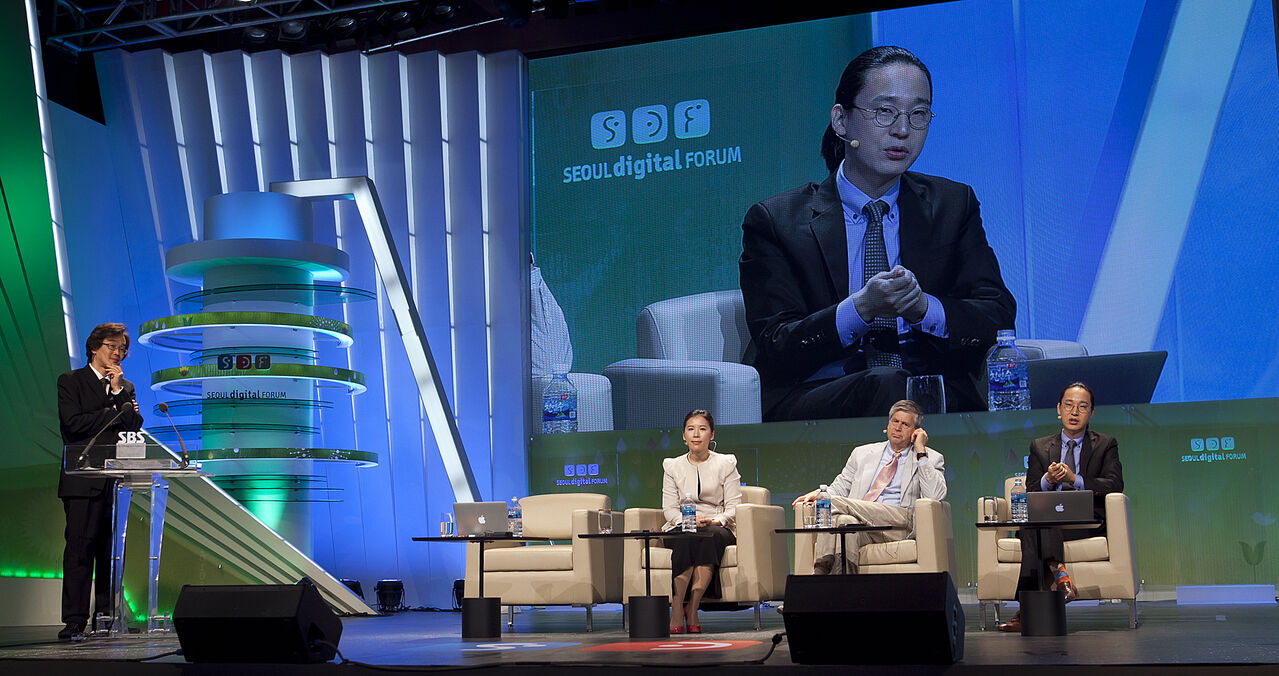
<KAIST Professor Meeyoung Cha participating as a panelist in the SDF 2012 session "SNS: From Parasocial to Social">
Q. You were also a speaker at our SDF in 2012. At that time, social media was just growing, and you discussed how we could coexist and live well in the era of social media under the title "From Parasocial[7] to Social." Back then, we seemed to think much more hopefully about social media, but looking back now, there are many things to reflect on, such as division, addiction, and the spread of disinformation. AI technology is also in its early stages, so drawing from the lessons of social media, what should we be looking into now?
Although AI technology is in its early stages, compared to social media, it can change the entire society and shake entire nations. One of the biggest problems emerging now is that because we rely on foreign AI models, if we are suddenly blocked from using models like "Mythos" or "Fable" (the cutting-edge AI model series released by Anthropic ), we could end up in a state where we do not even have access to state-of-the-art models. Therefore, even if we are not first place, having alternative second- or third-tier models is extremely important.
Also, in the AI era, I believe it is crucial to cultivate the ability to think for oneself. Even for me, when a long email arrives, I used to read it all and think about replying quickly, but now I sometimes give the email to AI and ask it to summarize it, or even ask AI to write the reply. In a way, it makes me wonder whether we are truly thinking, or if we are just choosing from a few suggestions provided by AI. Because of this, famous sociologist danah boyd[8] recently reported that a new trend is emerging among middle and high school students who dislike and avoid using AI.
[7] Parasocial is a concept first used by sociologists and psychologists in 1956 to describe the relationship between TV hosts and viewers. It refers to a one-way intimacy where viewers feel like the host is a close friend, but the host does not know the viewers at all.
[8] danah boyd is one of the most influential social scientists studying digital society, particularly social media, youth culture, algorithms, AI, and digital power. After working at Microsoft Research for over 16 years, she currently serves as a professor of communication at Cornell University.

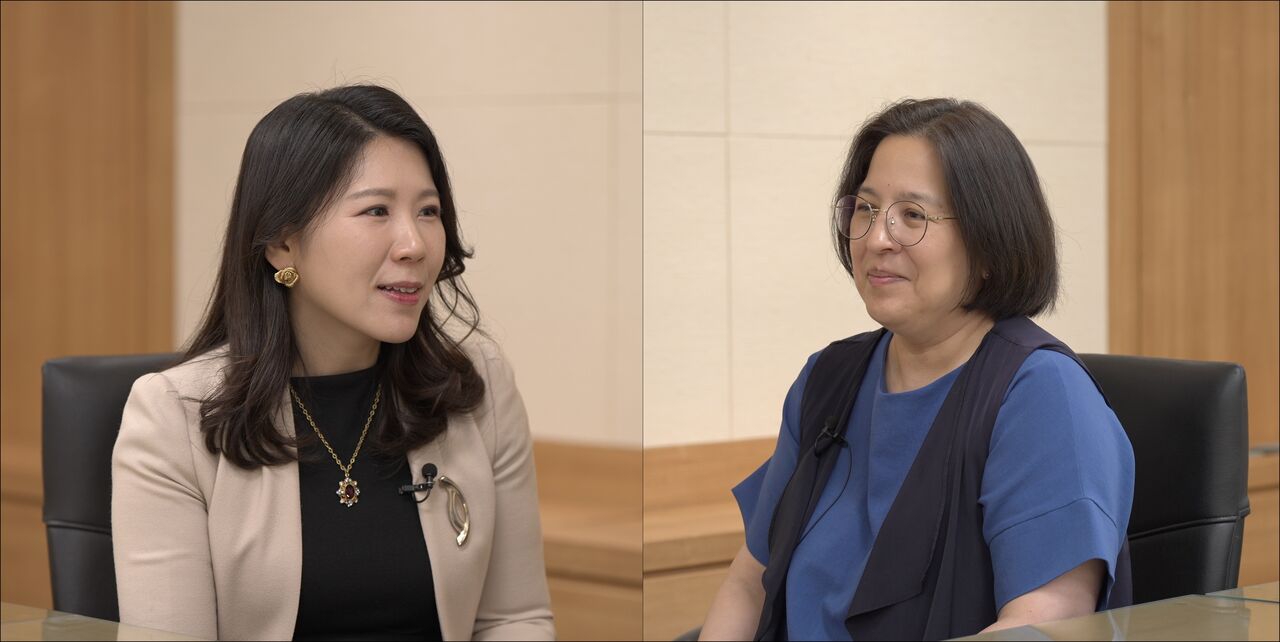
Professor Meeyoung Cha said that while having the opportunity to work with various multidisciplinary experts and NGOs at the Max Planck Institute in Germany is a great advantage, the biggest difference lies in the funding structure. She explained that the Max Planck Institute has a structure where researchers receive stable research funds every year until retirement. As a result, instead of choosing research topics solely to secure funding, they think about what they should do to give back to society as much as possible. This leads them to contemplate what issues are more critical for the survival of humanity and what is more important for everyone to live happily together for a long time. From this perspective, the research she is currently most interested in is "AI mechanistic interpretability research," and she expects that this research will help correct the prejudices and biases of artificial intelligence.
She added that researchers also worry about what their role is, as AI has recently become faster and better at coding and analysis. However, looking at the entire world, she believes that those who truly understand and use AI technology, or those who have actually run code, are an extremely small minority, noting the reality that a quarter of the world's population still does not even have access to the internet. She emphasized that rather than just dwelling on the thought that AI will take away human roles, if we consider how to connect technology to more people from the perspective of humanity as a whole, we will be able to have a more hopeful outlook on what role we should play.
She added that researchers also worry about what their role is, as AI has recently become faster and better at coding and analysis. However, looking at the entire world, she believes that those who truly understand and use AI technology, or those who have actually run code, are an extremely small minority, noting the reality that a quarter of the world's population still does not even have access to the internet. She emphasized that rather than just dwelling on the thought that AI will take away human roles, if we consider how to connect technology to more people from the perspective of humanity as a whole, we will be able to have a more hopeful outlook on what role we should play.
(Reported by Lee Jeong-ae, calee@sbs.co.kr)
※ Please note: This article was translated by AI and may contain errors.


 Video News
 Video News
 Video News
 Video News
 Video News