
 KOR
KOR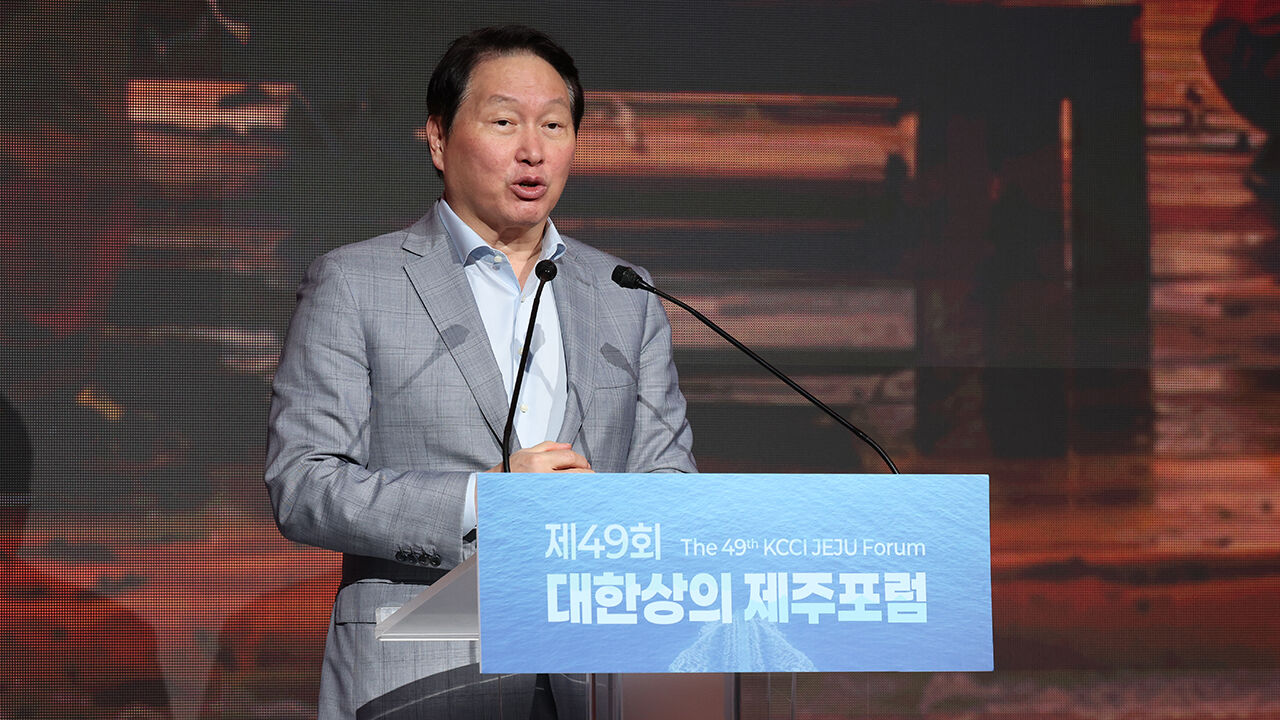
▲ Chey Tae-won, Chairman of the Korea Chamber of Commerce and Industry, delivering his opening remarks.
Chey Tae-won, Chairman of the Korea Chamber of Commerce and Industry (KCCI), addressed the explosive global demand for memory semiconductors, stating, "I am not sure if I should use the word 'pandemonium,' but I am receiving immense lobbying and pressure."
During a press conference held on the sidelines of the KCCI Jeju Forum recently, Chairman Chey stated, "Even if we limit it to artificial intelligence, there are projections that demand will increase by at least 60 to 100 percent next year compared to this year. Looking at the entire semiconductor market, we must expect an increase of at least 50 to 60 percent."
"Despite this, there is almost no increase in supply for next year," Chey explained. "Therefore, the gap between supply and demand is bound to widen much further next year than it is this year."
"It is not just companies, but governments of various countries that are concerned about national security issues," Chey added. "The situation has reached a point where they must secure memory semiconductors and provide them to companies to keep production running."
"This is a significant problem that could continue to escalate," Chey said. "While it is currently at the corporate level, there is a high possibility that governments will also begin to face pressure from other nations' governments in the future."
Regarding the recent demand from U.S. Secretary of Commerce Howard Lutnick for South Korean semiconductor companies to invest in the U.S., Chey replied, "They have been saying the same thing consistently. It is not surprising at all."
"We need to do our best to increase capacity at a rapid pace," Chey explained. "The scale must also be large. The current situation is that we are trying to build wherever we can."
He emphasized, "I believe we should build not only in the Honam region but also in the U.S. if possible. Finding the best, fastest, and largest locations across the globe, prioritizing them, and building quickly has become the lifeline of the Korean semiconductor industry."
Addressing concerns that expanding semiconductor production capacity could lead to an early end to the super-cycle, he countered from the perspective of "market normalization."
"Current prices are abnormal. They need to come down," Chey expressed concern. "Prices have already skyrocketed, and if they continue to rise and exacerbate 'chipflation,' we will inevitably face a backlash."
He continued, "Increasing supply to lower prices does not mean we cannot make money. We must protect and grow the market to maintain and develop the Korean semiconductor industry."
He also noted that it would take more time for the AI industry to secure self-sustainability.
"Right now, money is only going into building infrastructure with no output, but once that wheel starts turning, an ecosystem where AI operates autonomously will be formed," Chey explained. "We should not expect perfection from AI, which is like a four-year-old right now. Even when it grows into Artificial General Intelligence (AGI) in the future, it will still need experience."
Regarding the plan to build AI data centers worth 1 quadrillion won as part of the three major mega-projects, he expressed confidence that there would be no issues with securing clients, infrastructure, or financing.
"Building a data center means there is already a client," Chey explained. "We say a project has begun only when long-term contracts of at least 5 years and up to 15 years exist as a financing condition. Projects proceed and construction begins only when clients are found and equipment, land, and power are all matched."
Chairman Chey evaluated this project as "almost the first step toward an electrified society."
"If you calculate the total amount of data centers that need to be built every year, an enormous amount of electricity is required," Chey stated. "We have mainly used fossil fuels until now, but we are now facing the challenge of transitioning all of them."
"The costs are astronomical, but given issues like global warming, it is a situation where we have no choice," Chey said. "The government also clearly seems to believe that renewable energy alone is not enough. To this end, all base-load power sources, including nuclear power, will be considered."
(Photo: Yonhap News)
※ Please note: This article was translated by AI and may contain errors.


 Video News
 Video News
 Video News
 Video News
 Video News