
 KOR
KOR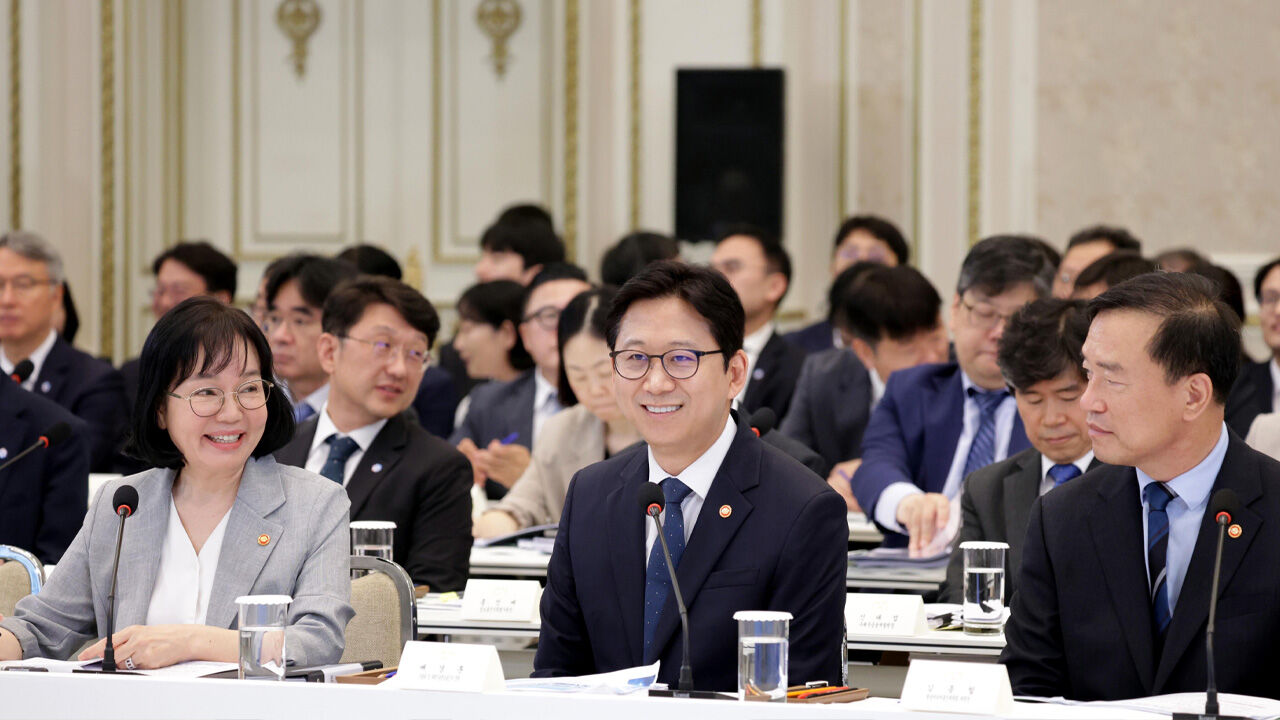
▲ Song Gyeong-hee, Chairperson of the Personal Information Protection Commission (left), Bae Gyeong-hoon, Deputy Prime Minister and Minister of Science and ICT, and Kim Jong-cheol, Chairperson of the Korea Communications Commission, are in conversation during a ministry briefing held at the Yeongbingwan of the Presidential Office on the 16th.
Bae Gyeong-hoon, Deputy Prime Minister and Minister of Science and ICT, announced today (the 16th) that the government will launch a proprietary AI model specialized in security within this year to counter cyber threats utilizing artificial intelligence.
This reaffirms the government's commitment to securing self-reliant cybersecurity capabilities amid growing uncertainties, such as U.S. restrictions on AI access.
During the ministry briefing presided over by President Lee Jae-myung at the Yeongbingwan of the Presidential Office today, Deputy Prime Minister Bae Gyeong-hoon stated, "We are pushing to create a security-specialized model within this year by training our existing proprietary AI model with additional security-related data."
Regarding the severity of AI-driven security threats, Deputy Prime Minister Bae assessed, "AI can be utilized to easily identify and exploit security vulnerabilities, so we must prepare from a defensive standpoint. While Korea possesses its own proprietary AI models, it is difficult to respond to these threats with our current level of technology."
He then presented two strategies.
In the short term, the plan is to build a security-specialized model by the end of the year by training existing models with security data. In the mid-to-long term, he suggested that the development of an advanced frontier model, comparable to the high-performance AI model Mythos developed by the U.S. AI company Anthropic, should be considered.
Deputy Prime Minister Bae emphasized, "Even though highly advanced frontier models like Mythos are not aimed solely at security, they have become capable of easily solving security problems. We need to deliberate on the development of such advanced frontier models."
Uncertainties surrounding U.S. restrictions on AI access were also a key topic during the briefing.
President Lee pointed out, "We must prepare for the possibility of being blocked. We cannot allow a situation where another country protects our security and then suddenly closes the door."
Deputy Prime Minister Bae added, "The U.S. has previously restricted and then lifted AI access, and has recently been imposing limited controls again. China is showing similar signs, so we do not know when we might be blocked."
Plans to institutionalize white-hat hacking to strengthen cybersecurity were also discussed.
Currently, the Korea Internet & Security Agency (KISA) provides mock hacking services contingent on corporate consent. However, there is a push to introduce a system that would allow for the inspection of security vulnerabilities under certain conditions, even without prior consent.
Choi Woo-hyuk, Director General for Information Protection and Network Policy at the Ministry of Science and ICT, explained, "We are currently conducting a pilot project that allows penetration testing without consent. As there is no legal basis yet, we are in the preparation stage to enable anyone to utilize such attack environments through legislation after next year."
Prime Minister Han Seong-sook suggested, "Security support for public institutions and small and medium-sized enterprises is currently limited. We need a new, prevention-oriented approach that informs them of vulnerabilities through regular inspections."
(Photo: Presidential Press Corps, Yonhap News)
※ Please note: This article was translated by AI and may contain errors.


 Video News

 Video News

 Video News