
 KOR
KOR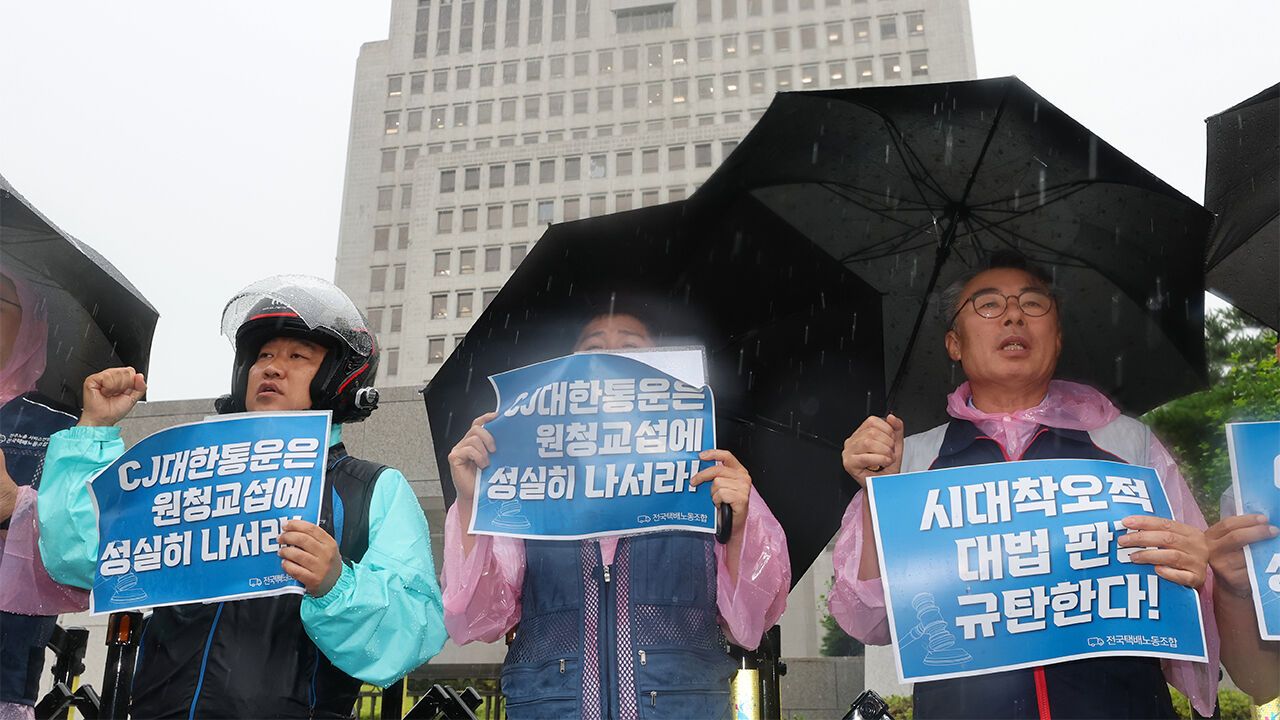
▲ Members of the Korea Parcel Delivery Workers' Union hold a press conference in front of the Supreme Court in Seocho-gu, Seoul, on the 9th, following a Supreme Court ruling that overturned a lower court decision which had deemed CJ Logistics' refusal to engage in collective bargaining with delivery workers an unfair labor practice in 2020.
Business circles emphasized that the Supreme Court ruling, which did not recognize CJ Logistics' obligation to engage in collective bargaining, has increased the necessity for revisions to the so-called Yellow Envelope Act.
The Korea Enterprises Federation (KEF) stated today (July 10), "The Supreme Court has determined that collective bargaining must be premised on an explicit or implicit employment contract, and therefore, a prime contractor without an employment relationship is not a party to collective bargaining with a subcontractor's union."
The KEF emphasized, "Although this ruling concerns a case that occurred before the implementation of the Yellow Envelope Act, it is highly significant in that the National Labor Relations Commission (NLRC) decision and lower court rulings on this case served as the core basis for the revised Trade Union Act."
According to the KEF, the NLRC previously decided in June 2021 that if a prime contractor substantially and specifically controls and determines the working conditions of subcontracted workers, it bears the obligation for collective bargaining. The KEF explained that the Yellow Envelope Act also defined the basis for collective bargaining obligations as "substantial control" based on this decision.
The KEF urged, "As the Supreme Court has reaffirmed that the basis for collective bargaining obligations is an 'explicit or implicit employment contract,' the need for supplementary legislation has grown even greater. The government and the National Assembly must take steps to revise the law, such as clarifying the scope of employers and excluding high-level management decisions, including personnel and management rights, from the scope of labor disputes."
Yesterday (July 9), the Supreme Court overturned the original ruling against the plaintiff in the final appeal of a lawsuit filed by CJ Logistics against the chairperson of the National Labor Relations Commission, in which the company sought to "cancel the retrial decision that its refusal to engage in collective bargaining was an unfair labor practice," and remanded the case to the Seoul High Court.
(Photo: Yonhap News)
※ Please note: This article was translated by AI and may contain errors.




 Video News