
 KOR
KOR
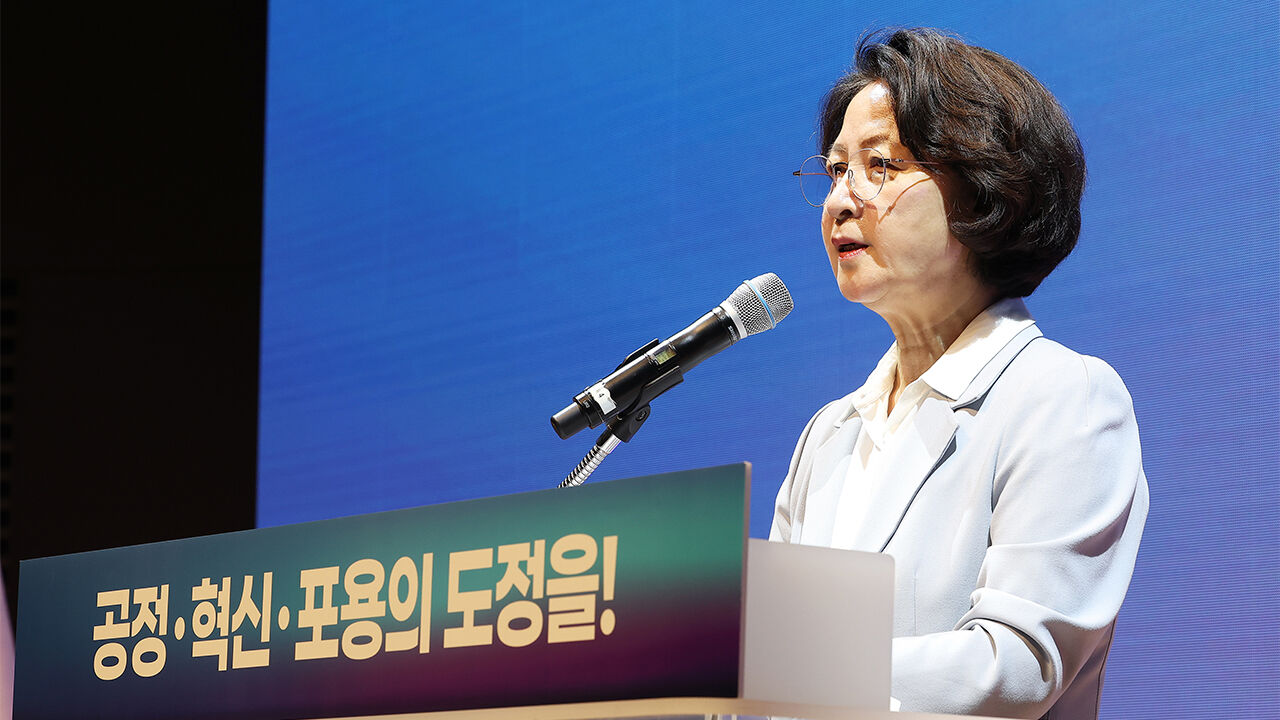
▲ Gyeonggi Province Governor Choo Mi-ae delivers her inaugural address at the Gyeonggi Provincial Government building in Yeongtong-gu, Suwon, on July 1.
Gyeonggi Province Governor Choo Mi-ae stated in a written interview with Yonhap News on July 8, marking her first week in office, "The 9th elected Gyeonggi provincial government begins with a debt exceeding 7 trillion won," adding, "I will turn this fiscal crisis into a turning point to change the constitution of Gyeonggi Province and develop it more robustly."
Regarding her top campaign pledges, the "Great Transformation for 30-Minute Commutes in the Capital Region" and the "Introduction of a Capital Region One-Pass," she emphasized, "Just because the results of the Seoul mayoral election have changed, we cannot stop the task of connecting the capital region into a single living zone," and added, "I will prioritize these as promises that must be kept, establish phased implementation plans, and proceed step by step."
The following is the Q&A with Governor Choo.
-- It has been one week since you took office as governor.
What are your brief thoughts?
[Interview] ▲ While listening to voices from the field, I once again felt the weight of the tasks facing Gyeonggi Province.
Fiscal conditions are difficult, and there are many urgent matters such as public livelihood, safety, care, and jobs.
However, my responsibility to protect the lives of the 14.2 million residents and create a better tomorrow has become even clearer.
I will build a Gyeonggi Province that is calm yet solid, where trust is built on fairness, change is created through innovation, and no one is left behind through inclusion.
-- You emphasized a comprehensive review of the fiscal structure in your inaugural address.
▲ The fiscal reality of Gyeonggi Province is grave.
The fiscal state was more serious than expected, to the point where the first report I received after being elected was the need for a supplementary budget reduction.
The 9th elected Gyeonggi provincial government begins with a debt exceeding 7 trillion won.
I will use limited financial resources on what is essential for the lives of residents first, and continue investments for public livelihood, safety, and the future in a responsible manner.
I will make this fiscal crisis a turning point to change the constitution of Gyeonggi Province and develop it more robustly.
Fiscal innovation is not about reducing numbers, but about changing how we use residents' taxes to ensure they are spent more efficiently where they are needed most.
I will open a sustainable future for Gyeonggi Province through responsible fiscal management.
-- The composition of your staff is a subject of interest.
What are your personnel principles?
▲ The 9th elected Gyeonggi provincial administration must be fair from the personnel stage.
Starting with the vice governors and chief of staff, I am carefully reviewing candidates who have the capability to not only fulfill campaign promises but also lead the overcoming of the fiscal crisis and AI-based administrative innovation.
I will evaluate them based on their capability and sense of responsibility to produce results for the provincial administration, not on personal relationships or backgrounds.
-- How will you handle organizational restructuring regarding provincial administration?
▲ I will review organizational restructuring based on how quickly and responsibly we can promote the core tasks of the 9th elected administration, rather than simply increasing departments or changing names.
As fiscal conditions are grave, I will reorganize similar and overlapping functions and lower the barriers between offices and bureaus.
-- There are concerns that your top pledges, the "Great Transformation for 30-Minute Commutes in the Capital Region" and the "Capital Region One-Pass," may face difficulties due to the election of Oh Se-hoon of the People Power Party as Seoul Mayor.
▲ The era of the "Great Transformation for 30-Minute Commutes in the Capital Region" is the first promise of the 9th elected administration that must be kept.
Just because the results of the Seoul mayoral election have changed, we cannot stop the task of connecting the capital region into a single living zone.
Transportation is not a matter of political factions, but a daily issue for citizens and residents who commute between Seoul and Gyeonggi for work and life.
The transportation rights of residents should not be swayed by who the partner for cooperation is.
I will carefully examine the implementation conditions and fiscal burdens for each project, establish priorities and phased execution plans, and proceed step by step.
-- Your first official act was the "K-Semiconductor Innovation Measures."
What fields will you focus on for future approvals?
▲ If the first approval was a "growth engine" to create future growth momentum for Gyeonggi Province through semiconductor super-gap, the second approval is to set the fiscal foundation to support that future.
That is why I launched the Fiscal Innovation Task Force. Growth is the power to open the future, and fiscal innovation is the foundation that makes that future sustainable.
-- It is predicted that the provincial administration will be helped by the Gyeonggi Provincial Assembly shifting from an "equal number of seats between ruling and opposition parties" to a "ruling party majority."
What is your relationship with the Provincial Assembly?
▲ More important than the number of seats is that the Gyeonggi Provincial Assembly faithfully reflects the will of the residents, and the executive branch realizes that will through policies and results.
Before deciding on policies, I will provide sufficient explanations and listen extensively to the local field experience and opinions of assembly members from the design stage.
I will not take minority opinions lightly.
-- The Democratic Party's leadership race is showing signs of overheating.
What is your position on this?
▲ Rather than focusing their energy on attacking opponents, candidates should be evaluated on their competence and vision regarding how to integrate the party more broadly and how to turn national administration and legislative tasks into results.
Competition may be fierce, but the result must lead to a united Democratic Party.
I hope the national convention will be an opportunity to move toward a more solid "one team," rather than a process that exhausts the party's energy.
As Gyeonggi Province Governor, I will also fulfill my responsibilities by taking care of the public livelihood and faithfully conveying the voices from the field to the party and the government.
-- It is generally assessed that you have joined the ranks of presidential candidates with your election as Gyeonggi Province Governor.
What is your position on this?
▲ I have just taken my first step after being entrusted with the grave responsibility of being Gyeonggi Province Governor.
Although I am assessed as a presidential candidate due to my career as a six-term lawmaker, Minister of Justice, and party leader, I have always engaged in politics with only one goal in mind.
I believe that politics should not be about looking at the next position, but about being evaluated by how much you change the lives of the people and residents in the position you are entrusted with.
I will pour all my capabilities into making the 9th elected Gyeonggi provincial administration a success.
(Photo: Yonhap News)
※ Please note: This article was translated by AI and may contain errors.


 Video News
 Video News
 Video News
 Video News
 Video News