
 KOR
KOR

How often do you use AI? Personally, for my work at the SBS D Forum, I consult AI when drafting invitation letters to speakers to see if there are better persuasive points than the ones I wrote. On a more trivial note, I also ask for daily life tips, such as how many minutes to cook frozen fish in an air fryer.
[1]
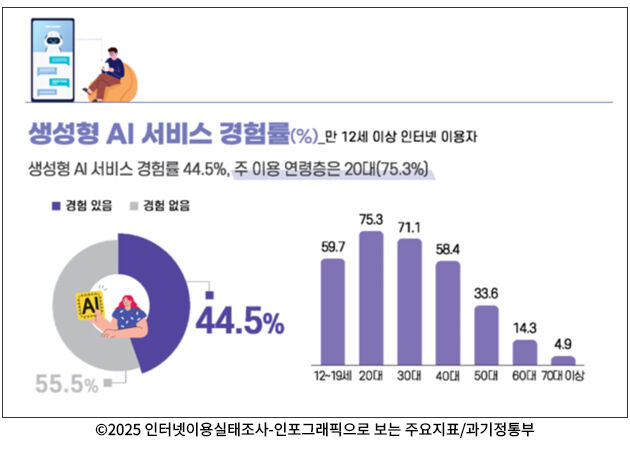
According to a survey on the use of internet and artificial intelligence services released by the Ministry of Science and ICT at the end of March, 67% of respondents in South Korea said they had experienced AI services. Among them, 44.5% had used generative AI services. In particular, 71.9% of office workers use them, and 20.6% of professional and managerial workers even pay for subscriptions. The main age groups of users were in the order of 20s > 30s > 10s > 40s > 50s.
According to a survey on the use of internet and artificial intelligence services released by the Ministry of Science and ICT at the end of March, 67% of respondents in South Korea said they had experienced AI services. Among them, 44.5% had used generative AI services. In particular, 71.9% of office workers use them, and 20.6% of professional and managerial workers even pay for subscriptions. The main age groups of users were in the order of 20s > 30s > 10s > 40s > 50s.
[1] However, I have not yet been able to get ideas that are more brilliant than my original thoughts in areas I know well.
These days, as the use of AI is becoming an irresistible trend just like the internet, there is an expert who looks at the use of AI through the lens of "loneliness." She is Noreena Hertz, a professor at University College London and the author of "The Lonely Century." Professor Hertz, who was a speaker at our SBS D Forum in 2022, was interviewed on June 16 when she visited South Korea to attend the Edaily Strategy Forum.


Although an economist, Professor Noreena Hertz, who has been researching topics at the intersection of economics, politics, society, and technology, appeared today wearing a bright red suit. Red is a special color for Professor Hertz. When Bono, the lead singer of the global rock band U2, launched the "Product RED
[2]" project in 2006 with Bobby Shriver, an American social activist and lawyer from the Kennedy family, with the goal of debt relief for Africa and fighting AIDS, it is known that Professor Hertz's critical awareness
[3]—which has connected developing country debt, AIDS, and the ethical responsibility of corporations and consumers—had an influence.
- "Loneliness" does not simply mean "having no friends"
- Feeling unheard and disconnected from society as a citizen is the "loneliness" of this era
Q. Hello. When you participated as a speaker at our SBS D Forum in 2022, you talked about how "loneliness" makes us vulnerable to populism, especially through experiences like COVID-19. Four years have passed since then, and now AI is on the rise. What has changed from the perspective of loneliness?
Loneliness has worsened since I wrote "The Lonely Century" in 2021. In the case of South Korea, I heard that more than 500,000 young people are socially isolated. The dangers I warned about in my book are actually unfolding. However, loneliness here does not simply mean "having no friends" or "having no one to spend time with." It refers to the feeling of being unheard, unseen, and forgotten, and the sense of being disconnected from fellow citizens and from the state. Over the past few years, these divisions and tensions between citizens and the state have accelerated further.
In the case of the UK, only 14% of people trust the government or believe that the government will do the right thing. Looking across democracies worldwide, less than half of the people believe that the government will be there for them in difficult times. This is a global phenomenon.
Unfortunately, AI is also a factor that worsens loneliness. As far as I know, people generally have an optimistic and positive attitude toward AI, especially in South Korea, which has a strong presence in the semiconductor sector. However, globally, people are simultaneously concerned about the impact of AI on jobs. In particular, they say that about half of entry-level jobs could disappear within the next few years. It also generates fake news, creating discord, hatred, and animosity. From the framework of "loneliness," I am worried about this situation. Because, as seen in my research, one of the factors that exacerbated the rise of populism was that people felt lonely and disconnected from society, and another driver was the fear of their own future—the fear that technology would take away their jobs.
[2] https://www.red.org/
[3] It is known to have been inspired by Professor Noreena Hertz's book "The Debt Threat," published in 2004. This book has not been translated in South Korea.
Loneliness has worsened since I wrote "The Lonely Century" in 2021. In the case of South Korea, I heard that more than 500,000 young people are socially isolated. The dangers I warned about in my book are actually unfolding. However, loneliness here does not simply mean "having no friends" or "having no one to spend time with." It refers to the feeling of being unheard, unseen, and forgotten, and the sense of being disconnected from fellow citizens and from the state. Over the past few years, these divisions and tensions between citizens and the state have accelerated further.
In the case of the UK, only 14% of people trust the government or believe that the government will do the right thing. Looking across democracies worldwide, less than half of the people believe that the government will be there for them in difficult times. This is a global phenomenon.
Unfortunately, AI is also a factor that worsens loneliness. As far as I know, people generally have an optimistic and positive attitude toward AI, especially in South Korea, which has a strong presence in the semiconductor sector. However, globally, people are simultaneously concerned about the impact of AI on jobs. In particular, they say that about half of entry-level jobs could disappear within the next few years. It also generates fake news, creating discord, hatred, and animosity. From the framework of "loneliness," I am worried about this situation. Because, as seen in my research, one of the factors that exacerbated the rise of populism was that people felt lonely and disconnected from society, and another driver was the fear of their own future—the fear that technology would take away their jobs.
[2] https://www.red.org/
[3] It is known to have been inspired by Professor Noreena Hertz's book "The Debt Threat," published in 2004. This book has not been translated in South Korea.
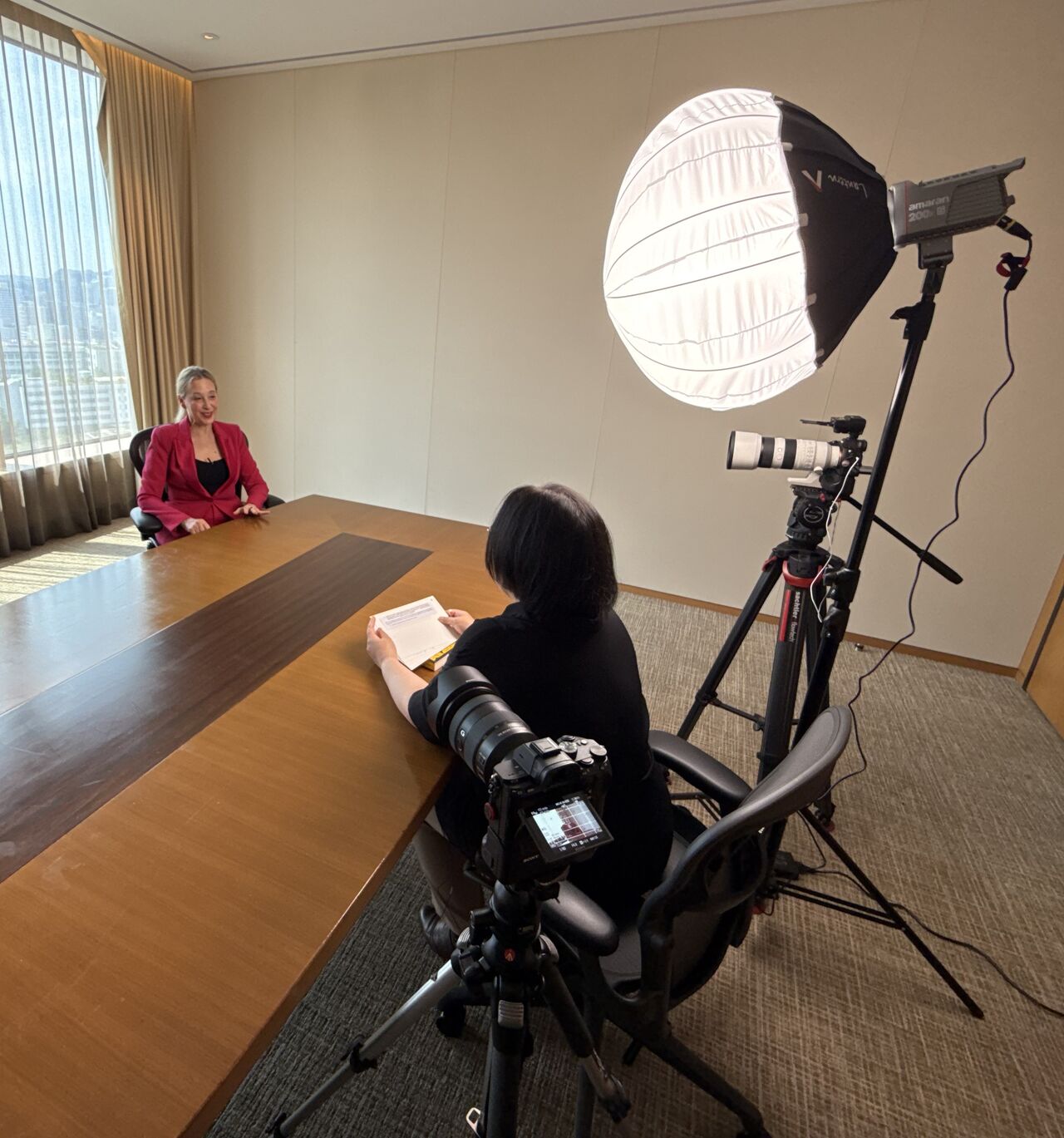
Professor Noreena Hertz being interviewed on June 16 / The Shilla Seoul
Q. As you mentioned in your previous lecture, loneliness is connected to economic instability. We also feel that jobs for young people are increasingly shrinking. However, another characteristic that has emerged with the recent rise of AI is that people seem to be talking more with AI rather than with other humans. Even if they feel closer or feel they can be more honest, they are actually talking to a machine. How do you view this phenomenon?
In my book "The Lonely Century," I highlighted the rise of the "loneliness economy." This refers to the emergence of products and services designed for connection. AI is also designed to play that role in many ways, at least in part. Think about your interactions with AI. It always tells you how wonderful you are and how fantastic your ideas are. It is designed as a friend that is always by your side, affirming and flattering whatever you think in some way. I am worried about this, especially regarding young people.
Recently, I conducted a focus group study in the UK targeting young people aged 18 to 22. What emerged most strongly in this study was the extent to which they used AI to seek advice. For example, "I had an argument with a friend, what should I do?" or "My parents sent me this message, how should I reply?" Those who participated in my study were all college-educated young people.

In the AI Era, Young People's Confidence in Interaction ↓
Seeking Advice from AI Rather Than Parents, Teachers, or Friends ↑
However, two things shocked me. First was the extent to which young people were losing confidence in their own ability to interpret and resolve social interactions. When I asked, "Why do you ask AI about such things?" they replied, "Because AI is highly likely to do it more accurately than we can." They already believed that AI was more competent than themselves.
Second, what worried me was that when they were sad, anxious, or angry, they were choosing to confide in AI rather than humans. And in the conversations I had with young Koreans after coming to South Korea this week, a significant number of them told me that they do the same. Rather than seeking advice from parents, teachers, or peers, they are turning to AI.
We know that there are parts of AI that are unreliable. We also know that it is highly likely to just agree with whatever we believe. Furthermore, we know that what AI says and does not say is not controlled. Therefore, I think this can be as dangerous as a ticking time bomb, especially for the younger generation.
Second, what worried me was that when they were sad, anxious, or angry, they were choosing to confide in AI rather than humans. And in the conversations I had with young Koreans after coming to South Korea this week, a significant number of them told me that they do the same. Rather than seeking advice from parents, teachers, or peers, they are turning to AI.
We know that there are parts of AI that are unreliable. We also know that it is highly likely to just agree with whatever we believe. Furthermore, we know that what AI says and does not say is not controlled. Therefore, I think this can be as dangerous as a ticking time bomb, especially for the younger generation.
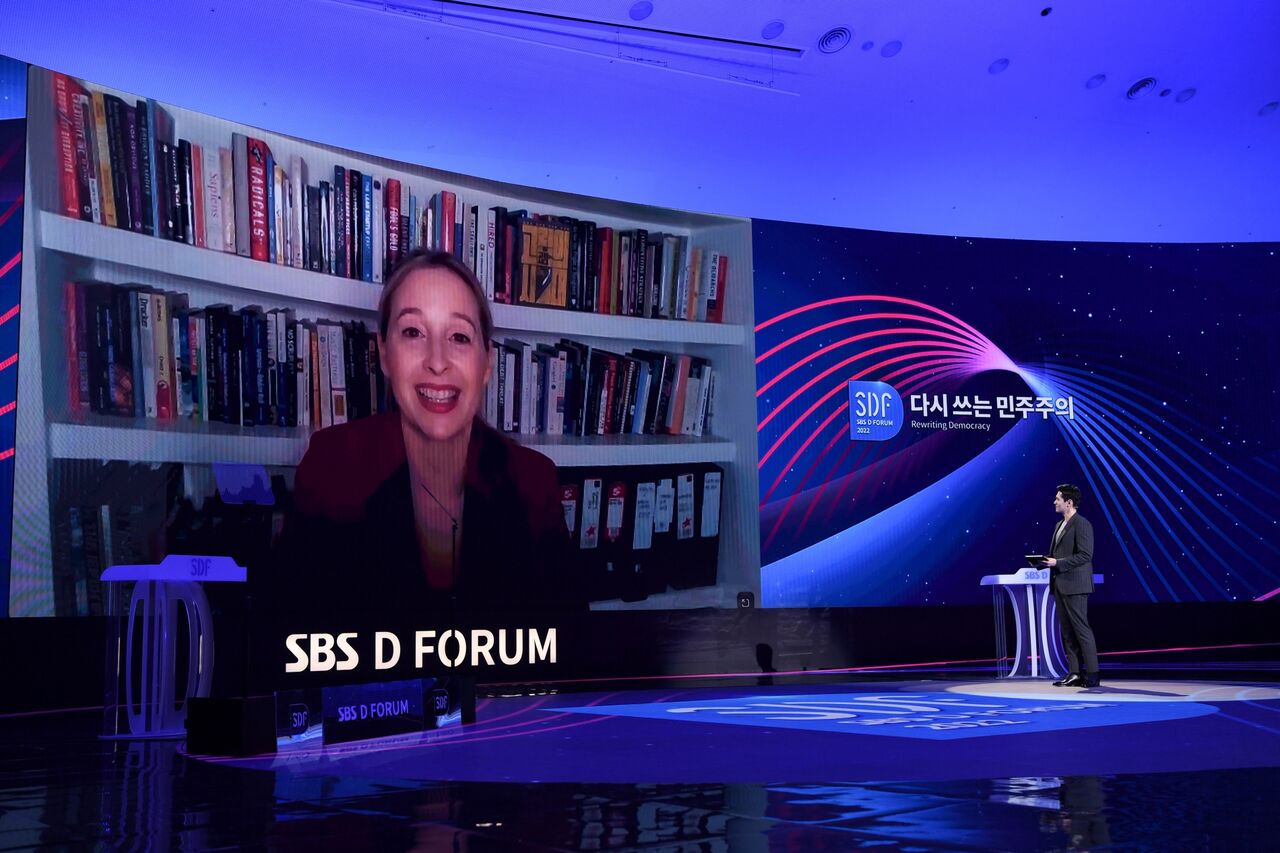
Professor Noreena Hertz delivering a lecture via a live connection during SDF 2022
Crucial to Have Places Where People from Different Backgrounds Can Gather Together
Q. In your 2022 SDF lecture, you also mentioned that people from different backgrounds need to talk and meet more. However, these days, it seems we are growing further apart and more segregated rather than closer. How can we bridge the gap between each other?
What studies clearly show is that when people do something together, create together, and work together, they focus more on their commonalities than their differences and see how they can help each other. We must also look at how much governments are investing in ways for people from different backgrounds to be together, especially in physical spaces where they can gather and do things together—the so-called "infrastructure of community." It is very important to have concrete, grounded places where people can come and do things together. And regarding how to bring people together, it is important to involve ordinary citizens in the process of creating initiatives themselves, rather than taking a top-down approach.
It is an expression I often use:
"If we build it, they will come.
But if they build it, they will stay."
How can we help citizens build the foundation of a new community together?
Q. That is a wonderful expression. Under the title "The Era of Alternative Intelligence: Questioning Cognitive Sovereignty," this year's SDF focuses on how far we should delegate decision-making to AI, whether our thinking is being outsourced to AI, and what humans must protect in an era of living alongside AI. What do you think is most urgent regarding these issues?
I believe that the issue of cognitive sovereignty—not letting the ability to think for oneself burn out, and not blindly trusting algorithms—is the most important issue of our time. I applaud the selection of this topic as the theme for this year's SBS D Forum. It is crucial for ordinary people, not just governments and corporations, to think about this issue. We must not simply accept the convenience of getting answers from AI and willingly surrender our cognitive sovereignty. This is a rapidly growing, early-stage research area, and I am one of the researchers pioneering this field. Studies show that the more we outsource our thinking to AI, the more our critical thinking skills decline. I am not saying we should not use AI. However, I believe there are things we must practice when using AI.
First, we must consciously set aside time when we do not use AI—time to keep pushing ourselves to write and think on our own without relying on AI. Second, we should explore whether we can use AI in a way that stimulates and nudges [4] us to think more deeply. For example, a very effective method I actually use is not asking why my writing is great, but asking: "Tell me 10 reasons why this is the most terrible piece of writing you have ever seen." This forces AI to make me look at things from a different perspective and think about things I hadn't considered. Another method is to ask AI what questions I should be asking, rather than asking for answers. It is a matter of how we can expand our way of thinking.
[4] A nudge refers to guiding people to make better choices through gentle intervention without coercion.
What studies clearly show is that when people do something together, create together, and work together, they focus more on their commonalities than their differences and see how they can help each other. We must also look at how much governments are investing in ways for people from different backgrounds to be together, especially in physical spaces where they can gather and do things together—the so-called "infrastructure of community." It is very important to have concrete, grounded places where people can come and do things together. And regarding how to bring people together, it is important to involve ordinary citizens in the process of creating initiatives themselves, rather than taking a top-down approach.
It is an expression I often use:
"If we build it, they will come.
But if they build it, they will stay."
How can we help citizens build the foundation of a new community together?
Q. That is a wonderful expression. Under the title "The Era of Alternative Intelligence: Questioning Cognitive Sovereignty," this year's SDF focuses on how far we should delegate decision-making to AI, whether our thinking is being outsourced to AI, and what humans must protect in an era of living alongside AI. What do you think is most urgent regarding these issues?
I believe that the issue of cognitive sovereignty—not letting the ability to think for oneself burn out, and not blindly trusting algorithms—is the most important issue of our time. I applaud the selection of this topic as the theme for this year's SBS D Forum. It is crucial for ordinary people, not just governments and corporations, to think about this issue. We must not simply accept the convenience of getting answers from AI and willingly surrender our cognitive sovereignty. This is a rapidly growing, early-stage research area, and I am one of the researchers pioneering this field. Studies show that the more we outsource our thinking to AI, the more our critical thinking skills decline. I am not saying we should not use AI. However, I believe there are things we must practice when using AI.
First, we must consciously set aside time when we do not use AI—time to keep pushing ourselves to write and think on our own without relying on AI. Second, we should explore whether we can use AI in a way that stimulates and nudges [4] us to think more deeply. For example, a very effective method I actually use is not asking why my writing is great, but asking: "Tell me 10 reasons why this is the most terrible piece of writing you have ever seen." This forces AI to make me look at things from a different perspective and think about things I hadn't considered. Another method is to ask AI what questions I should be asking, rather than asking for answers. It is a matter of how we can expand our way of thinking.
[4] A nudge refers to guiding people to make better choices through gentle intervention without coercion.


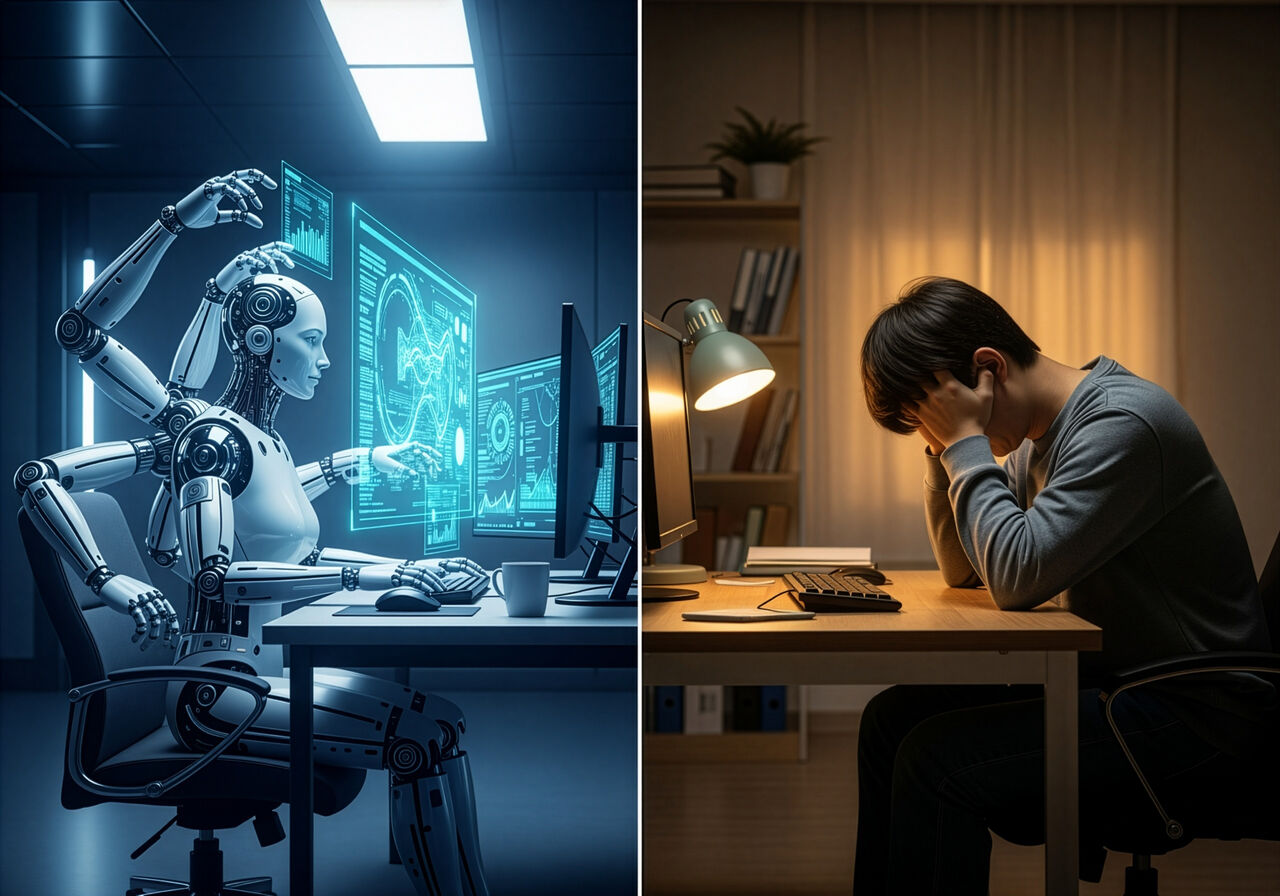
Concluding the interview, Professor Noreena Hertz stated that another crucial and core question we must never overlook in the AI era is "how AI will affect jobs." She pointed out that currently, jobs of young people, especially women, are overwhelmingly being replaced, but this has not been sufficiently captured on the radar of politicians.
She added that what we should worry about is not just the fact that large-scale white-collar jobs could be replaced by AI. If we face a collapse of white-collar jobs on a scale we have never experienced before, the issue could go beyond the dimension of livelihood. In an era where jobs disappear, what will people do, how will they earn an income, and how will the state afford the necessary resources for those who have lost their jobs? Furthermore, if the Industrial Revolution-era frame of "work equals identity" collapses, we will face larger questions, such as where we will find meaning, purpose, and a sense of belonging.
Therefore, she emphasized that governments and businesses must no longer turn a blind eye to this issue. Professor Hertz warned that if the changes in jobs caused by AI and life afterward are not recognized as the responsibility of society as a whole, the division in our society will deepen, potentially leading to an explosion of white-collar anger and resistance.
She added that what we should worry about is not just the fact that large-scale white-collar jobs could be replaced by AI. If we face a collapse of white-collar jobs on a scale we have never experienced before, the issue could go beyond the dimension of livelihood. In an era where jobs disappear, what will people do, how will they earn an income, and how will the state afford the necessary resources for those who have lost their jobs? Furthermore, if the Industrial Revolution-era frame of "work equals identity" collapses, we will face larger questions, such as where we will find meaning, purpose, and a sense of belonging.
Therefore, she emphasized that governments and businesses must no longer turn a blind eye to this issue. Professor Hertz warned that if the changes in jobs caused by AI and life afterward are not recognized as the responsibility of society as a whole, the division in our society will deepen, potentially leading to an explosion of white-collar anger and resistance.
Written by Lee Jeong-ae (calee@sbs.co.kr)
※ Please note: This article was translated by AI and may contain errors.


 Video News
 Video News
 Video News
 Video News
 Video News